
Julião Sarmento’s exhibition Some Limits of Reason—consisting of nine new mixed-media paintings and three installations—explores once again the artist’s trademark imagery: a sexy, headless mannequin-like woman clothed in a strapless black dress, naked or in a short black skirt, appears sitting, standing, or kneeling over antique chairs and tables.
The installations are made of life-sized sculptures of female figures cast in resin and fiberglass, and readymade pieces of furniture. In them, the headless female mannequin crouches naked under a table, leans over a table wearing her black dress or stands among rows of old chairs. The installations maintain a close dialogue with the black and white paintings, which also depict the incomplete female figure among tables and chairs. Sarmento applies white paint unevenly on the surface of the canvases, drawing and painting in mixed media the women’s silhouette and the furniture. He effaces and erases parts of the black outlines, leaving their smudged marks on the surface of the canvases, and offers the viewer the sense of an unfinished painting, like a work in progress. The erased lines also recall the idea of marks, fragments, memories, and traces that evoke a limit to be crossed or a boundary to be transposed or transgressed. And transgression is exactly the recurrent subject of Sarmento’s work.
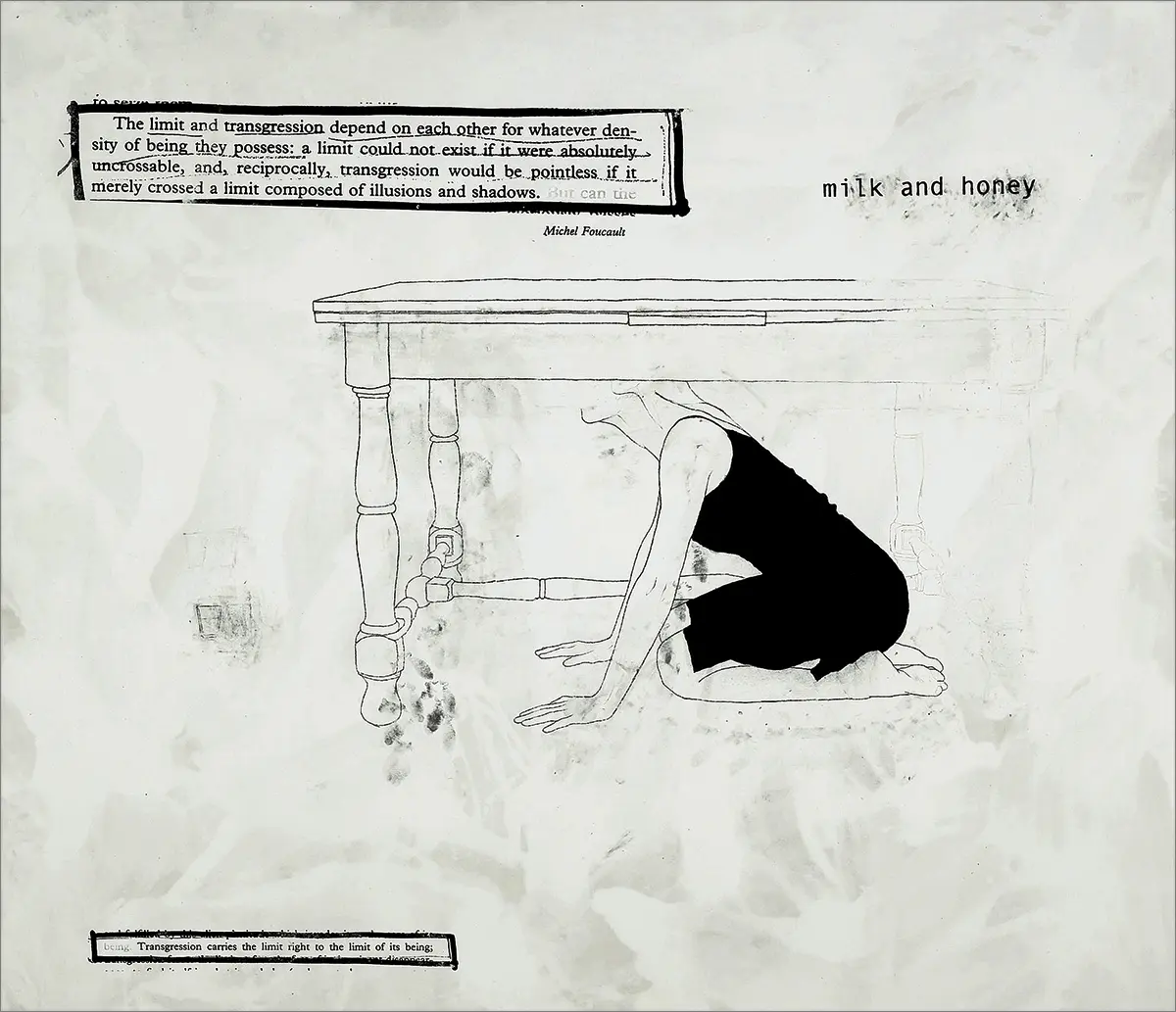
Sarmento’s new works suggest sexuality, transgression, desire, eroticism, and mystery. In these latest paintings, image and text are intertwined, emphasizing the veiling and unveiling of the mystery around this lonely, sexy female figure lying among the pieces of furniture. The fragmentary text silk-screened on the canvases is from a posthumously published essay by Michel Foucault on Georges Bataille. It explores Bataille’s ideas on sexuality and transgression. Parts of the text are also erased and most of it is outlined and carries the reader’s notes, like a book that has been carefully read. The titles are inscribed in the paintings and they are also sexual in nature, for example: Kiss me, Kiss my eyes, Milk, and honey, Behind your eyelids, and I love you.
Sarmento was born in Lisbon in 1948 and has exhibited extensively worldwide. In these works, his fascination with the territory of desire is explored through the suggestion of transgressed boundaries; the necessity of surpassing limits; or the idea that lines exist to be crossed. Sarmento quotes Foucault in one of his paintings titled Milk and Honey (2004): “... a limit could not exist if it was absolutely uncrossable, and reciprocally, transgression would be pointless if it merely crossed a limit composed of illusions and shadows.” In that painting, a faceless sensuous woman wearing a black dress is crouching under a table. In an installation entitled Milk and Honey (under the table) (2004), a naked, headless, mannequin-like woman, made of cast resin and fiberglass, also crouches under a wooden table. Over the table, there are two half-filled glasses—one with milk and the other one with honey. Like the wooden table, all the pieces of furniture in this exhibition originally belonged to the artist’s grandmother and have emotional associations with him. Sarmento never fully completes the figures or silhouettes of these women and they usually convey a feeling of longing, loneliness, and unfulfilled desire. In his works, there is always a line to be crossed between explicit aggressive sexuality and implicit erotic sensuality and it is open to the viewer to decide how much the artist knew and loved these women, or how much he despised and hated them and treated them merely as images of his erotic fantasies. There is definitely a feeling of voyeurism and fetishism underlying Sarmento’s pieces, given that the women appear to be inaccessible and untouchable objects of love and desire. His work can be seen as violent sublimated attempts against these women, or simply as poetic evocations of love for the women in his life. The obsessive, inexplicit, ambiguous, and sometimes disturbing suggestions evoked by the work are also the source of its strength. As Sarmento quotes from Foucault, “Transgression carries the limit right to the limit of its being.” It becomes almost tautological to read these images under Foucault’s analysis of Bataille’s ideas on sexuality and transgression.
Whether these ambiguous, suggestive images of painted and sculpted, naked or clothed, headless female figures crouching under the table or leaning over chairs come from an aggressive misogynist imagination or are beloved symbols of general and unspecific desire remains an open question.
CLAUDIA CALIRMAN