Nine drawings, a three-component installation, and a video piece comprise Lucía Warck-Meister’s untitled exhibition at Annina Nosei gallery (the artist is represented by Haim Chaim gallery.) All Warck-Meister’s shows display a delicate intellectual sensibility, in a subtly structured physical development; what seems soft is not diluted, and what appears almost transparent to the eye is not devoid of possible readings. In this sense, the show does not need a title. The artist’s name serves that purpose, it speaks and doesn’t speak, it constructs and deconstructs, it defines and doesn’t define, it outlines and blurs.
Visual and conceptual resources intertwine in Warck-Meister’s work, in a deconstructive vision that could pass as anonymous even as it is loaded with uncertainty, with Argentinean history and German descent. Divisions by country and nationality are no longer defining elements for the creative capacity of today’s art, but they are agents that nourish the artist’s context, articulated in the work as triggers. The show brings together an effort to alter traditional visual art manifestations and the mise en oeuvre of moments in the history of art. In their de-mounting, we perceive contemporary society’s poles of misencounter. A global and anguished society, a society that assumes development and freedom yet intensifies extremism and a loss of quality of life. A society where liberties are used erroneously, generating oppression. For every universal reader who reads this note, this is true in the global context. For those who know Argentinean history in-depth, such is the reality of a country that knows of barbed wire, torture, and very small and very dispersed little spheres of hope (sometimes fleeting, false illusions like the misleading sheen of the glass beads offered to indigenous peoples in the era of conquest.)
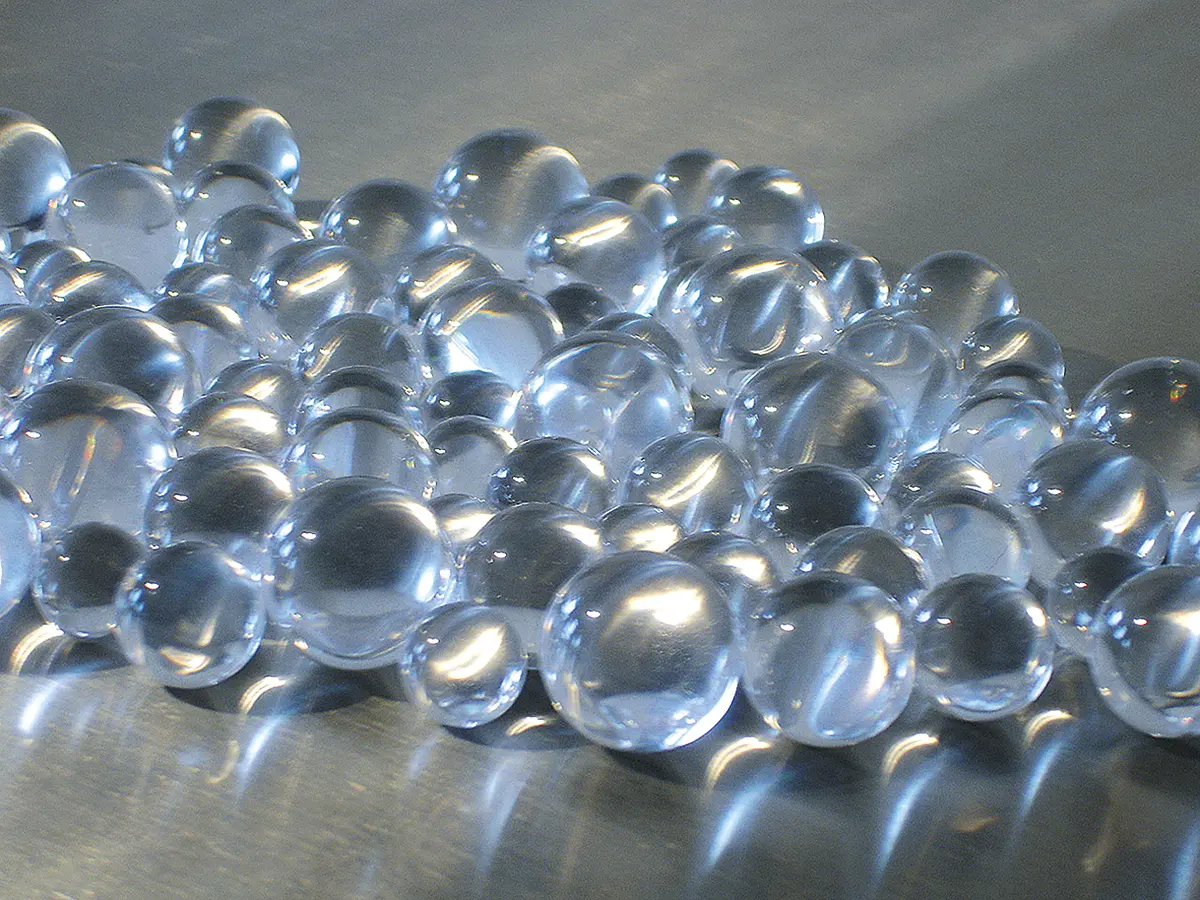
FLUX is an installation in three sections —each credited with an independent existence—, placed in a corner of the gallery space and taking over a good part of the floor. The installation, resolved in aviation cables, wire, and glass balls, attends to the interaction of opposite concepts such as life and death, light and shadow, prison and liberation, movement and fixed articulation, and torture and recovery. The gray cable and the wire bring forth different visual textures, and different grays, and are unexpectedly inhabited by those small round glass satellites. In those very discreet instants when line meets sphere, the gray cable is even grayer and more lifeless, in opposition to the shine, light, energy, and transparency of glass. Each entity projects shadows on the walls and the floor, and in this way the piece is one and at the same time many. Each piece is an individual and its persecution. With its curves, FLUX locates itself on the plane of the obsessive ideas that govern the labyrinth. It is impossible to detect in either the installation of the drawings a beginning or an end; there are instead infinite vestiges of human action. Alluding to the concept of the loop, the video piece registers fluidity and sensuality, while referring to spatial undefinition and to mirrors, two characteristic elements in the work of Lucía Warck-Meister. In general, this show —like others by the artist— does not offer a beginning and an end, but endlessness, in works that seem gestated and activated both through magnetic fields and delicate human actions.
The gesture, gesturality itself, is a pertinent reading of the installation, the drawings, and the video piece. The show as a whole speaks of gestures past and the quietude they imply once exposed. Activity and rest are intertwining vectors between drawings and video, between installation and drawings. There is a magnet, an incentive to go from pole to pole, both between the works and in the museography. The positioning of the pieces in the gallery creates a silent ping-pong from corner to corner between the monitor that projects the video and the suspended installation; these works whisper oppositions of technique and materials. Meanwhile, the two-dimensional presence of the nine drawings on the wall, tense on their side and their right angles, stands in opposition to FLUX’s tangle of interspaces and lines, and to the invisible action of tolling the glass balls that inhabit the video.
The work of Lucía Warck-Meister, which is abstract, is boldly symbolic, invasive, and corrosive. It is not based on direct representations of reality, but alludes to it in contemporary ways, carrying out analytical dismounting. It is consistent with the symbolic attention to social phenomena in recent Argentinean history. An interesting reading of the installation emerges from the notion of “connecting the dots…”: the equivalent Spanish expression, atar cabos, is used to mean the act of connecting ideas to arrive at a conclusion. From certain angles, those labyrinthine movements in wire form organic shapes. This is evident in the vertical section of the installation, which is suspended from the ceiling, in what would be “the hanged,” an organic entity suspended in decomposing humanity. While many works by other artists do not attend to such symbolism, FLUX does activate it (what I mean is that not all works suspended from the ceiling resembled hanged beings.) One of the sections of the installation, located on the floor, confirms this virtual approach to an organic volume, a large carved mass, and a small carved mass: veins, nerves, muscles; eventually they come to form the apparition of a pregnant woman, like a giant breastless Lespugue or Willendorf.
When one looks at the pieces in FLUX from a certain distance (three to five meters,) the little glass balls are not visible in the whole installation. Similarly, we can’t see from that vantage point the dollops of glue and other luminous agents that the artist placed on her charcoal-on-paper drawings. All her works have been and are spatial challenges, some are physically penetrable, and others are closed but can be visually entered in different ways. The articulation of opposites also manifested as acceptance and rejection, is verified in the drawings as the general and the detailed; silent from a distance, communicative from up close, from a distance gray anonymity with some dark curves, up close charcoal on paper, directly mounted on the wall. Does it make sense to move back and forth while contemplating charcoal drawings? Yes, the artist has established a kind of tacit code: one must commit oneself or remain outside. When upon coming up close one detects those polymer applications, those fields of light that are hidden from a distance, they induce us to think that the artist believes that participation possesses moments of luminosity.
Una historia nuestra, 2004, is a 5-minute-36-second video that confirms the sensation of attraction and rejection inhabiting Lucía Warck-Meister’s work. It appears to be the playful action of glass spheres on a gray mirror-like surface, emphasizing the fact that this is the show’s most dynamic medium and supports the thesis, the range of hues, and the contradiction between what shines and what lacks light that is also found in the drawings and the installation. Chance…, magnetized field, the spheres approach and attract, clash with, and reject each other. An elaboration on risk and certainty, about abyss and serenity, about making decisions.
Occasionally, readers ask whether what a critic writes is a free interpretation or emerges from declarations by the artist. The answer is: both. In this case, a confirmation that the work of the analyst and the perceptions of the viewer coincide with the artist’s concerns can be found in something said by Lucía Warck-Meister, regarding the current show: “Sensuality is opposed to repulsion and rejection. We are seduced physically but immediately a sensation of intellectual asphyxia overcomes us. Building and destroying are contradictions, but they also complement each other.” In the labyrinth of oppositions, in an always alive post-conceptualization, Lucía Warck-Meister and other artists of her generation have given another turn to the screw of extra-artistic materials, generating new bodily languages and expanding our senses. Thus, opposite materials —charcoal and synthetic glue, a natural and an industrial material— gesture and intertwine with a fluidity all of their own. This artist brings to the fore the transformation of postmodern aesthetics.
GRACIELA KARTOFEL