Like almost all members of the artistic avant-garde, Mirta Cerra Herrera (Bejucal, Havana, 1904) went through academic education. She emerged as honors graduate from Havana’s centenary San Alejandro Fine Arts Academy, which held impressionism as the most advanced artistic style or movement in its repertoire, and drawing, painting, and sculpture as the only disciplines to be taught and learned. While at the Academy, however, the budding avant-gardist also created magazine covers that clearly expressed her affiliation to art-deco and mechanism, as can be observed in original pieces dated 1930 and 1933, respectively, presented as part of Mirta Cerra: entre lo clásico y lo Moderno, an individual exhibition at the Museo Nacional de Arte Moderno’s Cuban Art building on the occasion of the artist’s centennial.
Following the maxim of “Rules need to be known before they can be broken,” on the year of her graduation (1934,) rather than traveling to Europe —at the time seen as the undisputed art Mecca and a mandatory destination for young artists who wanted to develop and adopt the new tendencies— Cerra chose to apply for a scholarship to New York’s Art Students’ League. Also, at the New York school, Cerra took classes in engraving, something unheard of for a Cuban woman at the time; the lessons learned there were evident in the lithographs and etchings shown at the recent retrospective show at the MNBA. Several of those works show scenes of urban life in the Big Apple, with its long-time denizens, its vigorous builders, and, as a background, the imposing architecture of its skyscrapers, establishing a vertical counterpoint to the oblique lines of the workers’ bodies and the construction materials, an interplay of visual tensions indebted to the dynamic system of line-forces promoted by Futurism.
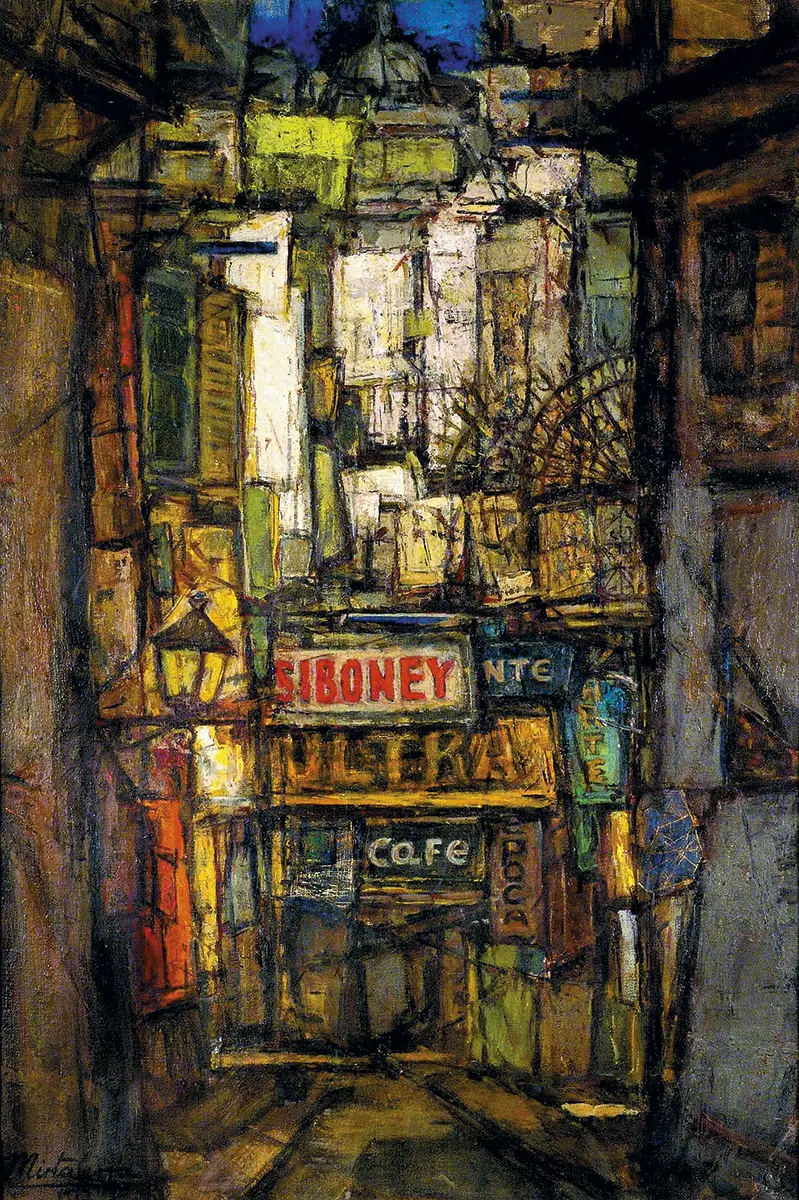
After returning to Havana, Cerra worked on her sculptures and won many awards at fine arts salons (1937, 1938, and 1941). Soon afterward, however, she abandoned sculpture altogether and took up painting, a discipline in which she was also to excel and win numerous awards. Yet, during this pictorial-figurative period of her career, she represented Cuban peasants or guajiros extensively (a theme also present in the retrospective,) and architecture was a recurring presence that needs pointing out. It was no longer the modern buildings the artist had encountered in New York, but the old, more human-scaled constructions of Old Havana, seen through the resources of modernity as conciliated by the academic métier. Thus, Cubism’s condensation of planes and angles, its successive superposition of forms and colors, was brought to the canvas’ depth by a central perspective juxtaposing past times with the artist’s present. These pictorial compositions conjure any precarious balance, and in them, any propensity for falling is frozen in its insinuation. At times, a straight line is broken, as if it had changed its mind midcourse. At any rate, the works’ general rhythm and plasticity are favored.
Her images of Havana make Cerra part of a saga that stretches back to the colonial period. Yet they bring her even closer to the capture of the city by her avant-gardist cohorts of the 1940s: Amelia Peláez and René Portocarrero, to give two examples. Unlike the former, however, Mirta Cerra compacted the architecture of Havana in situ, and did so through an urbanistic gaze. From a (her) balcony, she offered a semi-public or semi-private vision. It is not Amelia Peláez’s fragmented, intimate dimension, nor is it René Potocarrero’s baroqueizing Cerro interiors or his unrecognizable impasto exteriors. Nevertheless, by erasing the traces of colonial images left behind by European “graphic chroniclers,” Cerra’s own perceptions, like those of the two artists mentioned, do not allow us to recognize buildings, squares, walks, or singular corners of the Cuban capital. They do not shy away from chromatics, but they do proscribe all those typical street scenes, all those sensual mulatto women, all those equally appetizing fruits —in short, all that picturesque that even today is avidly sought by tourist and souvenir hunters.
A leitmotif in Havana that Mirta Cerra painted in the 1940s is the guardavecinos, a design that is at once decoration and divider, the guardian of a modicum of privacy in the midst of the promiscuity that results from living with only a thin wall in between households. (Once again, “together, but not mixed.”) Seen always in lateral foreshortening that strips them of their “individual personality,” the buildings that exhibit these guardavecinos are deprived of their condition as markers or organizers of the image of a city such as Havana. A city that, after juxtaposing new neighborhoods to long-standing ones, after superimposing grassroots building solutions to those projected by architects, has in a way become an extremely eclectic urban agglomeration, that “city without a style” referred to by Cuban novelist Alejo Carpentier, who would also have turned 100 in 2004.
It is significant that in Mirta Cerra’s urban landscapes the subject seems to have been elided. Nobody walks around in her streets, there aren’t any children playing. Only rarely does a human or animal figure appear projected against her doors. Nobody peeks out of her paneless windows. There are no clothes hanging out to dry on her balconies. These spaces are empty, yet they are not dehumanized. The artist is interested in the spirit manifested through the work, the sensations that reach different senses, and a certain spleen that emanates from the past, from absence. We can attempt to listen for the heartbeat behind those bays and panels, to cross those unitary walls that are not, per se, testaments to human activity. We can come close to deciphering the arcane through the obscure, yet we will still pose to ourselves the same questions that so preoccupied Gaugin: Who are we? Where do we come from? Where are we going?
Towards abstraction! Such could be the answer derived from some paradigms of Mirta Cerra’s pictorial investigations starting in the 1950s, which put her in sync with the Cuban mainstream of the era, represented above all by the Los Once group, and which even helped her win an international award at the Second Latin American Art Biennial in 1954. But while the members of that collective were mostly influenced by the US’s informalism or abstract expressionism, Mirta Cerra’s new visuality was more rooted in the concrete abstraction irradiating from Europe. With her rectangles, the artist promoted an abstract, plane-based vision of reality, and presented it as prone to details that, once magnified, became abstract elements. The origin of some of these compositions even seems to be in the walls of the buildings she painted. Her “rocks” possess varied and harmonizing colors that are multiplied on the sensible surface of the canvas. Albeit, in a geometric, organized form, in an asymmetrical interplay of planes, and in a certain emphasis, a certain delight, in the trace.
In this way, her work started to let go of the representation of architectural icons, which remained only as the pretext or original impetus for creation and, stripped bare, reemerged as expressive support for the artistic idea to reach the level of formal speculation. By over dimensioning the referential datum, Mirta Cerra brought her scrutinizing loupe so close to the object that she was able to transfigure architecture, rendering it unrecognizable to an insensitive, hasty glance.
In any case, the transit from figuration to abstraction is a mere formal convention. Thanks to their archetypal nature, the buildings painted by Mirta Cerra in her figurative period become abstractions of a representational paradigm. They are the visual representation of what is architectural in itself, for the artist, whose poetics reveal a growing tendency towards the loss of iconicity, by virtue of an intellectualized progression towards essences.
As is known, the city is the space par excellence for human communication. And, without a doubt, Mirta Cerra’s paintings of Havana dialogue with the viewer, fostering unexpected readings. They have remained —and not only because of the National Award one of them won in 1954— among the best-appreciated works in the vast production of this Cuban painter, sculptor, and engraver who passed away, at the age of 82, in the very same city she so insistently recreated.
ISRAEL CASTELLANOS LEÓN