In his first New York exhibition, at Roebling Hall, these recent works by baroque/pop-conceptual/social Brazilian artist Nelson Leirner confirmed some known characteristics of his oeuvre and provided a gradual introduction to new pieces. A total of fifteen pieces, comprising installations, objects, and wall art (photographs and stickers on wood,) created a Chelsinian contrast between the gallery’s white-cube format and those “Cacophonous theatrical stages of life and art.”1 Already at the entrance the show started in a note of “ping-pong” museography, a bouncing of perceptions, with two works there that expressed the three-dimensional and the two-dimensional expanded, prototypical aspects of the artist’s Bala perdida, 2004, using small ceramic figurines and bullets, and Sin título, 2003, from the series “Right you are if you think you are,” using stickers applied on wood-mounted vinyl, introduced, respectively, two playful and aggressive series: the one with figures and objects, and the one that discourses by means of stickers.
Revisiting a theme that has been characteristic of Brazil and of a large part of Central America: bananas, Nelson Leirner attends to a kind of food that is available for large populations of the poor, while at the same time responding to the saying “Banana Republic,” as some small Central American countries used to be known after achieving independence on paper only to find themselves unable to take off due to the lack of resources and infrastructure. In Leirner and his colleague the painter Antonio Henrique Amaral, Brazil has the two greatest practitioners of auteurism, who use bananas to refer to a variety of social problems. Through the use of glass and an allusion to two different formats, punch container, and supermarket support, Leirner brings this natural product from the outside to the privileged inside and to mass-market establishments. He emphasized themes of scarcity vs. opulence, nutrition vs. malnourishment, marketing, commercialization, and such, which the viewer and reader detect and associate upon encountering these works. The pieces in question are Banana Rack, 2003, in metal, glass, and fiber, aligned across Yes, we have bananas, 2004, ceramic, glass, and metal, both placed in the wing that preceded the explosion of Leirnerism in the gallery’s main exhibition space.
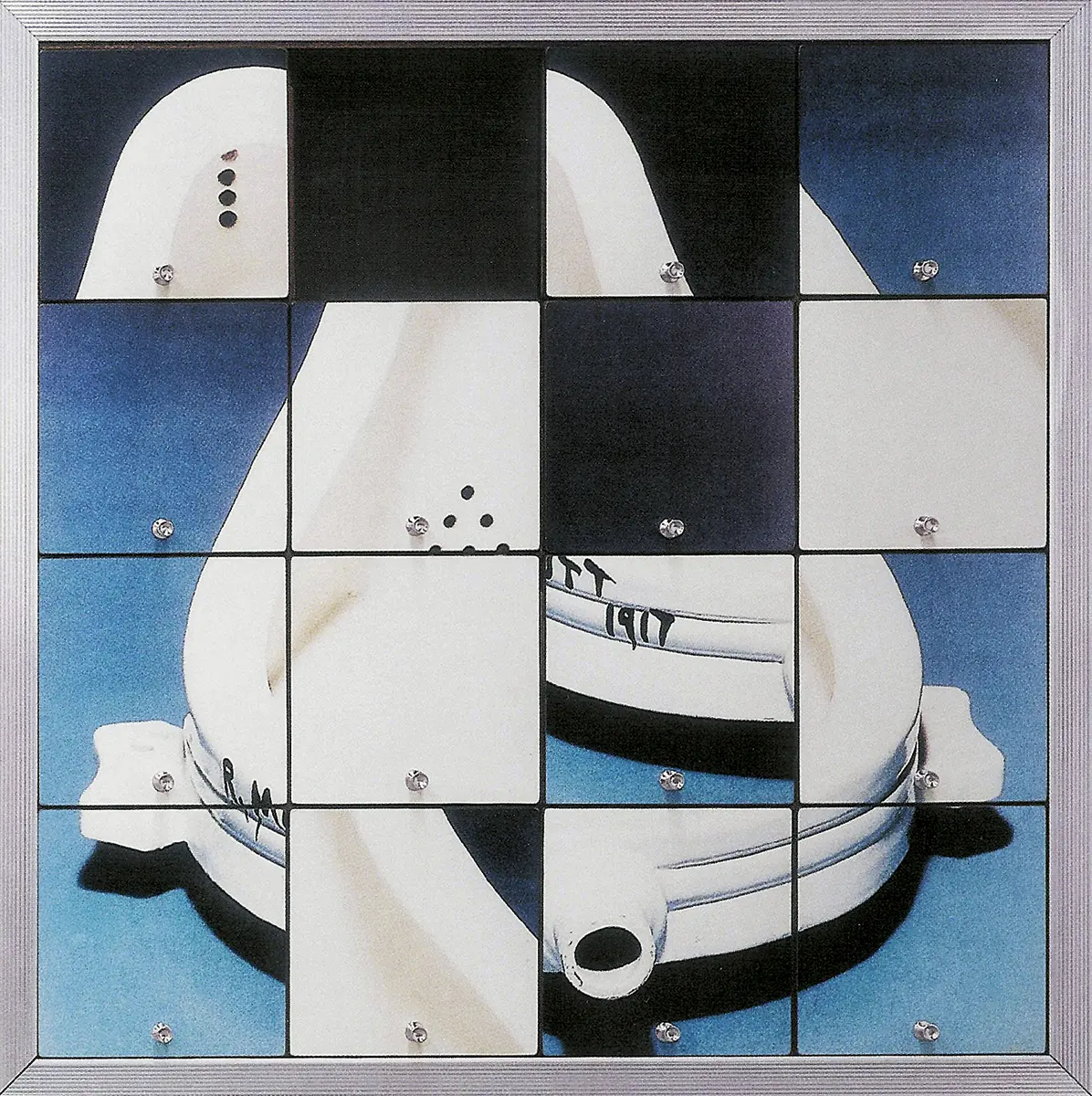
The Maracaná soccer stadium is an indisputable symbol of Brazil. Its name’s very cacophony evokes the public’s vociferations, yesterday calling Pelé’s name, today... And this connects with those elements of play, motion, of articulation of myriad parts Leirner displays in his works. Each one of his pieces is a team that functions in a supposed field. That intrinsic aspect of Brazilianness, governed by Afro-Caribbean rhythm and physical flexibility, is especially present in the composition of Leirner’s maps and in his installations. In this line, Maracaná, 2003, created an extremely intense center confronted with a cold, contrasting barrier in Uritorios, a 2004 installation. From the variegated and the tiny to life sizes and spaces, from popular everyday experience in the famous soccer stadium to the Duchampian repetition —which in his successive urinal stalls created a containment barrier for the gaze—, the show evidenced an intense warm/cold contrast. Even facing that human jungle in Maracaná, and in front of “Uritorios, the viewer continued to perceive in the gallery, left and right, the different percussions of abstract figurativism and of Leirner’s works resolved in photography. The artist confirms, from the space opened by his language, that the world keeps us inside that tragic ping-pong of different situations.
Leirner has generated in his work certain frames of reference, among which we can cite the history of art, contemporary society’s marginal situations, aspects of the Conquest of the Americas, religion, money, and the art market. He also works with elements taken from anthropology, sociology, and cartography, to mention just the auxiliary sciences with greater presence in his art. Ritualism, santería —on the basis of a Brazilian tradition of African deities onto whom Catholic figures are superimposed—, myth, aspects of everyday life, items of entertainment —wrestling, soccer—, war, and marginality. With respect to the last item, there is a quote from Fernando Henrique Cardozo2: “The concept of marginality, like all myths, exerts a magnetic attraction. It offers (...) an explanation of a complex social reality and an ideology that appeals to deep-rooted social prejudices. (...) The myth of marginality hides behind it something very real. Until the inner structure of the myth is discovered, one remains trapped within the bonds of its ideology which the myth affirms as if it were absolute.” Leirner inserts and reinserts himself in relation to these considerations. To analyze Leirner’s work, subversion and myth intertwine like unrestricted perpetually active motors. The artist does not present these situations but elaborates on them, helping us face and ponder them; perhaps his human concern is to bring them closer. He reduces the scene’s dimension so that we are able to encompass it without feeling threatened. He posits the scene by means of disproportions, of components he makes, commissions, or buys. He attends to the possible integration of myths and recycles the consequences of contemporary society’s actions.
In this way, his works border on kitsch and tend a bridge between the elegance and the urban-popular.
The show clearly displayed a Leirneirian attitude to the concatenation of themes, and the original interaction between the latter and specific supports and materials. Similarly, the artist’s working methods were understood, attending both to the concept of series and to isolated objects, and developing in pendular recurrent actions: installation and intervention. Leirner’s installations include urban, popular, historical, commercial, political, ritual, religious, and identity-related elements, among others. In that mixture of the ancient and the current, we find indigenous peoples and soldiers, animals and dancers, soccer players, and inanimate objects. In other words, there appear the viewer and the “actor,” the scene and its components in a vertiginous invasion of being and things that the viewer recognizes as devoid of life but unequivocally awaken individual mnemonic experiences and socio-historical memory. Leirner takes from the sacred and the profane to construct an apparent hybrid, which is precisely the way in which many contemporary societies are characterized.
In his interpretation of the world economy through the visual arts, Leirner does not leave out the role played by marketing. Leirner —born in 1932— is a stable artist who works permanently, he does not disappear from the creative realm, keeps having frequent shows, and is present at the most important biennials, fairs, and international art meets. The confluence of three elements helps verify that the career of this solid and humble artist has reached its peak: his age, operatic presence, and development of a language all of his own. Leirner’s work retains a fresh, playful, and critical attitude. More and more, collectors seek out his works as landmarks in Latin American art with globally reaching readings. Leirner’s work speaks of Brazil and, by extension, of all Third World countries. And an in-depth look will reveal how many of these things can also be detected —unfortunately— in developed countries. In intense colors and soft contrapositions, humorously combined by means of found and reinvented objects, Nelson Leirner’s operatic aesthetics are understood as art/game. His case establishes an equivalent with the phenomenon that generated Pop Art.
NOTES
1. Laura Fattal. Forthcoming essay for the curatorial script of a Leirner show.
2. Fernando Henrique Cardozo, preface to Janice E. Perlman, The Myth of Marginality. Urban Poverty and Politics in Rio de Janeiro. University of California Press, 1976, pp. XI-XIII.
GRACIELA KARTOFEL