
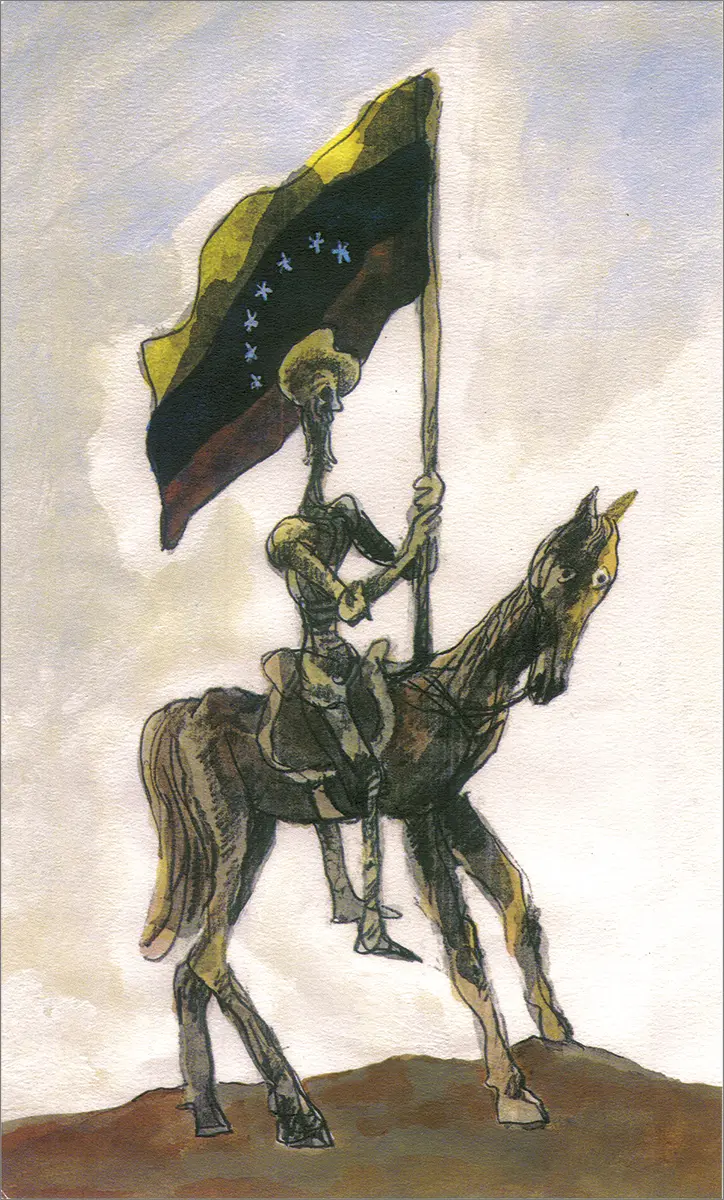
Since publishing his first caricature in 1946, Pedro León Zapata has built, in different advertising media, a spoken —and drawn— portrait of our reality. News, anecdotes, and current events are presented daily in his famous zapatazos, a kind of irreverent chronicle created with the purpose of lightening up the seriousness of the editorial page of the newspaper El Nacional. “Zapata,” says Ildemaro Torres in Papel Literario, on 2/19/05, “combines with great effectiveness the elements of a comedian of manners, a social critic, and a historian, elements that must be present in every comic cartoonist. His ideas materialized in this way, are granted editorial status, and the readers who every morning seek out his drawings as key to a better understanding of the national scene are counted in the thousands...” Zapata creates a spirit of the present, as well as the general feeling of the masses: old ladies, chameleons, gaudily overdressed ladies, famished and caricaturesque figures. Some of the great emblematic forces with a court of friends, as in “Coromotico” and “Tinita,” constitute the cast of characters that, with bitingly epic accents take center stage in his compositions. The formal and conceptual synthesis effected in Zapata’s discourse unveils a sharp sensibility that, behind the mask of the humorous, shows hidden aspects of reality. In pieces like Don Quijote de la Marcha, 2005 —to quote but one example, the artist plays with the words “Mancha” and “Marcha,”— draws the legendary character holding up the national flag, alluding in that way to the multitudinous protests that occurred in the country and displayed the national symbol.
Forty years have passed since the first Zapatazo, published on January 21, 1965, and to celebrate the occasion Galería D’Museo is presenting Zapatazos de mil colores. A selection of 48 pieces represents the artist’s work during these four decades, intervened with watercolors and acrylics. In this way, these caricatures highlight a palette of saturated hues, with string chromatic resonances that contrast with drawings in sinuous, organic lines, playful in their trajectories, which impress a certain vitality upon the whole.
These creations share the stage with Zapata’s paintings. Full of freedom and lyricism, these paintings describe an open space with weightless figures that extend over the plane, suggesting movement and continuity. The deformities and exaggerations of his characters are a way of explaining the grotesque, unhinged, and extravagant elements of our world. In Zapata’s oeuvre there are no periods but a flow of forms and images that match a satirical and eloquent narrative, both in its oral and graphic forms. His visual and comical language captures our gaze and at the same time silently appeals to our consciousness. The meaning of his work is linked to that goal sought by the Mexican muralists, end even more closely to the incisive lucidity of artists and engravers like José Guadalupe Posada (Mexico, 1852-1913), whose pamphlets, newspapers, and calaveras —single-sheet circulars— showed images, notes, and vignettes ridiculing, in a burlesque and critical tone of great expressive force, the issues, and characters of the day.
The pulpit afforded him by his space in the daily press allows Zapata to express in a simple and witty manner episodes of the local human comedy. A comedy that represents the fundamental aspects of our everyday life, with individual and collective problems that, in essence, emanate from the human condition. In the present, as in the past, we encounter here issues that connect with the question of values, principles, of the triumphs and miseries of mortals. Zapata speaks about us, and that is why his discourse is so close. His skills as a painter, humorist, caricaturist, actor, animator, essayist, and university professor reveal a special talent, the same talent that has resulted in a large number of distinctions, such as the National Journalism Award in 1967, the National Art Award in 1980, and the Honoris Causa Doctorate by the Universidad de Los Andes in 2002, among others.
GLADYS YUNES YUNES