
Even before Magritte’s Ce n’est pas un pipe, artists had ceased exploring the question of whether even the most vulgar of objects could acquire artistic resonances by the mere fact of residing in a museum.
In the face of interpretive doubt, we trust that even without experiencing an aesthetic epiphany, it is urgent to speculate on and prioritize possible theoretical positions. Nevertheless, we are unsettled by the cognitive insecurity that takes hold when, for instance, no correspondence is found between conceptual art and its grandiloquent and promising discourses (which are, by the way, imported from literature). Although the laws of the marketplace determine our taste, our comments skirt any politically incorrect and semantically overloaded terms, a fact that has turned the texts of more than a few catalogs into nothing more than timid descriptions.
Given our proclivity towards post-vice royal courteousness, there could seem to be no possible objection to the fact that for Rubén Marshall’s recent show, Entre lo espiritual y lo mundano, the windows of a renowned gallery (Praxis) acquired the appearance of commercial displays. From the start, both the cards for each work and the show’s catalog suggest the value of an authorial intention that is, in a way, redemptive. Indeed, what we have in front of us is a series of mannequins altered with the purpose of inducing (or reviving) a spiritual quest that combines the virtues of axiology and ontotheology, for example, devotion to pan-capitalism. Painted in a white whose purity barely transgresses the metaphysical allusions written on each piece, these figures have been stylized to the point of adopting the posture of recognizable religious icons. In an attempt to re-signify the human body —the cognitive and perceptual unit par excellence— Rubén Marshall aspires to imbue something as useless as a series of mannequins, those female-anatomy models, with transcendental echoes.
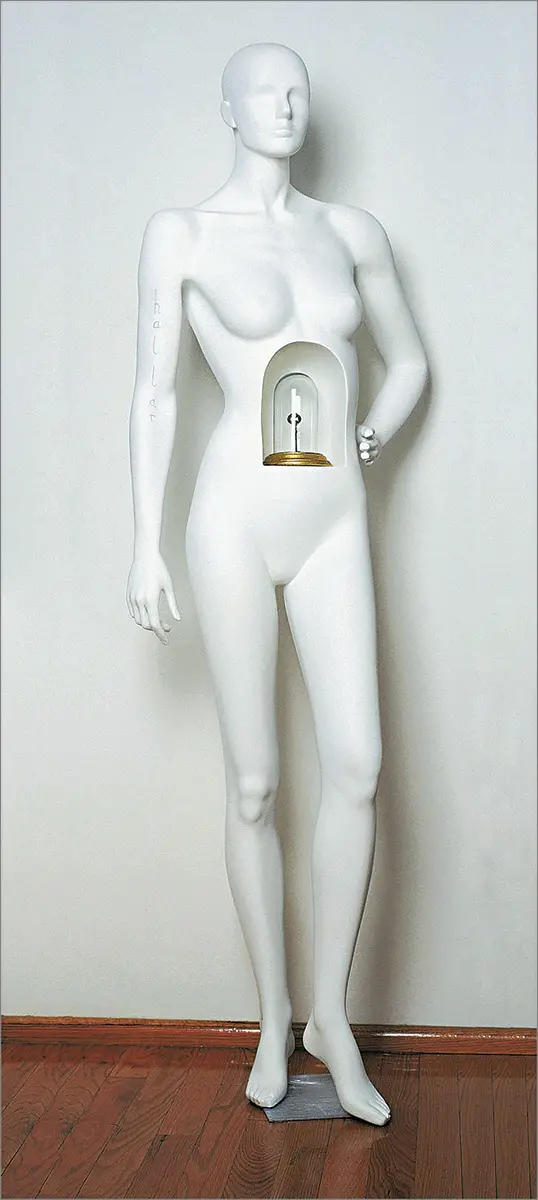
But while the idea of beauty has shifted from images of fertility like the Venus of Milo to the anorexic top models that have crowded the catwalks since the 1990s, their minimal —they are waiflike as well as empty— measurements might very well find their counterpart in the hyper-realist organisms of, let’s say, Von Hagens. The latter devised a process he called plastination of cadavers in order to preserve and reveal internal body organs, unveiling fat, pulmonary emphysema, and malformed fetuses. Moreover, although today the list of donors overwhelms Von Hagens’s capacity to display them, his legendary story has it that in order to realize his exquisite compositions —a collection that boasts of great artistic achievements beyond pedagogical intent— Von Hagens illegally trafficked the corpses of executed Chinese death-row inmates.
Well, nothing is as opposed to Von Hagens as the naiveté with which Marshall beatifies cultural products that, in the first place, respond to the marketplace’s imperative to determine taste. According to that precept, a spiritual woman must be thin (consider the torturous corset), small-footed (a ballerina’s broken insteps), and Caucasian: an androgynous elf, as pristine as dictated by the aseptic character of those who proclaim a New Age. It is in that sense that I find a pretentious elevation that ends up falling back down, melting into frivolity (Marshall Berman), and, in sum, can be read like a best seller that, in its desire to sublimate our Western stereotyping by intermixing motifs from any creeds, Rubén Marshall comes close to yet another instance of well-intentioned “ugly-ism.”
Leaving aside issues like a re-appropriation of voice, we are the inheritors of baroque gaudiness, modern kitsch, and Pop cheapness, which demonstrate our neo-modern ineptitude through inoperative theoretical discourses, often without a counterpart in the artistic or visual production, they purport to scaffold. This is to say that while we cannot subtract ourselves from the spirit of the time, which globally tends toward the Good and is expressed in creations that appeal to an ethical end and give aesthetic attributes the second order of importance rather than importing ideas, it is imperative that we adopt critical attitudes in the face of, for example, post-positivism.
The Age of Aquarius came from utopias such as The Principle of Hope. Using spectacle in order to obscure the emptiness of content, it would seem that in the age of communication nobody has anything to say. Bloated as we are with data, the inability to interpret announces the death of ingenuity.
Farewell to Renaissance humanism; hail to those who, aware of Orientalism, assume the Western hubris and its vertical chiaroscuro rather than embracing intellectual imposture.
MAYRA INZUNZA