It is not uncommon for Rubens Mano’s action in the space of the city, inscribed quietly into different instants of the same event, to escape notice by given metropolis denizens. His interventions seem to be telling us that the urban form is not solely defined by buildings, vegetation, and urban furniture, but also by continuous flows and fleeting situations. The relationships established by the artist between architecture and photography demonstrate that the construction and transformation of a physical area pass, for instance, through the production and circulation of images. Definitely, the “act of photographing” includes, besides the gesture of the click, the viewer’s reception and contemplation of the resulting image. To the point of transforming its reproduction into “almost” an object in itself. Or better yet, to the point of having the reproduction of space become a space in itself, a place to be occupied not by the body but by the mental projection of an event to complete the scene or take over intervals of time and of open spaces between one scene and the next. Espaço entre and tempo entre are immaterial constructions constituting our experience with Mano’s work.
The selection of works presented at the show Tudo entre nós awakens the visitor's awareness of the fact that, amidst the city’s processes of routine transformation, we are prisoners of relative blindness. Despite the fact that “everything” is among us, we can not see or perceive everything. Suffice it to think of those fleeting moments, impossible to repeat, that we carry out in the street, every day, at any time. Things that would easily be overlooked by a harried pedestrian are suggested by Rubens Mano as a hiatus. Just as we possess no certainty regarding that which we don’t see and can only intuit, we don’t know whether what is presented in the gallery, be it photography or video, registers the result of an “intervention” by the artist, who, besides, is not in the habit of revealing the date, time, place, and duration of his actions. There is an element of fortuitous encounter in these images, of directed attention, and, by the same token, of lost event. Because: “Tudo vaza,” (Everything empties out,) the show warns us, from the very entrance.
The work exhibited on the glass façade of Casa Triángulo gallery, titled Tudo vaza (2004,) consists of the inscription of this phrase using symbols from the Braille alphabet. Mano covered the glass with opaque vinyl. Leaving opened only cells corresponding to the letters t-u-d-o v-a-z-a. Arranged so that they can be read from inside the gallery, these transparent circles define the possibilities of contact with any viewer situated outside. The tactile language system becomes a code for visual reading, but in an imperceptible way, because it is easy to take it for some kind of decorative treatment for the façade. Probably very few visitors “saw” the message, which clearly signals that there is always a potential for permeability, despite the limits to our seeing and vision; and that precisely due to those limits, there is also a potential for exchange.
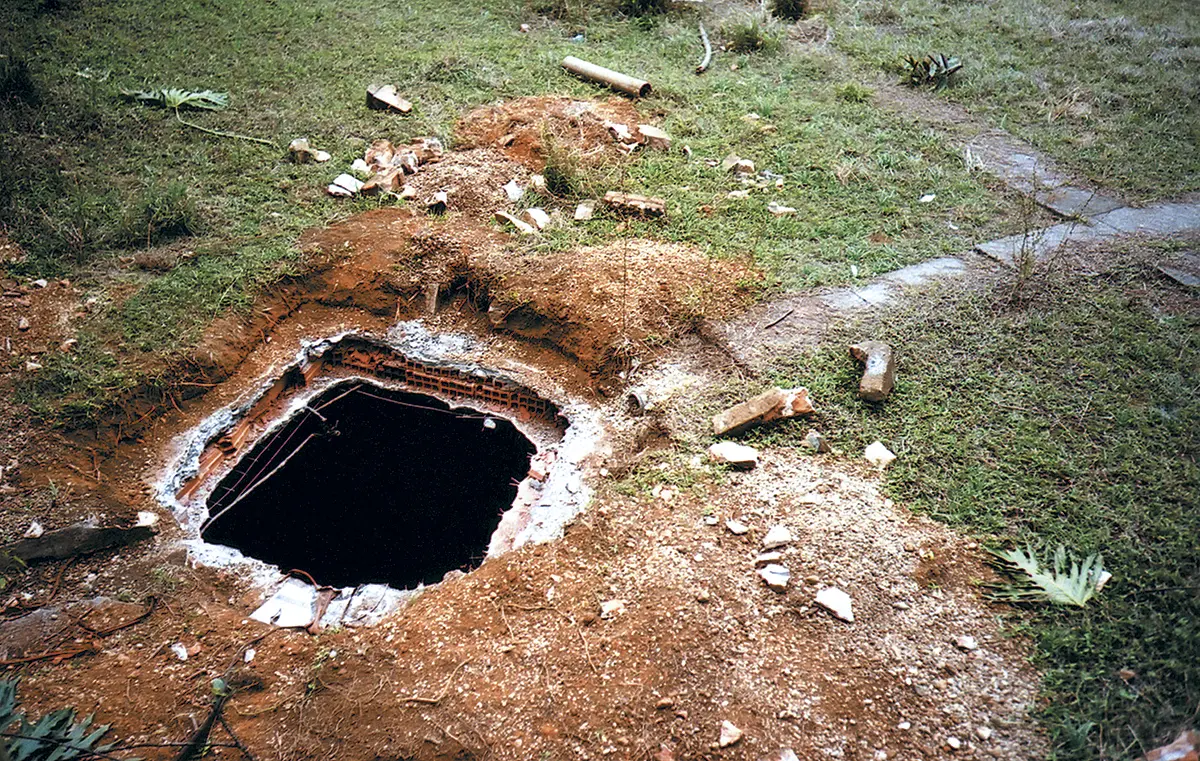
At least three of the works exhibited here to discuss a recurring idea in Rubens Mano’s production, regarding the “subtraction of landscape: This notion emerges regularly to unveil the artifices of nature. As in Mano’s photograph Fundo falso, where a hole opens in a residential garden reveals that the grass was planted on top of a cement-and-brick floor, on an empty lot, without raising the ground with dirt. In another moment, as in Sin título (Contracampo), another photograph, which can be termed “subtraction” generates a virtual space to be occupied by the presence of visitors. The image reproduces a park, with trees, bushes, and a hologram placed in a nuclear position within the composition, toward the viewer. The intense luminosity, which would impede viewing the piece frontally, produces in the photograph a white circle, a cavity, which reconstitutes the photographed space as an image under construction.
Disponha, a diptych, proposes a narrative game by placing, side by side, photographs with identical composition, lighting, and a single plane, in which two vans appear parked or abandoned on a street. The difference between the two copies is the gradual disassembly of the vehicles, with their parts being taken away, perhaps by a recycler, in the time elapsed between one shot and the other. The protagonist of this action is not registered, and only the distance between the photographs refers us to the duration of the intervention. The compression of time, achieved through a cut in the narrative, deflects in this way the experience of observation towards an event that the photograph —a documentary medium, of course— did not capture.
The show included also an installation, which gave it its title, occupying the gallery’s first floor back wall, painted in yellow. Tudo entre nós includes also a glass piece that serves as a body for two common lamps, joined to one another by a section of their bulbs. Each lamp has its own electrical filament coming out of its socket, which gives them autonomous function. Plugging any one of them to a power outlet located, for this show, in the middle of a wall, barely above the floor, both light up; it is also possible to keep one on and the other off. Only gas and space are shared by the lamps, which are one as well as two. Everything is located on the extremes of a single physical piece, to prevent light from escaping this type of determination in the glass.
JOSÉ AUGUSTO RIBEIRO