
The exhibition Tamayo, a Search for the Essence captures, in seventy-five prints, drawings, paintings, and sculptures, the esprit de corps of the renowned artist’s work. The exhibit opens with several rooms that highlight his mixografia prints, a medium co-invented by the artist in conjunction with Luis and Leah Remba in Mexico City during the 1970s. Created during Tamayo’s mature years, the mixographia prints approximate the painting’s physical force and power.
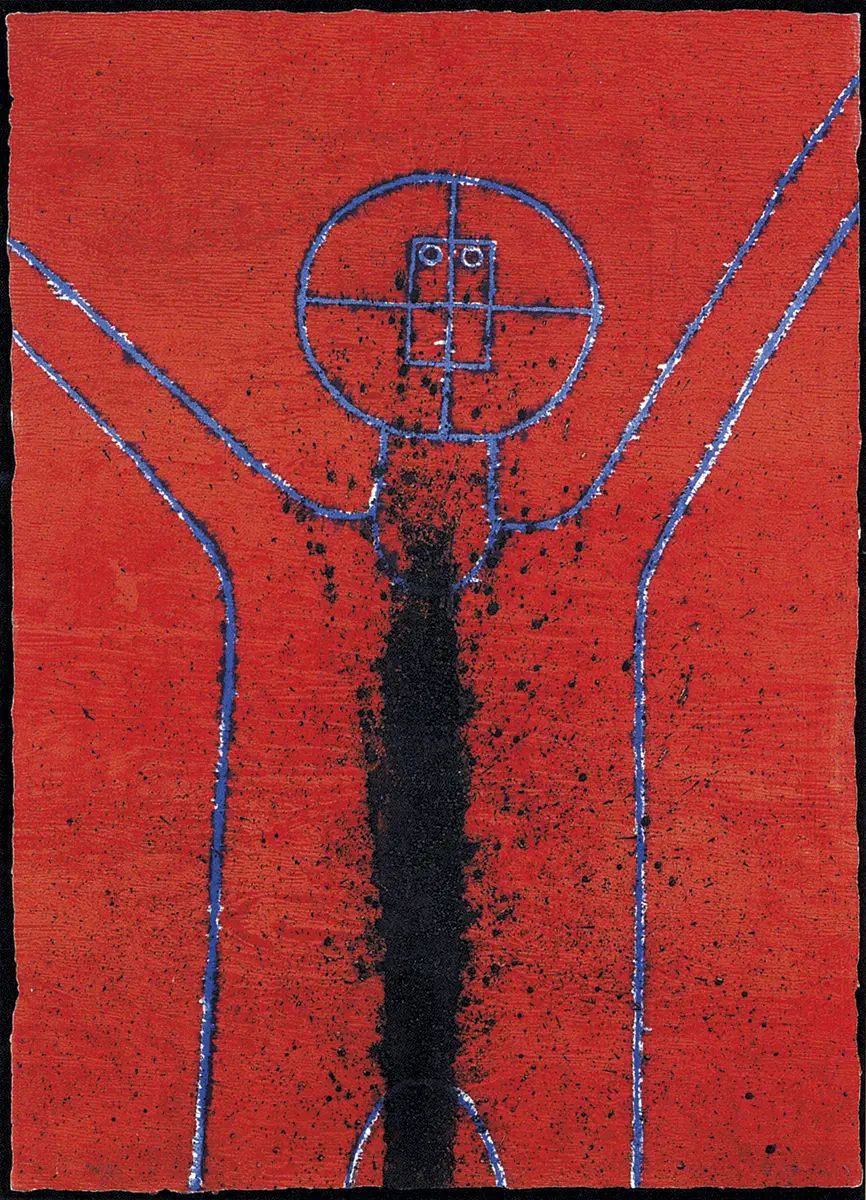
The opening gallery features the mixografia from the 1970s and introduces Tamayo’s personages, who are envisioned in various psychological states. Near the entrance, in a work entitled Cosmic Ecstasy, an intense figure rendered in red stands with outspread arms. This passionate, fierce figure seems simultaneously ancient and contemporary. Configured using the most elemental forms, Ecstasy converses with Head in Black, which hangs across the room and presents a human face rendered with a few, basic shapes. Despite their structural similarities, the emotional tenor of these works is dramatically different. The vibrant reds of Ecstasy project a celebration of life, and the black and ivory tones of Head in Black describe loss and pathos. Galaxy, on the room’s back wall, presents a majestic night sky illuminated by a thin crescent moon and constellation of stars. Contributing to the image’s poignancy, the unforgettable colors —cobalt blue, deep purple, and burgundy-fuchsia— hover above a silhouetted, black landscape that anchors the image.
Moving further along, one enters a gallery anchored by the colossal mixografia, Two Characters Attacked by Dogs. With its immense scale, rugged textures, and brooding colors, this is one of the most commanding works in the show. This potent psychological image profiles a nude couple fleeing from the pursuit of two snarling dogs. Here, as in other select Tamayo works, the dogs metaphorically signify those forces that plague or shadow humanity and threaten to unravel our dreams of tranquility and freedom.
Shifting from the mixografia galleries, the visitor enters the interconnected spaces that highlight the artist’s works in other media. Among these is a memorable early painting, Still Life with Calla Lilies of 1924, lent by the Andres Blaisten Collection in Mexico, as well as two 1989 steel sculptures, Atlante, and Hombre rojo, lent by a private collection in Miami, Florida.
The small Women of Tehuantepec also appears amid a sweeping wall of paintings. It profiles two statuesque women, whose abstracted features hint at Tamayo’s knowledge of the pre-Hispanic art of Mexico. Rendered with equally weighted hues of stone grey, cornflower blue, linen brown, and rose pink, the painting functions as an ode to the poetic potential of art and life. Absent from it are the more didactic, social commentaries celebrated by Tamayo’s contemporaries, Rivera, Orozco, and Siqueiros. Linking the present to the past, Women of Tehuantepec ironically contrasts two slices of ripe watermelon —a metaphor for a woman— with the chiseled coldness of two stone-grey figures. Lyrically it also whispers of Tamayo’s role in forging —along with artists such as Francisco Zúñiga and Carlos Mérida— a post-revolutionary, avant-garde Mexican art that conversed with pre-Hispanic, popular, and international art developments.
COLLETTE CHATTOPADHYAY