
At first sight, 8 manos years old sounds like a disconcerting Spanglish expression and, at the same time, some sort of complex arithmetic operation. But when one remembers that a standard hand (“mano”) has five fingers, then it becomes clear that eight of them (ocho) add up to the age whose arrival Bejarano celebrated with the show of that title, with selections from three of the artist’s many graphic and/or pictorial series: Cabezas Mágicas, Las coquetas and Los ritos del silencio, covering a temporal arch from 1988 to 2004.
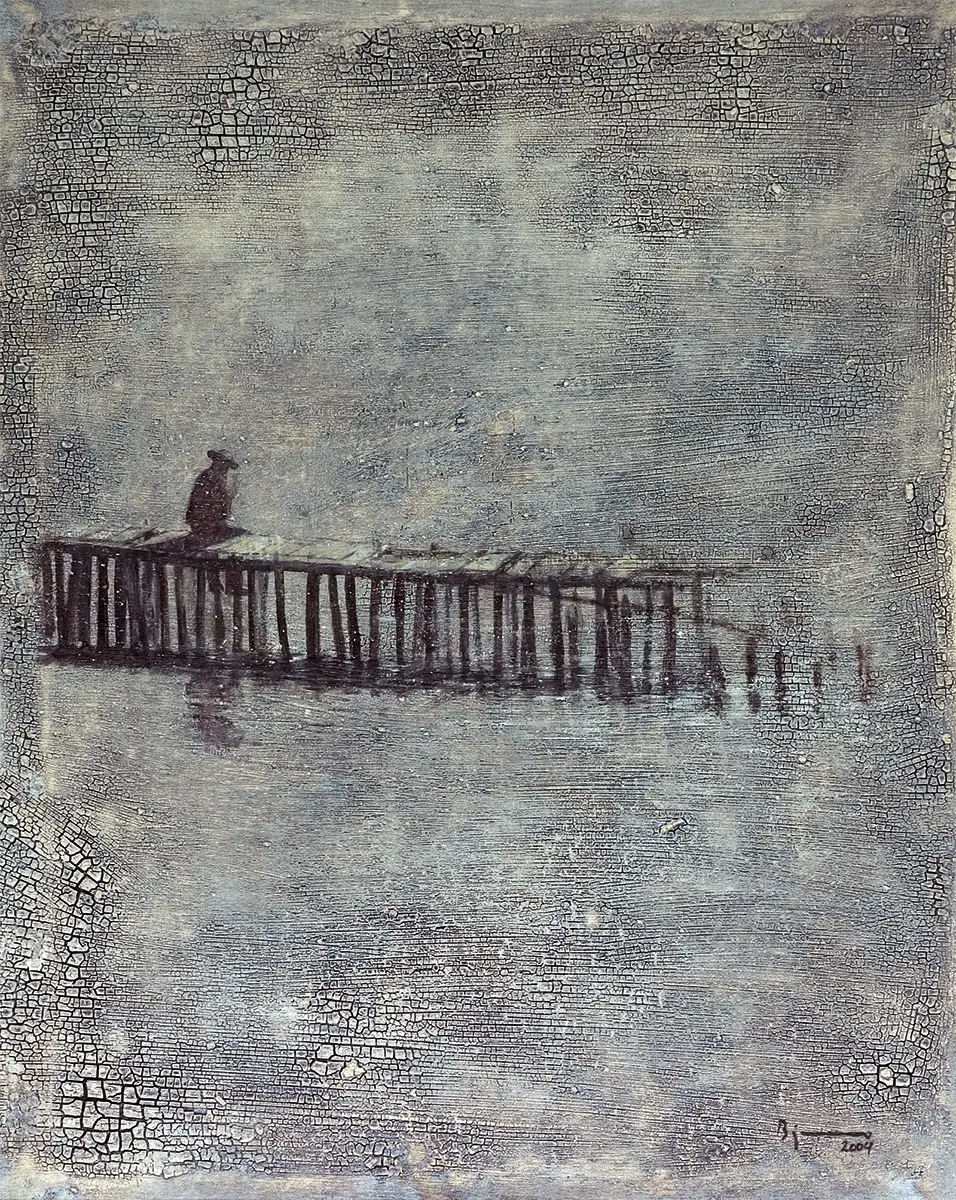
Besides his mastery of printmaking techniques (such as etching and metal plate engraving, represented in this show,) Bejarano is well-schooled in the painterly métier. And he is a constant experimenter. In this way, in using acrylic paint in some pieces of Cabezas mágicas, he has tried to attain the gestural and expressive informality of drip painting. He has also incorporated, in Los ritos del silencio, a kind of mixed technique that can be called “ceramic painting”: the application of a layer of pelvin on the canvas, which produces a crackle glaze. Objects represented in this manner leave behind the merely visual texture and acquire a different, matteric one that in my opinion also strives for a three-dimensional corporeity and an imminent installation concretion (something not at all alien to Bejarano.) But all these procedures continue to show the imprint of drawing. Drawing underlies Bejarano’s entire oeuvre, as Cuban critic David Mateo has pointed out.
Bejarano can also be attuned to other contemporary morphologies and/or technologies, such as digital printing. But this approach, more a response to practical needs than to artistic-expressive demands, dilutes the semantic-visual connotations so well suggested by the initial versions of these pieces.
Bejarano carries out his experimentation along the lines of the manual arts, the tradition and craft he revisits. By choice and not by limitation he has followed perhaps the most difficult path: to renew long-established expressive means and to propose a fresh visuality all of his own. He has not affiliated himself a priori with the latest technological trend, which guarantees almost from the start the benefit of “novelty,” regardless of whether the resulting artistic proposal is empty or does not possess the conceptual solidity of others that are billed as equally “advanced” technologically.
The author of “non-objectual,” seemingly abstract works (not included in his recent show,) there is in Bejarano a notable abstract-thought vein that, through synthesis and visual tropes, has irrigated also his “figurative” pieces. These are derived, similarly, from that level of intellectual abstraction implicit in the creation of any human work, which in Bejarano’s figurations has been maximized by the economy of expressive resources used in the compositions, close as they are to the austerity of minimalism.
This artistic quest has been organically linked to the thematic renewal that is so clearly expressed through seriality. This conception, typical of all printmakers, also coheres with the vocation to explore the topics mentioned. And although each series has its emblematic icons, there are leitmotifs that connect them. The human, the telluric, the aquatic, the silent, and the work-related have ceased to be references tied to a sense of local belonging, in order to connect (especially in Los ritos del silencio, still undergoing a process of formal-expressive experimentation,) with preoccupations that are ecumenical in their reach. And this is thanks to their narrative breath. Even silence, while it hasn’t finished falling silent, continues to suggest.
These days Bejarano seems more interested in the problem of (in)communication: between human beings and other human beings, or between them and their shadows. Yet visually what he proposes are other dialogic relationships, ones that have been a part of his ontological preoccupations: between man and nature, between city and countryside (the natural and the constructed.) And it would seem that singer-songwriter Silvio Rodríguez, in one of his poems made music, has already found a solution: “If I didn’t live in the city, I might see the dirty tree where I went to play.” But Bejarano’s assumptions go beyond the autobiographical nostalgia revealed in that song, which in truth does not propose an exit route but a disjunctive, a possibility, a conditional that Bejarano resolves through the fusion of the vegetal and the human precisely at the point of what both have of natural. In the first instance, through the symbiotic extensions of the one on the other. And in a second instance, by way of their representation in pelvin, a calcareous material that symbolizes that great entity of nature we call Earth.
In giving concrete expression to all those conflicts, the hand has been of cardinal importance, and not only by virtue of having created the works exhibited here. It multiplied itself in order to welcome/bid farewell to people at the entrance/exit to the gallery, or to greet them as they walked through the exhibition. But it also seemed to be saying: "Stop, see, feel, reflect…"
ISRAEL CASTELLANOS LEÓN