
Agustín Fernández (Havana, 1928) moved to Paris in 1959. At that point, he abandoned the colorful palette he had been cultivating for a more austere one. In exile, his work became more erotic and, according to Fernández, more metaphysical, less Cuban, and less romantic. Fernández began searching for a “more condensed style,” capable of expressing more with less. In 1968, he moved to Puerto Rico and in 1972 he moved again, this time to New York where he still lives and works. Mitchell Algus Gallery presented an exhibition of 19 pieces that trace 45 years of Fernández’s art from the sixties when he adopted the use of earth tones —beige, black, and White— to some very recent oil paintings where he seems equally comfortable with abstraction as with figurative art. The show includes drawings, objects, collages, and paintings that demonstrate the versatility and coherence of this body of work.
Fernández is still identified as an abstract painter, but since he left the island of Cuba, his work has evolved, touching on most of the Modernists schools: Dadaism, Surrealism, Pop, Conceptualism, and even Minimalism (as in the series of graphite drawings: Little Points #4, Scissor Time, Small Nipples, and Game, all from 1972). Fernández’s most outstanding works are his large-format paintings from the sixties, like Développement d’un délire (1961), and Looking at and Understanding Two Different Operations (1963). These are dramatic and powerful pieces where styles collide and psychologically charged imagery seems to surface or erupt through layers of symbolic “painted skin.” This can be constructed as a pretty literal reference to the Return of the Repressed, but also as a more aesthetic struggle, a personal quest for integrity at a time of rupture and transition. Nevertheless, we cannot ignore the influence of psychoanalysis and Freudian references in Fernández’s work, for instance, two of his recent paintings are called Totem and Taboo (both from 2005).
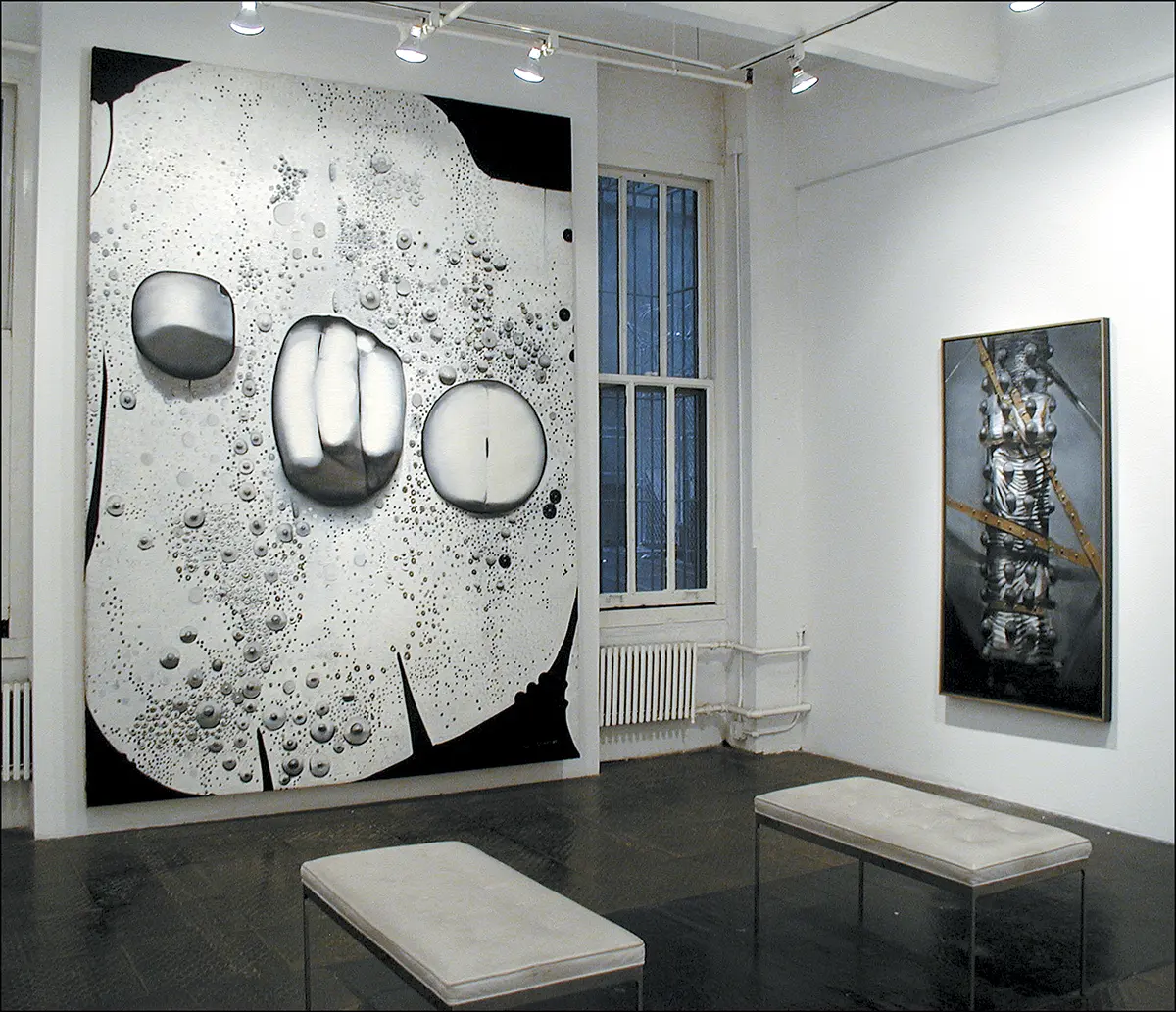
Fernández explores the border between the figurative and the abstract, in which recognizable images (extremities, fingers, nipples, and so on) emerge through a mostly abstract pictorial field but remain trapped, half-drowned, or overwhelmed. These fleshy human-like forms seem to have evolved from the curvaceous shapes he used in the early sixties that are vaguely reminiscent of Henry Moore’s work. The theme of bodily containment is emphasized in Fernández’s trademark iconography of bounded flesh, as in Legs (2005). Pale extremities merge with an assortment of devices that seem to belong to the repertoire of sadomasochistic practices. The interest in such imagery was certainly one of the elements Fernández had in common with the photographer Robert Mapplethorpe. Two collages included in the show are collaborations with Mapplethorpe: Robert’s Box (1975), and Malcolm X (1982).
His paintings of limbs and other disembodied parts tied with straps and strings, cut by blades, and penetrated by a variety of objects are not only appealing (or repulsive, according to the viewer’s sensibilities) for their “perverse” and sadistic sensuality but also because they conjure the Frankenstein specter of technoculture and our contemporary obsession with cyborgs, organisms that fuse the evolutionary and the manufactured, the mechanical and the biological. Another common obsession in Fernández’s work is the armor, the exoskeleton that serves as protection but also as insulation from the outside world. The armor is an illusion of invulnerability, a shell, and a surface created to contain and protect the body from external aggression but incapable of protecting it from its own internal change and decay. Fernández’s fascination with the armor seems to be related to Greek and Roman statuary and its intrinsic obsession with Apollonian perfection of the body’s form.
Fernández’s work is a sober reflection on the virtues and the downfall of Modernism itself. As Kim Levin has put it, “Modern art was scientific. It was based on faith in the technological future” and involved experimentation, the introduction of scientific methods, “even Surrealist visualizations of Freudian dream worlds and Abstract Expressionist enactments of psychoanalytical processes.” Fernández participated in this search to tame chaos through reason until Modernism collapsed sometime around the seventies (some say in 1968, others believe it happened closer to 1974). Fernández survived and continued working beyond trends and labels with a surprising and powerful style, with an aesthetic philosophy capable of maintaining a framework that has enabled him to continue to renew and revitalize his art.
NAIEF YEHYA