
Reflejos en el Espejo, an exhibition of works by Ángel Rodríguez Díaz at the San Antonio, Texas, Southwest School of Art and Craft, displayed a multiplicity of pictorially solved tensions. These 12 paintings offered viewers an intense interplay of gazes through several time/spaces: from the conception of the work, the physiognomic study in front of a mirror, photographic exercises, and pictorial execution, to the frontal, eye-to-eye between viewer and self-portrait. Metaphors, dreams, and realities are united in a concept that links Puerto Rico’s beautiful marshlands —Ángel Rodríguez Díaz’s native land— to the baroque theater that is present in a large portion of Latin America’s visual expressions. This is especially so in Mexico, a country with which the artist is associated. Antifaz: ...Forget the Alamo ...Yellow Rose, a 2004 oil and acrylic on canvas, display the curvilinear baroque brocatto. It extends as a painted motif through the piece’s background and competes with the softness of the nude figure as well as with the delicacy of the hand and the arm enveloped in soft folds and brocade rims. The composition can be compared to a scale whose point of balance is represented by the empty space at the painting’s center.
By saying that the artist resides in the city of San Antonio, Texas, we might well be detonating a historical and political signal (another tapestry of relationships, between the United States and Mexico, and between the United States and Puerto Rico, is interwoven there). The history of dependence, independence, and their combination between these countries has not yet achieved resolution; rather, they are articulated as relationships of the chewing gum type. Perhaps without intending to, Ángel Rodríguez Díaz establishes the same relationship of dependence in each one of his paintings, that is, between the parts and the whole. His self-portraits and portraits denote a bodily dependence on their backgrounds, their add-ons, and the myths they reveal. In this show, there are no masks, buts faces; there is no inhabitant, but a mirror; there is no inlay without a role. The metaphors that Rodríguez Díaz slips in refer to the contrived symbolic constructions found in Latin American societies, among which are: wrestling, machismo, ostentatious strength, and gratuitous boasts.
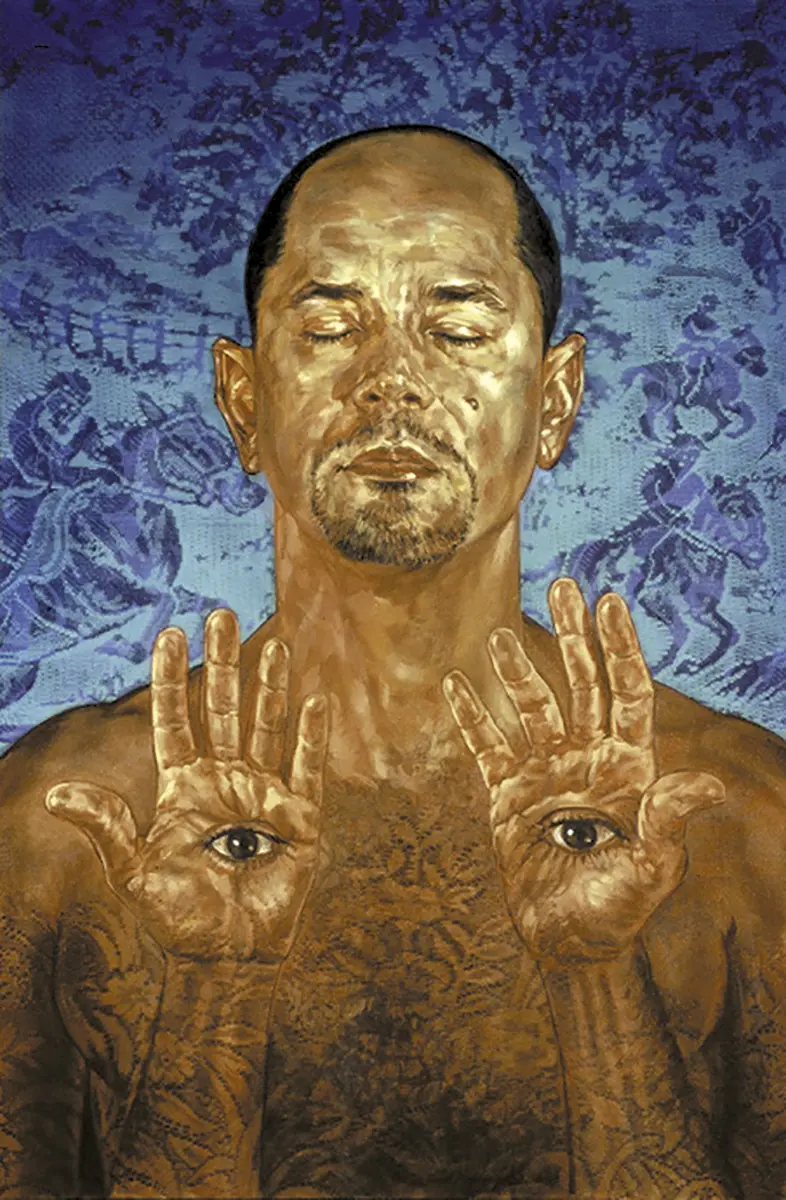
Reflejos en el espejo is a show that is formed within the parameters of painting. These are realistic, figurative, highly detailed works that at the same time include an illusionist element with science fiction intimations, albeit of a naive character. By this means these paintings are not evaded in their epoch and are placed in a mixture of natural and urban jungles. Works representing interiors dominate the show, except where the presence of an immense ocean evokes Atlantis. Saints, symbols, and signs reveal personal histories, as well as fantasies, hopes, and allusions to the price of fame.
Facing these paintings, the viewer realizes, that the artist is transforming him or her into the mirror mentioned in the title. Through the neo-baroque that emerges from this Indian, mestiza, African, symbiotic, and multifaceted Latin America, Ángel Rodríguez’s paintings go beyond mere gazes on the surface of a mirror.
The vanquished and their conquerors, those who look at themselves in the mirror and those that hide behind masks, form an interplay of hits and misses, even if ultimately we all know who they are. Today, when lies are uttered and defended publicly, it seems useless to ask what is true and what is false. These works respond to a quest for self-discovery. The cultures through which Ángel Rodríguez Díaz has journeyed are manifest in that inner-directed gaze expressed by the artist in different ways. These works seem absolutely mundane and secular, although there are some religious allusions. The artist’s fantasies and those of his society emerge through tinsel, horror vacuum, and figures in threatening or unhinged expressions. Even here, in a purely pictorial context, we note the geographical and cultural mobility that is the vector of our time, a time of acceleration and uncertainty. Only Looking Into My Hands I See a Distant Mirror, Kitty’s Mirror, and Josie, Woman of Good Fortune are executed in oil. In some of his paintings, the artist uses both acrylic and oil on canvas, for instance, Blue Panther, and The Stealthy Watcher. He incorporates charcoal, pastel, and oil in In the Mirror of Your I... Mil Mascaras. The works in this exhibition have numerous points in common, although seemingly dissimilar in technique and composition as often happens with Latin America, inhabited as it is by as many differences as similarities and not quieted down by any single one of them.
GRACIELA KARTOFEL