
In his essay about the work of René Magritte, Michel Foucault reflects on the relation between word and image. Foucault bases his observations on a picture in which Magritte matches the representation of a pipe with a written statement claiming the obvious: the represented figure is not the real thing (Ceci n’est pas une pipe, 1926). Beyond this “simple-minded” truth, the essay detects in the work a series of complex operations whose description exceeds the purpose of the present text. The conclusion to which such operations lead will nonetheless be central to the reading proposed here of the work of Carmen Herrera (Havana, 1915), currently the object of a retrospective exhibition (The Forms of Silence, Miami Art Central, Sept. 20-Nov. 13). As Foucault concludes, in connecting language and image to deny the identity of an object that is at the same time affirmed by the figure, Magritte undermines the “common ground” where both modes of signification kept a tense relationship in the context of classical painting. Thus placed outside or pitted against discourse, modern painting enters its own zone, a zone in which form “floats anew in its natural silence.”1
There are of course other modes to account for modern painting’s rejection of discourse. The most influential is no doubt Clement Greenberg’s vision of “modernism” as a set of practices through which art gradually enters abstraction’s domain, a domain where, instead of the expression of a theme, what counts —what holds value— is that each visual medium is successful in silently verifying the formal laws that absolutely are its own.2 Though Greenberg’s position shaped much of this country’s postwar modernist art, and despite the fact that it is in such a context that Herrera has worked uninterrupted since 1954— after having lived in Paris at the beginning of that decade —it is not against a Greenbergian background that I read the artist’s exhibition. Rather, I will refer to that background in order to test an assumption: despite its historical context and its modernist affiliation, Herrera’s production points to an alternate trajectory, a trajectory that raises specific problems and calls for the elaboration of another method of reading.
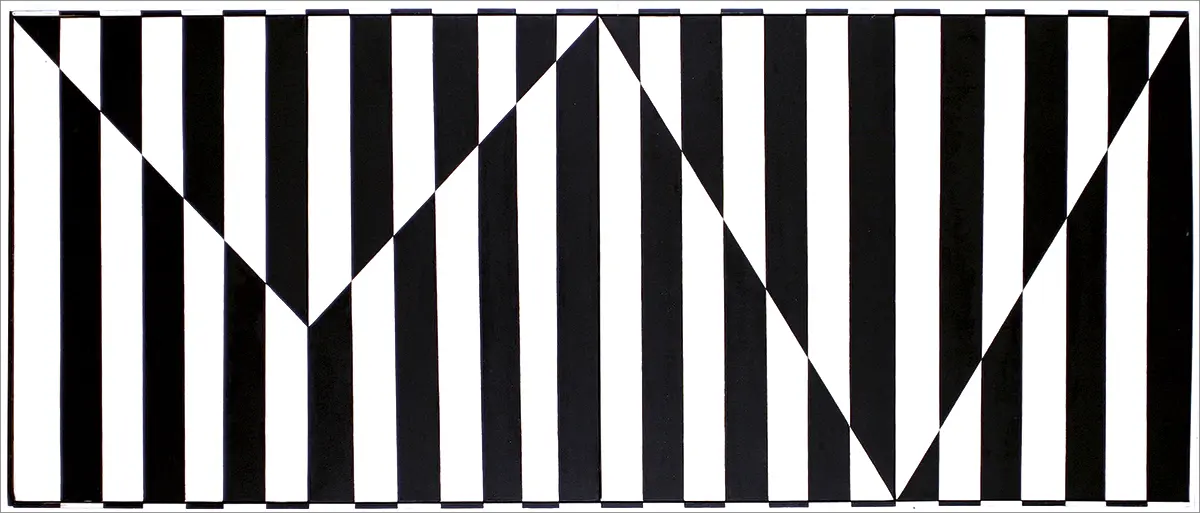
Besides the glaring signs of painting’s modernist reduction to its essential constituents, Herrera’s work contains other, clear traces of interest in pushing the pictorial act to a point at which the picture would stop being a closed universe of formal relations between the plane and other visual elements —relations between a set of pictorial signs— and would instead take on the concrete, mute condition of the object. For example, take the four panels that make up the untitled work made in 1952, from the series of black and white pictures that the artist has produced for decades: the progression of bands that serially divide the support reflects the articulating logic of objects more than painting’s compositional order, even though the bands reconfirm the support’s flatness and thereby reveal that the work is, in the last analysis, the delimitation of a flat extensión-or a picture, following Greenberg’s essentialist prescription.
The intensified focus on what is intrinsic to painting, if only to pry the medium open to what lies outside it —the sculptural form, the architectonic surface, the object— can also be perceived in the “geometric abstraction” produced by a group of Latin American artists during the period in which Herrera developed her own style. For those artists, what is important is the creation of constructions whose structural clarity would link them to the functionalistic logic of an emerging Latin American “modernity.” In the “concrete art” produced in Brazil during the 1950s, for instance, the preservation of the strict specificity of the pictorial medium gives way to the intention to create works whose rational transparency would be equivalent to that of the modern object. This is not Herrera’s position, but her work contains formal and conceptual elements that could be linked to the rational platform of postwar concrete art, both the one practiced in Brazil and the one advanced by Max Bill and other members of the Ulm School: “The starting point of my work,” the artist states, “is a process of organization that follows the dictates of reason. The visual execution is contained within the limits of that established order.”3 Yet if the starting point is ruled by order’s exact precision, and if that order determines in advance the formal events that will take place upon the plane, the endpoint —the work’s reception— is quite different.
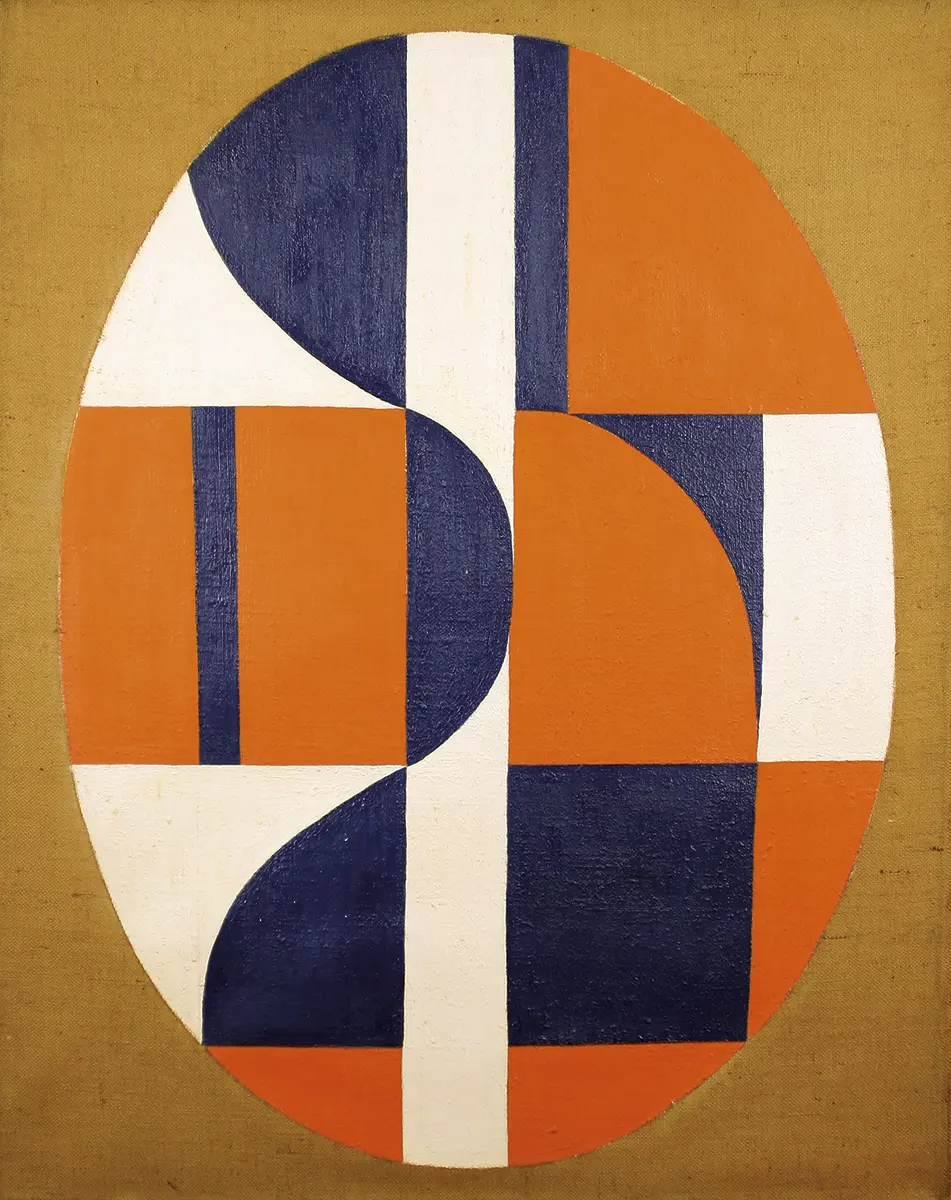
What defines that final moment is the ambivalence between the construction’s structural clarity and the impossibility of fixing the relative position of its elements precisely. Herrera’s pictorial objects —if one accepts that the exhibited works can be understood as constructions, and not only as formal compositions— thus contain a contradiction: rationalized, regimented by the lucidity of a constructive argument, at the same time they allow for reversible readings. The intention to test the limit at which the precision of formal rigor generates multiple meanings was clearest in the 1960s. But that intention was already there in an untitled work dated 1949, the center of which is marked by a black square that could be taken to be a cryptic reference to Kazimir Malevich. Despite the precision with which the forms position themselves on the support, their reading is constantly displaced between opposite options: Should one assume that the central square is located above the red triangles, thus suggesting a virtual pyramidal form that surges up toward the spectator?; or should one suppose, on the contrary, that the star-shaped structure is placed over the black color as a way to measure and remark upon the ground’s flat extension? There is no common ground where both of these readings may be reconciled. The way I see it, the work defers the selection of an alternative and thus makes it possible to deny and affirm —at the same time— the central square’s virtual emergence or, what amounts to the same thing, to deny and reaffirm the work’s real flatness.
The reversibility thus proposed is similar to the one El Lissitzky, Malevitch’s disciple, uses to explain the suprematist system.4 Yet the connection between the artist and suprematism would seem formally and historically contrived.5 Closer to Herrera in both counts is Lygia Clark, the Brazilian artist initially identified with concrete art’s planar geometry but who used that identification as the fulcrum for the strategic dismantling of the plane, a plane she would later declare “dead.”6 The connection could be established on the grounds that, like some practitioners of geometric abstraction,7 during her concrete period, Clark exposes the work’s formal rigor to multiple readings. Yet in using this fact to connect Herrera and Clark, or Herrera and other Latin American abstract artists, one does not sufficiently account for the specific tenor of the exhibited works. One would then have to locate first the distinctive traits of the Cuban painter’s production and ask to what extent its coincidence with concrete art, more pertinent, to my mind, than an alleged avant-la-lettre link to minimalism,8 could explain some aspects of other contemporary forms of abstraction. I intend, in other words, to invert the question and to calibrate not so much the way in which Herrera was influenced by similar projects in the Latin American context, but how her painting, which for the most part was practiced in almost ascetic conditions of isolation, could reveal the work produced by movements, such as the geometric or the concrete, from another point of view.

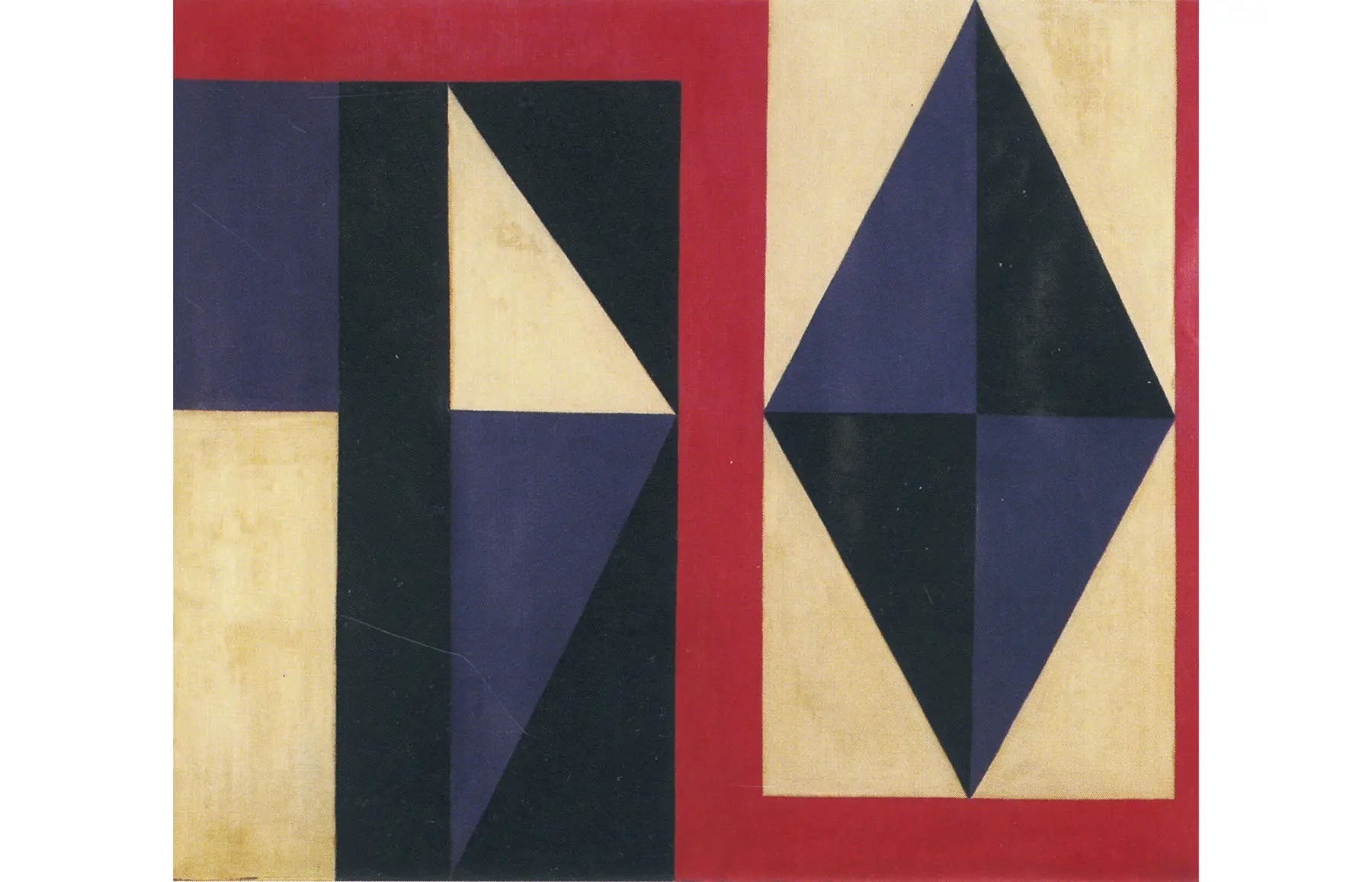
Two works contain the elements one needs to engage in such a calibration. In the first one, Shocking Pink #20, 1949, a zigzag band divides the plane into two zones apparently similar yet related, as a closer inspection reveals, not so much by their similarity as through their opposition. Whereas in the right section, the triangular planes have been organized in such a way that one can identify a diamond shape on a white ground, in the left, we are denied the apprehension of a defined figure. There, the planes, akin to those of the other section from a chromatic standpoint, no longer come together in a legible order; the order seems to have collapsed, and the planes encourage us to re-form it. The work thus examines in an arguably systematic manner its own capacity to generate a formal entity. But such a visual trajectory from the left to the right sides of the picture does not need to be arrested in the crystallized figure: it is always possible to trace it back, to go from the figure whose presence is offered to the viewer —whose presence is affirmed by its constructive order-back to its negation. In the jargon of structuralism, one could say that together both sides make up a paradigm, that is, a pair of terms related to being opposed. And given that language, according to the same school, is a system of paradigms out of which sense is generated. One may theorize that in this early work, Herrera proposes the specific paradigms —the other being the opposition between the work’s interiority and the surrounding space— that would henceforth determine her own visual language.
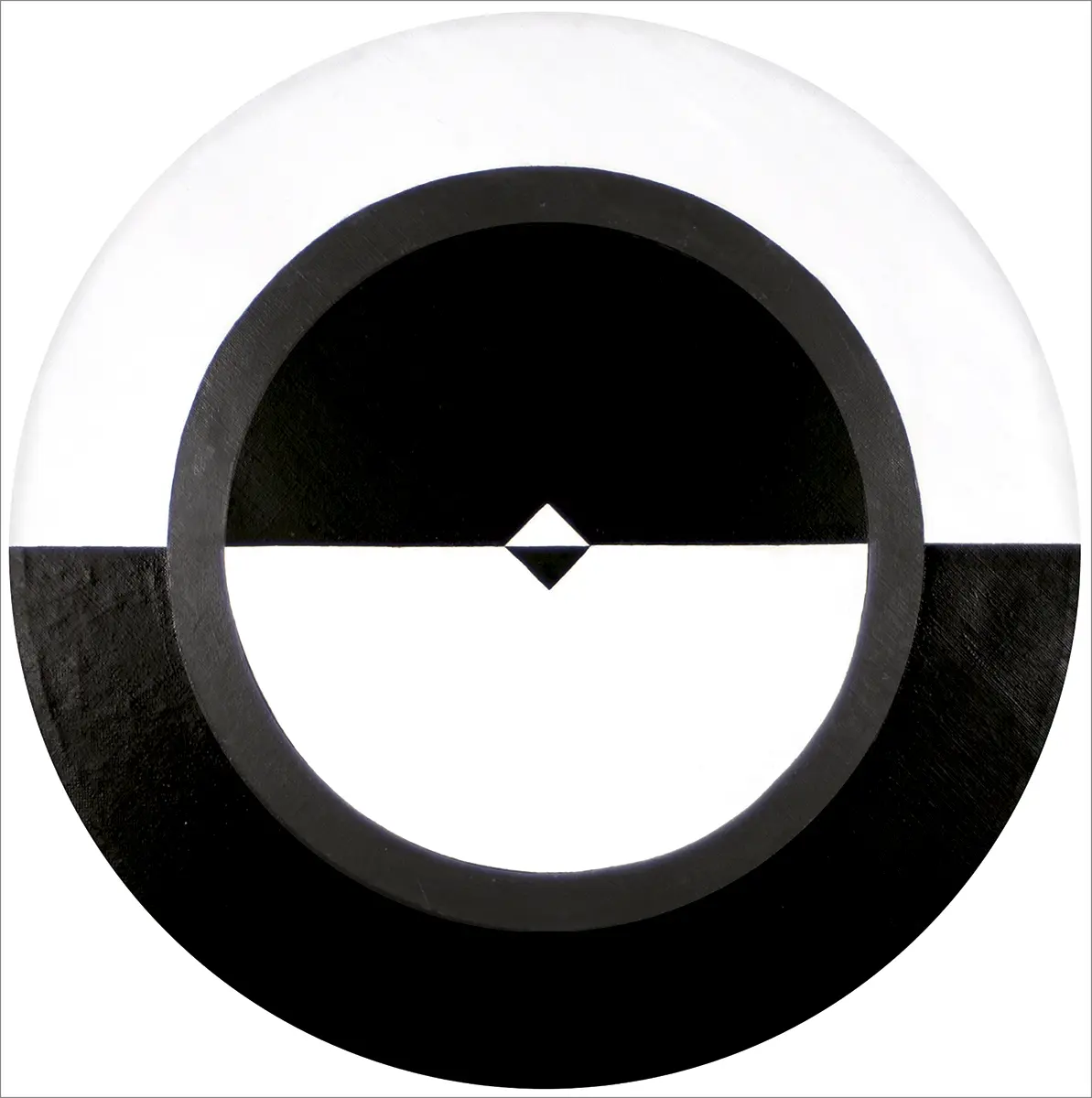
The need to rethink abstraction’s discourse in the immediate postwar moment was linked to a socio-political process of reconstruction. Herrera lived in France since 1948 and took part in that process when she exhibited between 1949 and 1952 in the Salon des Realités Nouvelles. This site served as the stage for the return to abstraction proscribed by the Nazi regime as entartete, “degenerate.”9 But such a return implied a critical transformation motivated by the contradiction between abstraction’s humanist ambition —its connection with a social project based on reason— and the fact that it was an exacerbated rationality that fed the war’s systematic machinery of control and extermination. It would have been impossible, therefore, simply to resume the path of abstraction at the exact point at which it was interrupted. Nonetheless, it is as a predominantly rational process that Greenberg conceived of abstract art’s critical capacity, demanding that painting be considered from within the painting itself according to a model that, ultimately, had been formulated when Kant used “logic to establish the limits of logic”10 The quote comes from a text published much later than the immediate postwar moment. Yet it confirms the position Greenberg held during those decades on the need to preserve the purity of the pictorial médium-threatened, in his opinion, by the kitsch condition of cultural objects in a then-emerging mass society.
The conjunction between the European and American context —the conjunction present in Herrera’s personal trajectory— seems to open up a space between two options that postwar abstraction would oppose: the non-critical assumption of enlightened rationality, and the affirmation of that other rationality, the market’s, at the service of the new culture industry. Such a double bind would express itself under different guises in postwar art. Barnett Newman’s work would explain the strange conjunction between, on the one hand, an almost ritualistic will to approach a sort of originary experience on which to re-found art and, on the other, the rational, empiricist, positivistic vocation toward verifying those formal conditions that define painting. In the work of Herrera, a close friend of Newman’s since she came back to this country in 1954, the terms would be different:
“We spoke about the nature of abstraction, its very essence. Barney felt strongly that abstraction needed a mythological or religious basis; I, on the other hand, wanted something clearer, less romantic and dark.”11

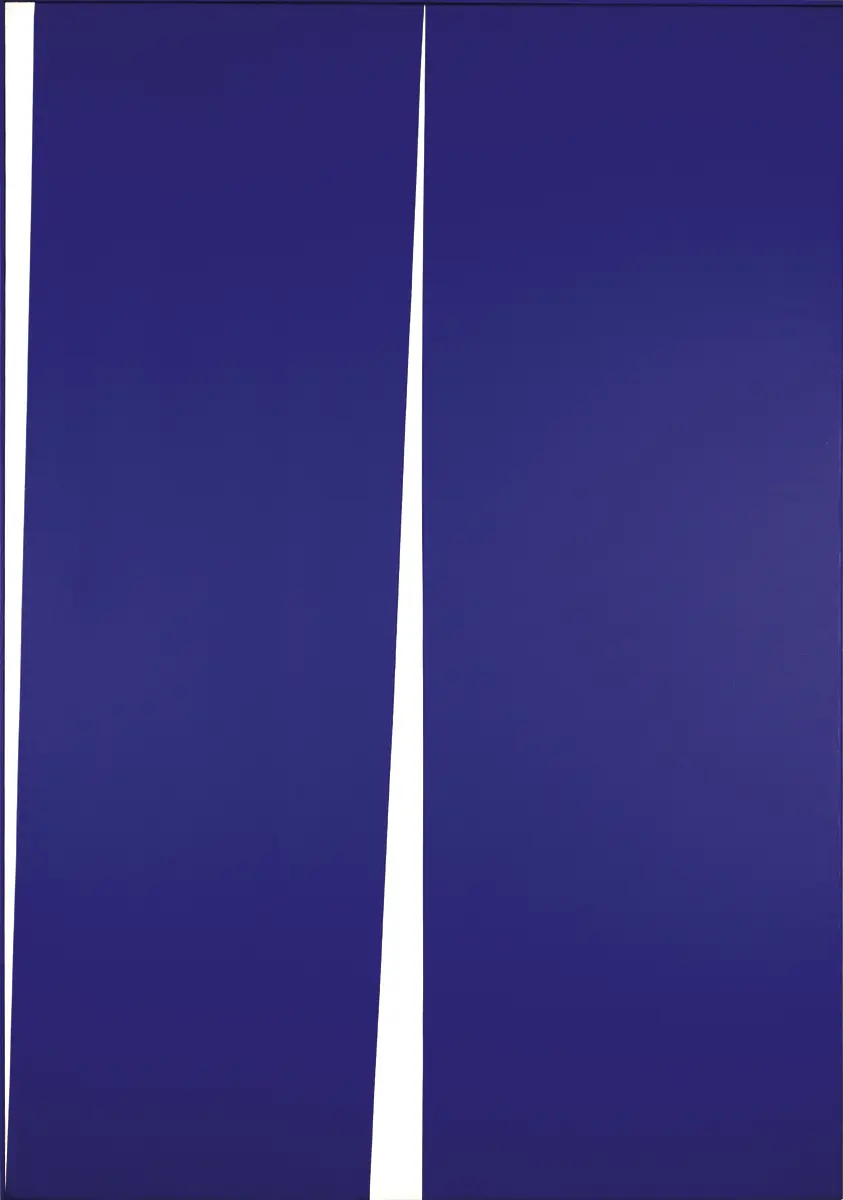
Yet to explore a rational order’s clarity does not amount to endorsing the position that Greenberg defended. This is even more true in Herrera’s practice: by incorporating monochrome painting into her work of the 1950s and 60s, the artist approaches that point where Greenberg locates the limit beyond which a picture would be no more than a simply stretched blank canvas, in his words, an “arbitrary object.”12 It is then, by assuming such a risk that Herrera is able, in such works as Blanco y verde (White and Green), 1959, to formulate a rational order. But instead of an organized whole whose formalizing possibilities are locked up within the latitude allowed by Greenberg’s positivism, what she attains is an order that opens itself to a dialogical relation with the order proper to the architectonic structure of its surrounding space.
The second work that will help me calibrate the specific character of Herrera’s work, Blanco y verde is properly speaking just an example of an extensive series, as revealed by the Miami Art Central’s exhibition. In these works, the limit between the white planes of the support and those of the wall loses definition, so that the green planes that interrupt the picture’s monochrome extension seem to “float,” to quote once more Foucault’s expression. Wedged onto the support, the color planes then appear deracinated, suspended in between two orders —the pictorial and the architectonic— that are thereby alternatively affirmed and negated. From that indistinct site where they float in suspension, the abstract inscriptions oppose discourse in a two-fold fashion. For on the edge between two formal systems, the bands prevent both painting and architecture from representing “themselves” within self-enclosed orders. Nor could one say that painting illustrates a discourse here —that of Greenberg and his school— as it happens in those modernist works that allege to verify their own formal conditions. It is not possible to affirm either of these things because the works break with representation, which is ruled, according to Foucault, by resemblance. They relate instead to architecture on the basis of a different connection, one that the French philosopher calls similitude: the painting does not resemble, does not represent itself, but establishes connections with its surrounding space so that the similarities between one order and the other are “multiplied [and] circulate” within a new space or upon a “common ground” that they themselves found, that is proper to them.13 Limiting itself to such a space, painting is diffused and edges on discourse, which is to say on silence.
NOTES
1. Michel Foucault, This is not a pipe, trans. and ed. James Harkness (London, Berkeley and Los Angeles: University of California Press, 1983), p. 23.
2. Clement Greenberg, “Towards a Newer Laocoon,” in Clement Greenberg, The Collected Essays and Criticism, ed. John O’Brian, vol 1. Perceptions and Judgments, 1939-1944 (Chicago: University of Chicago Press, 1980), pp. 22-38.
3. Quoted in Carmen Herrera: A retrospective, 1951-1984 (New York: The Alternative Museum, 1985), p. 4.
4. See Yve-Alain Bois, “Radical reversibility,” Art in America 76.4 (April 1988): 160-181.
5. See Grace Glueck’s review of Herrera in The New York Times, July 15, 2005.
6. Lygia Clark, “Death of the plane,” in Inverted Utopias: Avant-garde art in Latin America, Mari Carmen Ramírez and Héctor Olea eds. (New Haven and London: Yale University Press, 2004), 524-525.
7. In this respect, see Juan Ledezma on Alejandro Otero in the catalogue Contemporánea, Adquisiciones 1994-1998 (Caracas: Museo Alejandro Otero, 2000), 99-117.
8. The connection is made by Alejandro Anreus and other writers. See Anreus, “Carmen Herrera in the context of modern painting in Cuba,” Carmen Herrera—The Black and White Paintings, 1951-1989 (New York: Museo del Barrio, 1998), 16-20.
9. Ibid., p. 20.
10. Greenberg, “Modernist painting” (1961), in Modern Art and Modernism, A Critical Anthology, Francis Frascina, and Charles Harrison eds. (New York: Harper & Row, 1982), p. 5-9.
11. See Anreus, Carmen Herrera.
12. See Greenberg, “Modernist painting,” p. 8.
13. Foucault, This is not a pipe, p. 50.
*All images illustrating this article are courtesy of Latin Collector, New York.
JUAN LEDEZMA
Art historians focused on the art of the Russian avant-garde and on Latin American abstraction. Currently a Ph.D. candidate at Columbia University, New York.