
In 2003, when Javier Téllez resigned his official invitation to represent Venezuela at the 50th Venice Biennial -by way of an e-flux “open letter”- he spoke of standing “side by side with the excluded ones of our society.” Téllez described these individuals as “‘invisible’ subjects within the social fabric: the mentally ill confined in psychiatric hospitals, prisoners or the populations of shanty towns,” concluding that he had “never believed in the autonomy of the work of art over the social context.”
Refusing patronage from a government he considered intolerant and corrupt, Téllez identified ‘autonomy’ as the indispensable ingredient in both his personal life and work. In stark contrast, it is precisely the absence of personal autonomy that pervades Téllez’s Bronx Museum project. Through various media and multiple voices, the New York-based artist constructs a composite of overlapping subjugations -psychosis, drug abuse, institutional oppression, historicized racism, among others- but stops short of suggesting that autonomy is possible for any of his subjects.
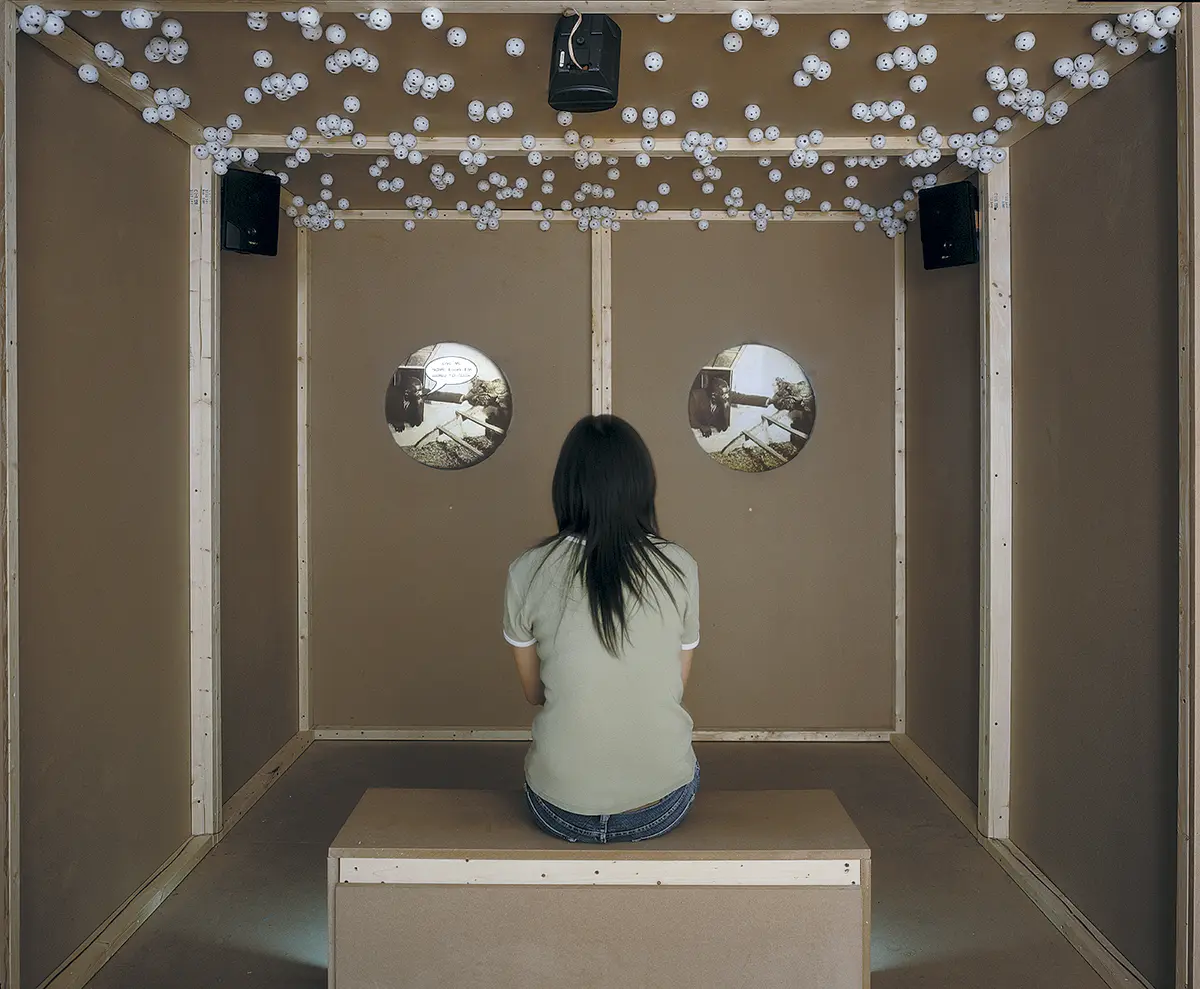
S-T-E-R-E-O-V-I-E-W, part of the Museum’s ongoing Conversations with the Permanent Collection, continues Téllez’s collaboration with the mentally ill, a topic that reflects his childhood as the son of two psychiatric doctors. This time working with the Bronx Psychiatric Center, Téllez conducted audio interviews, captured video inside and outside the institution, and invited patients to respond to the museum’s Stanley Burns Collection of nineteenth-century photographs of African-Americans, specifically vintage stereoscopic cards. The patients made up comic-style word balloons to give voice to the figures in the photos—primarily black children and adults suggestive of or outright depicting racist stereotypes.
To organize and present this material, the artist applies several motives -binocular sight and birds (the latter being the less original and quite unfortunate given the facile allusion to One Flew Over the Cuckoo’s Nest). In the center of the darkened gallery, Téllez has placed a human-scale “birdhouse” made of plywood. Two circular holes are cut to allow viewing (or perching—roosts are mounted under the holes on the outside). The stereoscopic cards, audio interviews, and video have been edited together to create a piecemeal montage, which is presented as two separate and nearly identical projections side by side on a gallery wall.
The binocular motif, suggested by the birdhouse holes and the dual projections, is clumsily made explicit in the video. In it, the patients (all men) speak calmly about life inside and outside the hospital. Sometimes nutty but often eloquent, their stories recount how they’ve learned to cope with their mental illness and status as, using Téllez’s term, “outsiders.” Gazing out barred windows through binoculars, the patients seem to like the ultimate insiders. Particularly poignant is a man who performs James Brown’s I Feel Good, singing and dancing down a narrowing, hospital corridor.
Between these segments are transition shots from outside the caged institution, accompanied by a heavy-handed soundtrack of twittering birds. The stereoscopic cards pop up randomly in the video and offer a silent rebuttal to the more fluid and audible meanderings of the patients. There are no apparent links between these materials, but it is impossible to disallow the bleed of information that naturally occurs. One image of a smiling woman nursing a baby carries the word balloon, “I wish she has solid food when I get older.” Another, of a boy posed by a pond, says, “Many people call me a half-breed bastard.”
We can imagine these lines spoken by the voices we’re hearing and woven into their stories of misery, fantasy, and compromised dreams. Yet since these voices are multiple—and many hands have stirred this collaborative pot—are we doing anything other than projecting our own conclusions? In all of this information, the author’s voice is fugitive, shifting, and ultimately unidentifiable. In fact, it is the only thing “autonomous” in Téllez’s project.
Inside the birdhouse, a hundred or more white plastic Whiffle balls are screwed to the ceiling in random clusters. Though these are famously popular as bird toys, they strike one in this context as stray thoughts pressing futilely against the cranium and other layers of confinement. There are many reference points offered in this sad, eerily quiet work but no central thesis to navigate their interests. We get stereo where mono is needed.
JOHN EWING