
Seven years after his last individual show in Caracas, and with the generic title of Obra reciente, José Antonio Hernández-Díez reappears with a new and attractive exhibition filled with keys for an understanding of who the emigrant artist is and what his current interests are. Deploying a universal language while signaling toward the national, Hernández-Díez continues to renew forms and assign meanings to unsuspected materials. But this time around he does not present his works under a forceful title that would indicate thematic and formal unity, as he did with his shows San Guinefort y otras devociones, 1991, or Soledad Miranda, 1998; rather, there coexist several aesthetic developments that have his private moments and his vision of everyday life as their starting point. The title may not forceful, but it is precise: all the works exhibited were made in 2005.
Autorretrato con pantalón and Autorretrato con franela, which move and make noise, are the two pieces that first grab our attention. These are two sculptors' machine installations that shake the artist’s used clothes, a flannel shirt and a pair of pants, respectively. The artisanal machines, built using old parts and motors from varied origins, are an event in themselves. They are built on the wheel and handle, with fewer bicycle frames.
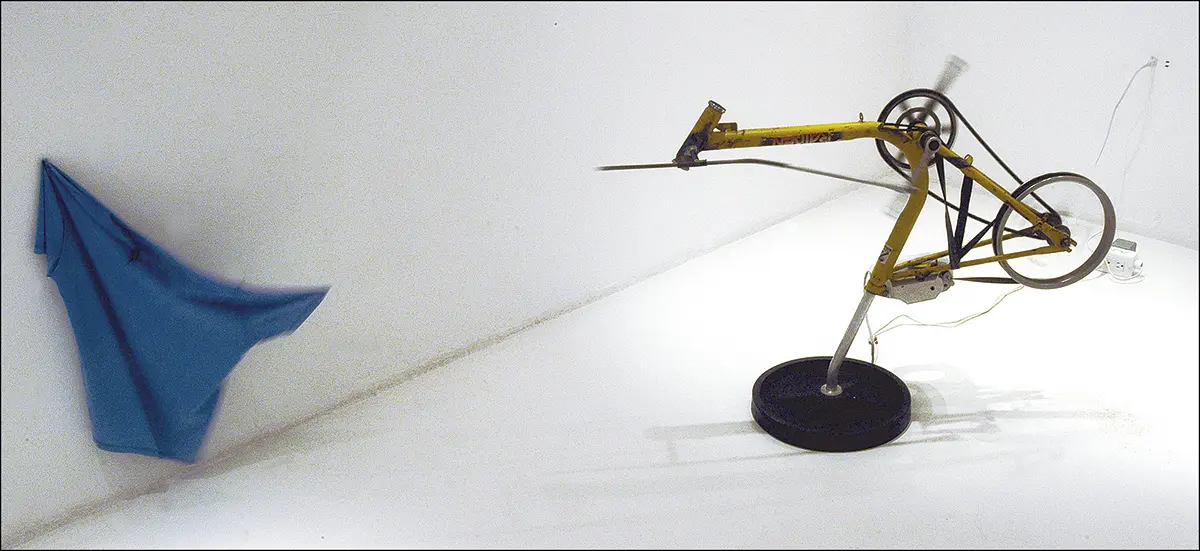
One of the machines uses as its motor an electric kitchen mixer, which makes a rubberless gear turn; inside the gear, small ornaments clink and clang. In turn, the gear moves the chain that connects to the pedals, from which an invisible thread projects and shakes a blue flannel shirt from one of its arms (the other arm is attached to the wall.) The base of the machine is a disk of the kind used in weightlifting.
In Autorretrato con pantalón, two machines shake a pair of blue jeans turned inside out from side to side. These machines do not use a bicycle wheel or gear; instead, a motor that seems like an electric knife moves the pedals directly. The chain hangs, useless, to the side. Equally useless are some rubber connectors that seem structural, which reveals an element of irony in the mechanisms. The bases are metallic feet like those of benches or high chairs.
Hernández-Díez’s ingenious and ironic creation of mechanized sculptures is far from a modern artist’s intention of incorporating technology into art and exploring the possibilities of motion. His machines are conceptual dispositifs and domestic technologies, made with what is found at arm’s length, with the remains of a more optimistic technology.
In the same line as the self-portraits, the show includes three large-format photographs of used clothing items in which the labels are foregrounded. We see the brand label and the instructions for care, slightly worn just like the cloth is. Hernández-Díez exhibits everyday objects that have undergone use, pushes, and pressures, just like the person who wears them, with the difference that the wearer does not come with instructions for care. The title of these photographs refers to this ambiguity; Cuidado, with different numbers (7, 8, and 9 are the ones on exhibit.)
Two minimalist sculptures/paintings rest on the gallery floor. Each is comprised of three boxes of “Maizina Americana” with its eagle logo, an easily recognizable image for all Venezuelans (“great national product” went its slogan, which comes to mind promptly.) The artist combines cardboard boxes with monochrome abstract paintings in order to create simple hybrid geometric volumes that are the product of pairing a typical element with a painting of an international character.
Two large portraits, titled Chica morena con gota 1 and 2, occupy an entire wall. On the dark faces, we see, in relief, the droplet (“gota”) mentioned in the title: a white, milk-like semi-sphere. The compositional element of the droplet reinforces the force of the subjects’ gazes.
The installation Carrera contra la muerte 2 is found in an orange-colored gallery. On the white floor, we see the representation of a trajectory, with orange spheres acting as landmarks. The runners are two strange figures in black granite, resembling bats. It is difficult to understand the meaning of all this until a well-versed observer explains that the black figures represent a kind of anal implement taken to an impossible size. Possessed of this information, the piece starts t acquire meaning as a journey towards our innards, and we understand that the competition is not one of speed, but one of size, in the direction of death.
That key was needed to begin to understand the meaning of this piece; there are likely other keys requiring interpretation in this show, like the meaning of that white droplet. The work of José Antonio Hernández-Díez is a challenge because it suggests meanings that are difficult to express and moves in the space of ambiguity, although with clear titles and within contemporary codes. The viewer emerges shaken by the turn towards the profound that every day has taken.
SONIA CASANOVA