
Although art is often discussed in spiritual or quasi-religious terms, it is rare that contemporary artists take on the roles of holy man, shaman, or seer as overtly as does José Bedia. The Cuban artist is a member of the Palo Monte priesthood, a sect of the Afro-Caribbean religion known more generally as Santería. Bedia has also studied with the Lakota in South Dakota and with indigenous communities in Mexico, where he emigrated in 1991 before settling in Miami in 1993.
When brought into the secular gallery setting, religious practice and symbolism can come off as merely illustrative or worse, gratuitous. Bedia has consistently avoided these traps by combining the vocabulary of spiritualism, religious practice, and art into a syncretic visual style not unlike his eclectic religious background. Bedia’s earlier black wall paintings and site-specific installations are utterly contemporary in their disregard for “white box” conventions, coursing across walls, ceilings, and floors with animal forms and symbol systems. Though specific religious content is no doubt lost on the uninitiated, the raw, nimble spirit that imbued Bedia’s works requires no translation.
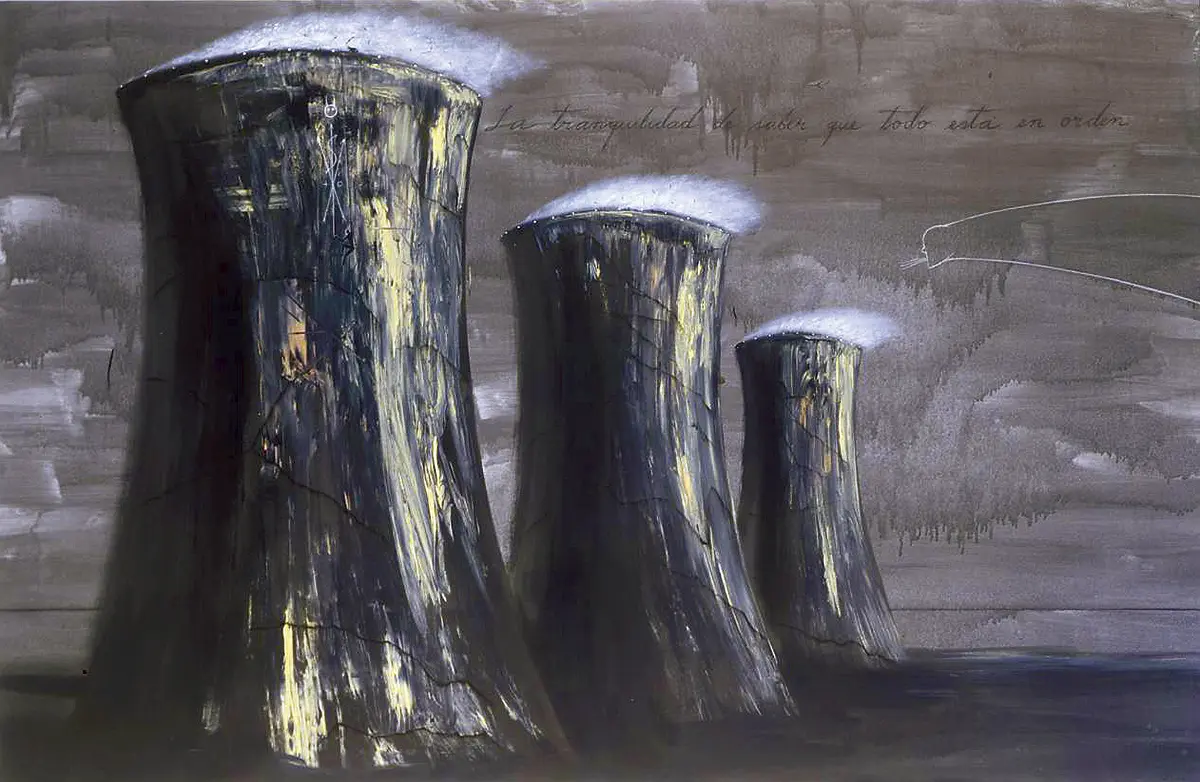
However, in this new group of five acrylic-on-canvas paintings –all roughly 5 x 8 feet in size– much of Bedia’s signature energy is hemmed in by the traditional painting format. Each picture contains the work’s title painted in white and is organized around a totem image of an industrial culture that Bedia infuses with a kind of animistic pathology. What the artist loses in outsize fervor, he attempts to make up in political critique and dark humor.
La tranquilidad de saber que todo esta en orden (The Tranquility of Knowing That Everything Is in Order) depicts a row of receding smoking nuclear reactors. The bruised palette of dirty blacks and grays —with thickly applied highlights of white, pale yellow, and peach— creates a brooding and toxic atmosphere relieved only by a tiny, mischievous-looking horned figure. Suspended from the top of a reactor, the black cartoon figure appears to be marking the surface with mystical symbols in white chalk, a common component of Santería ritual and a recurring motif in the exhibition.
In La vida pudo ser más simple (Life Could Have Been Simpler), the horned figures lounge and smoke on a surfaced submarine floating toward the viewer, its hull chalked up with religious symbols. Más rápido nos hará mejores (Faster Will Be Better) depicts a high-speed train lunging across the picture from right to left. The locomotive’s simple, stylized outline gathers an animate ferocity as its headlight bears down on a graceful, loping animal shape, not unlike the horned figures riding the back of the engine, which is also marked with religious symbols.
Eso no se queda así (This Will Not Remain as It Is) features a warship steaming toward the viewer with guns blazing—a dramatic image achieved with sharp dashes of acrylic applied by a knife. More horned figures lounge and smoke on the ship’s various decks, while a hovering orisha spirit rendered in chalk-white outline, holds a finger to its mouth as if to say shhhhhhhhh.
The last painting, Adonde no existe la muerte (Where Death Does Not Exist), is the most affecting of the five works. The central image is a huge, stonelike figure riddled with cracks that lumber across the picture accompanied by more of the tiny, horned creatures. The figure’s shadow, painted in the thin wash, appears to lead it toward an undefined destination. Where the other paintings present aggressive images undone by ironically understated titles and comic-horned figures, this last picture is heavy with genuine pathos.
True to the role of shaman or seer, Bedia seems to be suggesting multiple levels of existence—the dark landscape poisoned by greed and aggression; the carefree, horned interlopers who blithely negotiate the mess; and the watchful but apparently ineffectual spirits hovering over all. Bedia has treated the gallery walls with painted drawings that echo the relationships within and between the paintings (perhaps an effort to shake up the rather decorous look of the show).
There are also additional spirit outlines painted on the gallery walls —arcing, shapeless forms with faces— that float above the paintings in several places. As indicated by short lines coming out of their mouths, the spirits blow air. Whether this represents helpful intervention or capricious play is the airy ambiguity around which the show’s heavier, darker elements revolve.
JOHN EWING