
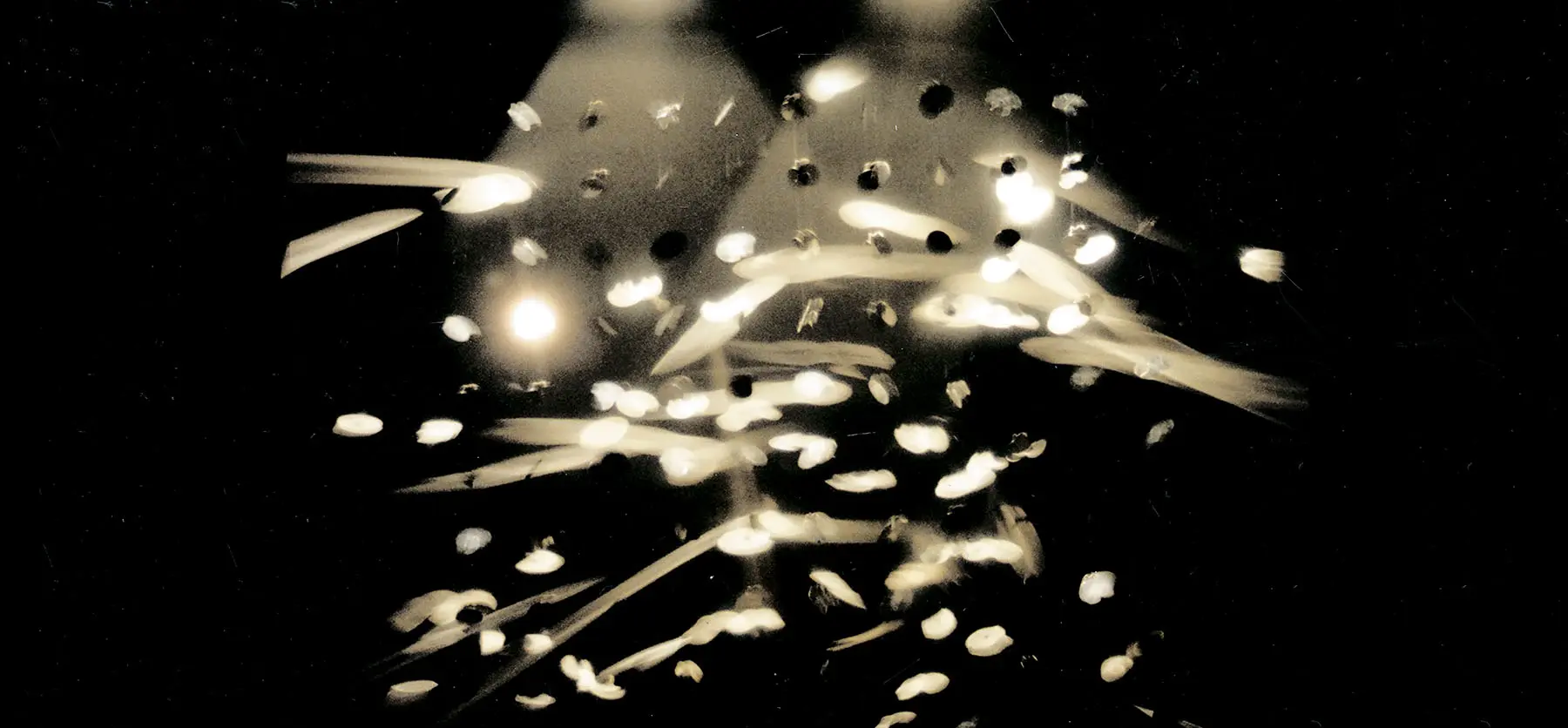
A group of emblematic
kinetic works made by Julio Le Parc in the 60s and 70s comprising
installations, sculptures, mobiles, light projections, and a series of
interactive objects opened in early June at the Daros Museum in Zurich. The
works were presented within the ample, blacked-out spaces of the museum as a
journey through an assortment of playful experiences, stimulating a sum of mind
states in the spectator far from the museological, lineal apprehension of
individual works of art.
Entering the black-painted room, the first piece on view is Continuelle lumière mobile (Continuous Moving Light) of 1960–1966. With this mobile structure hanging from the ceiling, Le Parc maximizes the movement induced by air onto the cascade of round stainless steel mobile circles to create a myriad of twinkling lights around the space with the simple means of directed light. Alongside this emblematic piece and bathed by its wandering reflections, a sequence of other mechanical structures delivering light projections summarises the kinetic developments that are the fruit of the witty invention and pervasive playfulness that characterizes the artist's body of work of the period.
Julio Le Parc was born in Mendoza, Argentina, in 1928. In 1942, when he was still an adolescent, he moved with his family to Buenos Aires, where he studied at the Manuel Belgrano Art School under the tutelage of Lucio Fontana. It was precise during those years that Fontana was in the process of formulating his groundbreaking White Manifesto while sharing his ideas on spatial with his students, who as Le Parc recalls, were made responsible for signing the manifesto.1 In it, Fontana advocated an art made with the help of scientists, whose research should be directed “... toward the discovery of the luminous and malleable substances and the sound-producing instruments which will make possible the development of tetra dimensional art.”2 In an attempt to materialize these principles, Fontana developed a series of experimental works in the 1950s which incorporated filters for light projections and movement from television emissions.
After his formative years, Le Parc obtained a grant from the French Cultural Services which allowed him to travel to Paris in 1958, where he still resides. In Paris, he met Vasarely, Vantongerloo, Morellet, and Denise René—nicknamed La Papesse de l’Art Abstrait—the French dealer committed since 1944 to the promotion of abstract art and who a decade later helped launch kineticism. In 1960, Le Parc became one of the founders of the Groupe de la Recherche d’Art Visuel (GRAV). The group, formed by the artist along with Sobrino, Yvaral, Morellet, Stein, and García Rossi, proposed collective strategies devised to delegate the creative act to the viewer/participant. The principle of stimulating the creative force within humans—also enunciated by Beuys in his legendary "Everybody is an artist" mantra—became a deep preoccupation for the group, who advocated for art to play a wider, more active role in society. Judging by Le Parc’s theoretical formation in Argentina, the seeds of GRAV’s artistic and social concerns could be found in a succession of collective initiatives such as MADI, and Grupo Concreto-Invención, which blossomed in the River Plate in the 1940s and produced an array of breaks in formal and conceptual conventions, ranging from the challenging of boundaries between plastic forms to the displacement of art from the gallery space to the public sphere.
Through the 1960s, GRAV articulated a thorough theoretical corpus in the form of manifestos among which was the seminal No More Mystifications, written in 1961 and distributed in the form of pamphlets in the Paris Biennale that same year. The manifesto defined with great clarity the main concerns of the group:
“We want to develop in the spectator a powerful ability to perceive and take action. A spectator aware of his power to take action and tired of so many abuses and mystifications will himself be able to create the true 'revolution in art.' He will put into practice the slogans:
It is forbidden not to participate.
It is forbidden not to touch.
It is forbidden not to break.”
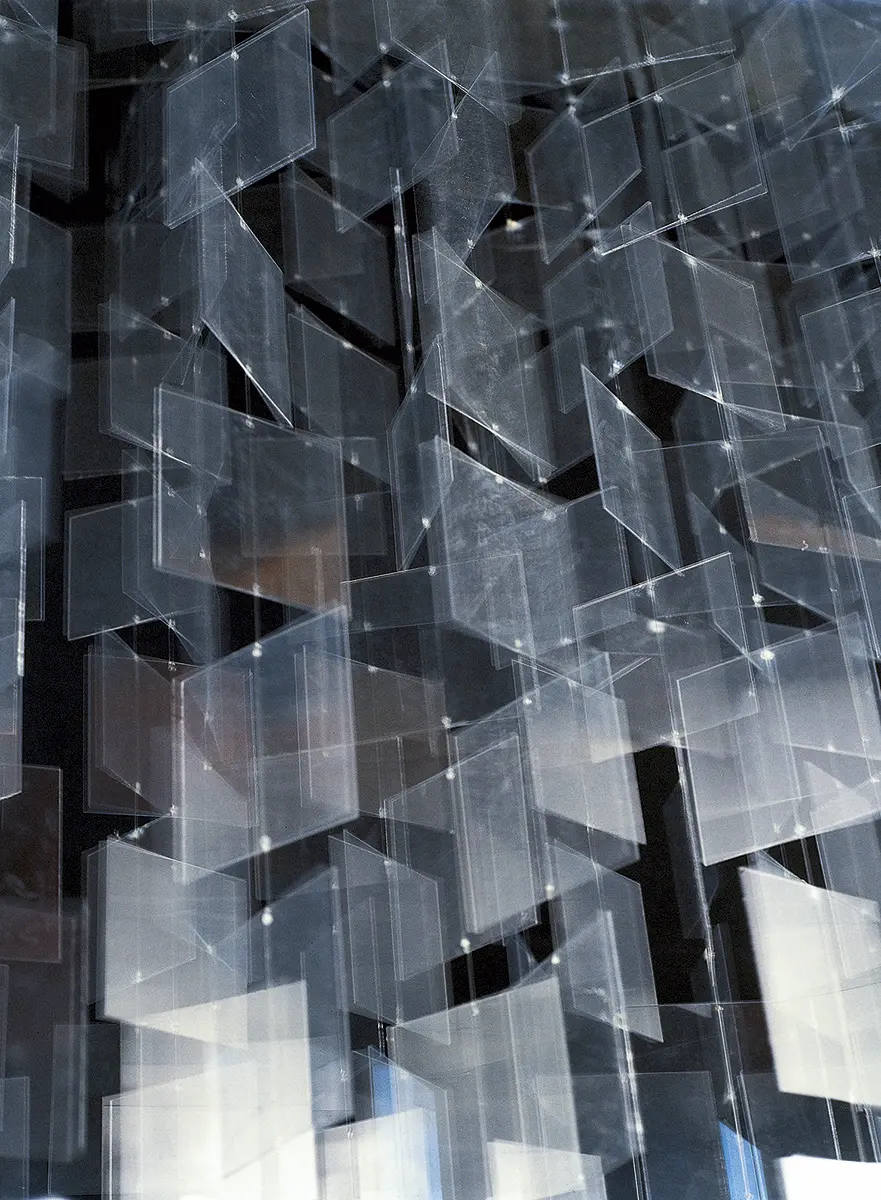
Alongside these ideological developments, Le Parc began a series of paintings based on the investigation of multiple permutations of fourteen colors in a mathematical way. He embarked on the analysis of the multiple sequences of color and the consequent visual instability to arrive —with the use of movement produced first by the superimposition of acrylic planes (optical), and then by simple mechanisms— at the employment of direct and lateral light as his main material. During those years, he built the first mobile structures that consisted of wooden boxes with simple mechanisms activated manually to produce rotation and progression, elements that he continued to explore throughout the following two decades. In 1965 he began to employ reflective surfaces such as glass mirrors —that he would later replace with stainless Steel— and would invent devices such as special shoes, unstable surfaces to walk over, and sets of glasses to produce psychedelic visión, Lunettes pour une vision autre, that he would present as playful tools to induce perceptual experiences. Those early experiments, first presented in Buenos Aires at the Instituto Di Tella Experiences exhibition of 1967, were reconstructed for the Zurich show to the great delight of the audience.
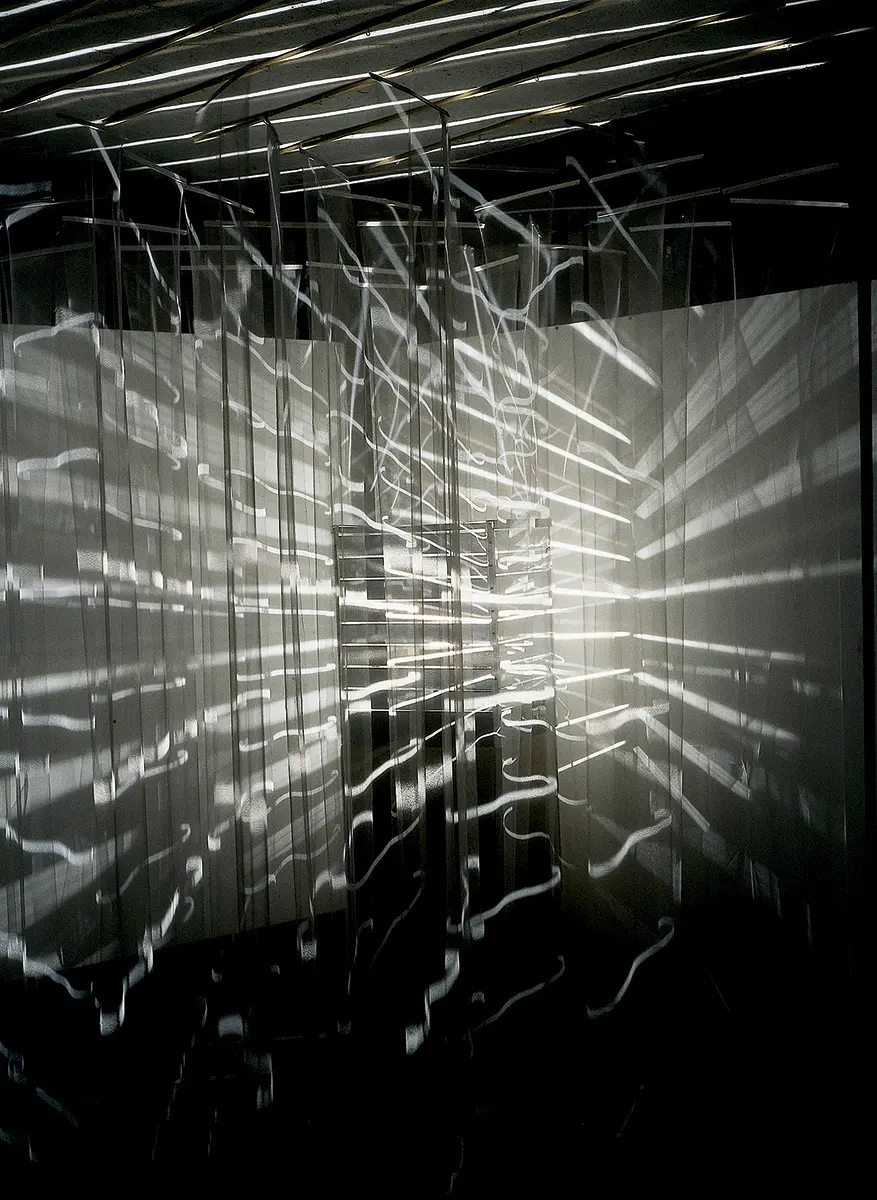
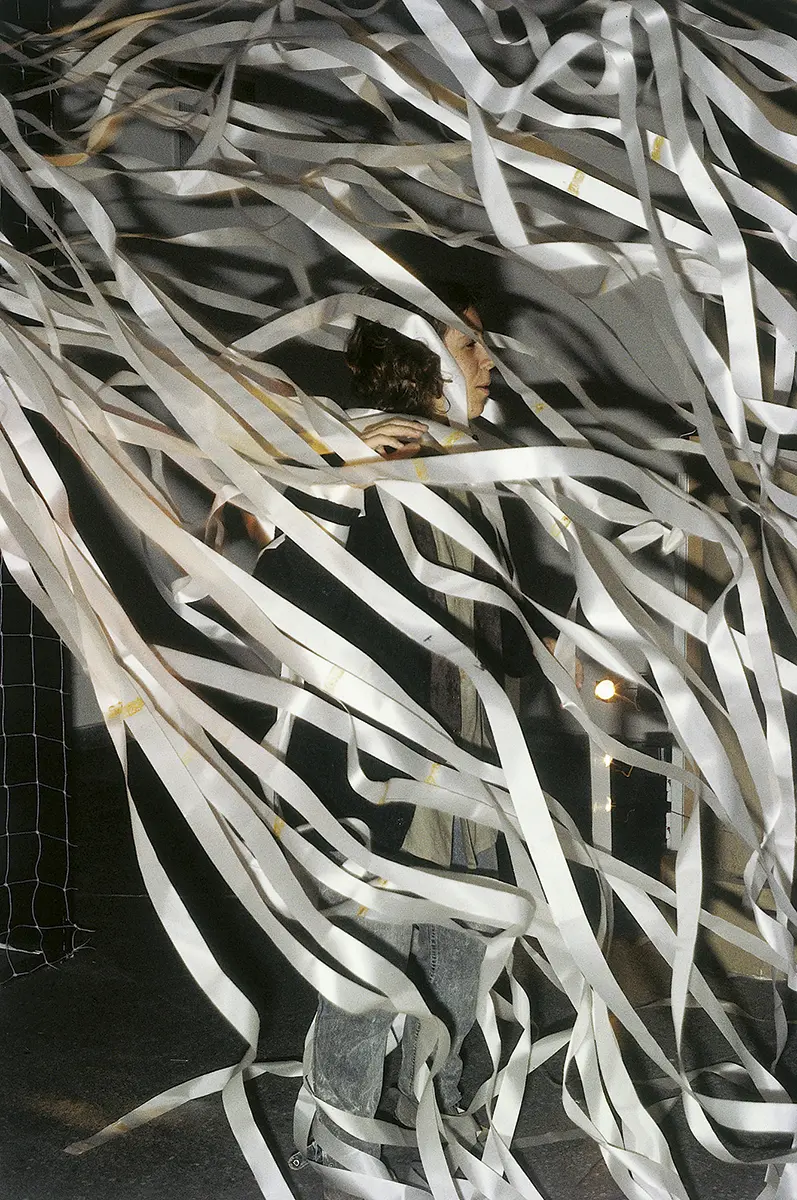
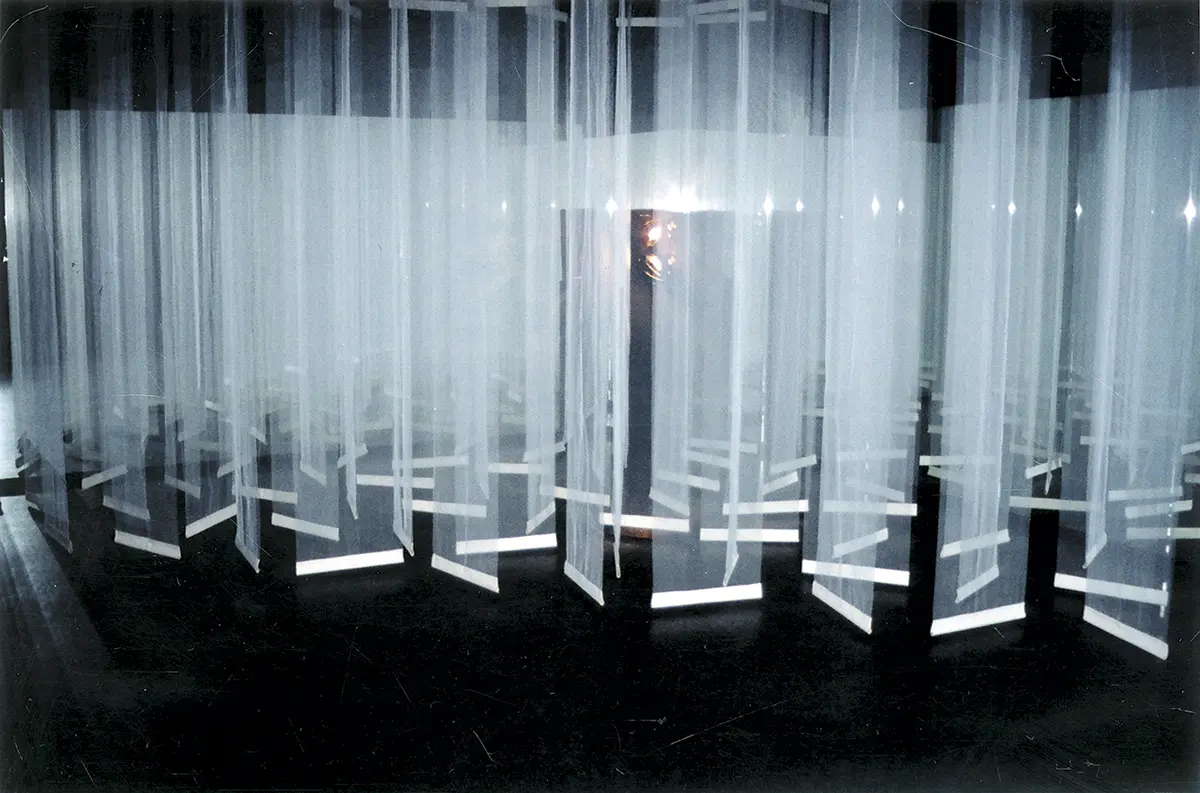
Another work created in 1963, presented at the Di Tella exhibition, and rebuilt in Zurich is a truly enjoyable labyrinth, an installation in two parts that fully materializes the principles of physical interaction of the viewer/participants with artworks advocated by GRAV. The maze consists of two environments made with mirrors: Cellule à pénétrer and Cellule avec miroirs curves et lumire en mouvement, (Cell to Penetrate and Cell with Curved Mirrors and Moving Light) 1963–2005. One of the spaces is dominated by a curved stainless steel mirror hit by a series of pulsating lights, and the adjacent space is like a forest made of twenty-five moving double-sided mirror strips hanging from the ceiling, which produce a kinetic landscape of human presences, their reflections, and light. In later years, the piece would be identified as a Penetrable, echoing the creations of other artists whose investigations of spatial structures and the relation body-artwork also produced similar structures: Hélio Oiticica and Jesús Rafael Soto, for example. The piece was first presented at the Paris Biennial, alongside other propositions of activation by the public, such as “walking pillars”: simple plywood columns inhabited by participants that moved through the exhibition space that, as the artist recalls, frightened André Malraux, then French Minister of Culture, during the opening party.3
But it was not until 1966, after winning the prize at the Venice Biennial that Le Parc was given his first solo exhibition in Paris in the gallery of Denise René. That same year, GRAV produced a text on the issue of multiples that would be of great importance for subsequent generations. His own work of the period developed in different formats, incorporating new elements such as pulsating lights, while continuing to test ideas of fetish value against the role of art in the social field, and denouncing the criteria imposed by academic elites. Those principles, which more broadly became some of the preoccupations of kineticism, were manifest in street actions where GRAV would generate unexpected activities such as A Day in the street, program on April 19, 1966. The activities recorded on a hand leaflet included walks on moving tiles, walking with flashlights, distribution of balloons, spontaneous funfair-style installations such as giant kaleidoscopes, and gift granting to underground commuters.
Defying the challenges imposed by history and fashion, Le Parc the ideologue continues to operate in the same field of social activation through the creation of participatory events that might take the form of exhibitions, symposia, or workshops. In this spirit, he conducted several experiences with art students in Havana, Cuba, in the early 1980s, where he proposed the visual improvement of the urban landscape. More recently, on a visit to his native Argentina, he participated in a seminar that congregated the contemporary art collectives Escombros, Mondongo, and Eloísa Cartonera among others, to discuss urban interventions and social participation in the Centro Cultural General San Martin of Buenos Aires. The seminar coincided with the restoration of his public work Desplazamiento (Displacement) of 1967, which had been donated to mark the opening of the Cultural Centre in 1970. The seven-panel self-standing structure is one of the most remarkable examples of optic art of the period and continues to bring back with its reflective qualities the possibilities of interaction, physical enjoyment, and playfulness that Le Parc wished for in his long life devoted to giving us the gift of magic.
NOTES
1. The artist was in conversation with the author in Zurich on June 4, 2005.
2. Lucio Fontana, White Manifesto: We are Continuing the Evolution of Art, Buenos Aires, 1946.
3. The artist was in conversation with the author in Zurich on June 4, 2005.
*All images illustrating this article are photographs of works from the Daros Latinamerica Collection, Zurich.
GABRIELA SALGADO
Curator on Latin American art, London.