
Bogotá’s Cu4arto Nivel gallery presented in the months of May and June Labores de Amor, a show by young local artist Pablo Adarme, curated by Jaime Cerón.
Adarme, a 2000 graduate of Jorge Tadeo Lozano University and an active figure in Bogotá’s art scene, prompted with this show a series of reflections about his work.
A clarification is needed for the appropriate understanding of Pablo Adarme’s strategy. In Colombia, the concept of DIY construction defines an architectural topology employed by the least privileged classes as a means and method for the building of their houses. The terms make explicit the technique used and can be distinguished by a series of particularities in its characteristics.
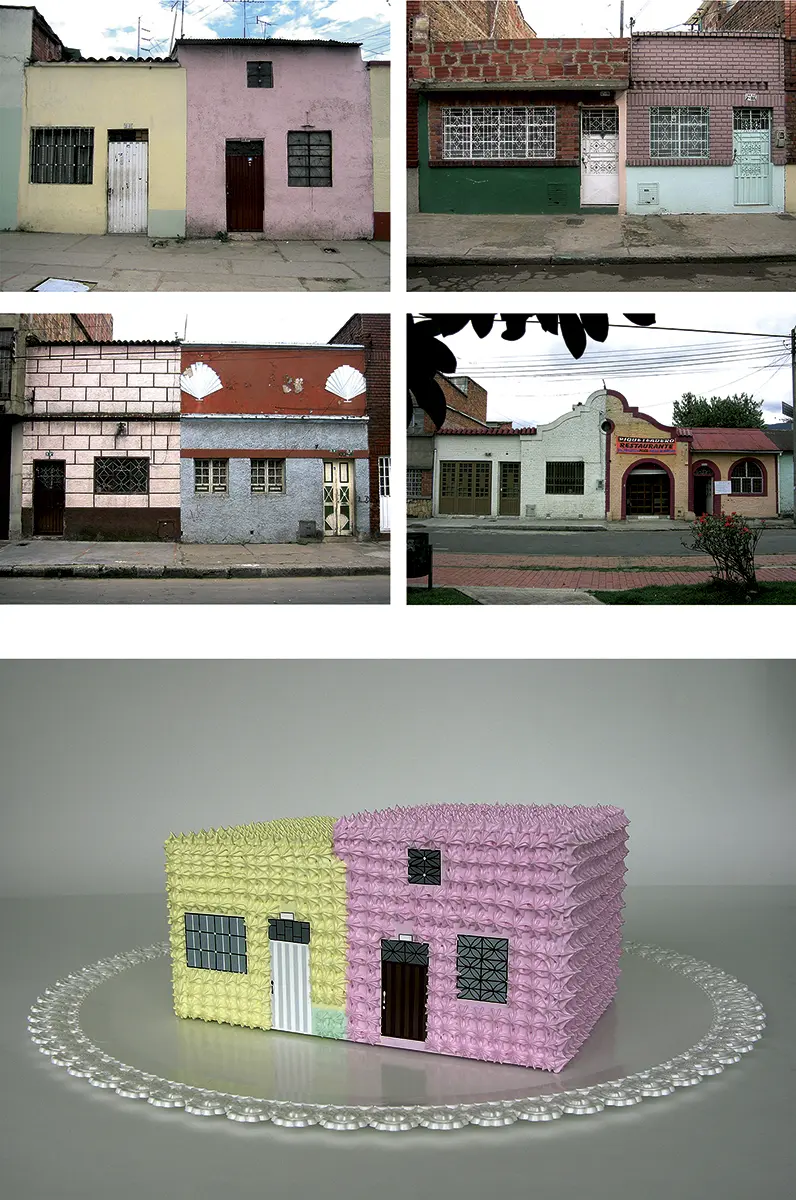
GO, a free-time guide defines this typology in the following way:
“The architecture of the capital’s popular neighborhoods presents a pretty aesthetics dictated by the façade of family homes, where a small or medium-sized income promotes the construction of story upon story (...) like a multi-layered wedding cake, where the uppermost layer becomes the most important one.”1
Normally, these units have a street-facing front and three sides that border, wall to wall, with the neighboring homes.
In this way, the façade becomes the differentiating element and is worked according to the image the family wants to project to the community. Under that principle, the inclusion of decorative elements in the application of drywall, paint, windows, wrought-iron fences, and doors, become elements of equal or greater importance than the solidity of the structure or the sheltering qualities of the walls. The result of reading a neighborhood built under this architectural typology is joyful, spontaneous, diverse, and possesses a strong personality.
In Labores de Amor Pablo Adarme adopts this reality as his paradigm, taking specific examples collected during his experience in Bogotá’s Venecia neighborhood in order to establish a general aesthetic judgment. Popular architecture becomes, then, the raw material for a project that, through the fusion of sources and disciplines, allows for different readings that move always within the boundaries of the aesthetic territory.
According to Jaime Cerón, in the text that accompanied the show:
“This translation of architecture into pastry involves the recognition on the part of the artist of a whole set of cultural conceptions that describe the ways in which the members of a particular community find collective affiliation principles and appropriate other communities’ cultural experiences.”
A series of five works copy in detail the architectural model and transform it into delicately confected cakes. Works that Adarme commissions to pastry professionals who replace cream, sugar, and chocolate with acrylics applied with confectionery sleeves to a wooden model. These five pastel-colored cakes that at first glance confound the eye with their highly defined details and their fidelity to their model, suggest a subtle feeling of hunger and signal a festive day.
In terms of strategy, the project generates an effect of complicity with the viewer, giving the value of beauty to what for some is an affirmation of self, and for others is a demonstration of aesthetic principles that fall within the realm of kitsch and are subject to ridicule, but Adarme goes beyond that.
His discourse dislocates an exhausted redundancy about social differences, pointing towards the collective recognition of a spontaneous fact. A detailed analytical glance deriving from creative exercises that multiply the plastic alternatives to the application of two crafts, transforming an object into the preciousness of the miniature and the impact of a monumental work of art.
The display at the gallery attested to that: five stainless-steel round tables, typical bakery, and tea-room furnishings are the support for the cakes and for their respective photographic register/model. The walls are painted a pale pink, reinforcing the use of “pastel hues,” and five photographic testimonies of the process, watching over the results of a finished process.
In this show, Pablo Adarme makes clear to the viewer that what is understood as monumental does not reside in size alone but in the definition of a good idea and the plastic strategy of its construction.
NOTE
1. GO, Guía del ocio. Medio Graph Editions, June 15-July 12, 2005. Edition No. 3. Bogotá, page 12.
ESTEFANÍA SOKOLOFF