
On the occasion of the one hundredth anniversary Pablo O’Higgins’s birth (1904–1983), the Old San Ildefonso School (Justo Sierra # 16 in Historic Downtown) presented the exhibition Voz de lucha y arte, from October 2004 through February 2005. This show brought together a significant number of works and documents that complemented the careful selection of more than 250 pieces that, among drawings, lithographs, encaustics, oils, and fragments of murals in the process of being, highlighted the artist’s importance in our country.
Pablo O’Higgins attended the San Diego Art Academy in California, but he dropped out after a few months because the school’s methods struck him as excessively classical. He was searching for a way to express himself; he wanted to communicate, had found the means to do it—painting—but had yet to find his message. Interested in Mexico’s political, social, and artistic effervescence, he decided to write Diego Rivera about his interest in what the Muralists were achieving.
O’Higgins arrived in our country in 1923 determined to join the Mexican artists’ struggle. They had found in art a medium to express their ideas of revolution and national identity. Rivera quickly warmed up to O’Higgins and introduced him to the guild. O’Higgins learned mural techniques from Rivera and the two of them worked together until the younger artist’s hand loosened up. He joined cultural missions around the country and taught people to read and write as well as paint. He supported the workers; he knew and painted them, was aware of their problems and needs, and was always prompt to offer his hand to those in need. He studied the work of José Clemente Orozco and José Guadalupe Posada. His own work was forged under the undeniable influence of our country’s most notable artists. In the mid-1930s, O’Higgins started on the path towards the maturation of his own style where nature, people, work, social injustice, and the struggles of the people infuse every forceful and decisive brushstroke with a spirit of protest.
The show at San Ildefonso was carefully documented with letters and manifestos signed by artists like Leopoldo Méndez, Alfredo Zalce, Fernando Gamboa, and David Alfaro Siqueiros, among others. Also on exhibit were examples of agitprop literature created at the Liga de Escritores y Artistas Revolucionarios (LEAR) since 1934 and out of the Taller de Gráfica Popular (TGP) established in 1937, both of which had O’Higgins as their cofounder. These anti-fascist pamphlets carried extremely clear images to which the artist had to apply all his knowledge and technique since a poorly-argued idea could lead the message astray. Some of the gallery’s walls and partitions were painted in red, establishing a subtle allusion to the socialism that characterized this moment. In the main space, large-format explanatory cards illustrated the most salient events in the artist’s life with a timeline.
The physical presentation of some restored fragments of murals in one of the galleries, as well as the projection of O’Higgins’s murals at the Abelardo Rodríguez market, were important enhancements to the show. The highlights of the main selection are a series of pencil sketches on paper, in which the artist’s hand loosens up and gains greater determination, his style becoming more evident in the bodies of workers and peasants often portrayed as they carry out their work in extreme physical conditions.
Among the show’s most notable oil portraits is María, estudio en blanco (oil on linen, 1965), which captures the likeness of María, the artist’s wife, wearing her wedding dress against a white background. The artist applies well-defined lights and shadows in white-on-white. His long and fluid brushstrokes demonstrate skill and technique. He uses different hues or saturates the linen with pigment in order to generate volume and movement. Sharing the gallery space were O’Higgins’s portraits of Mariana Yampolsky (oil on linen, 1962), in greens, and of Leopoldo Méndez (oil in linen, 1953), with red background; both artists are presented with their eyes on a piece of paper and a pencil in their hand, drawing.
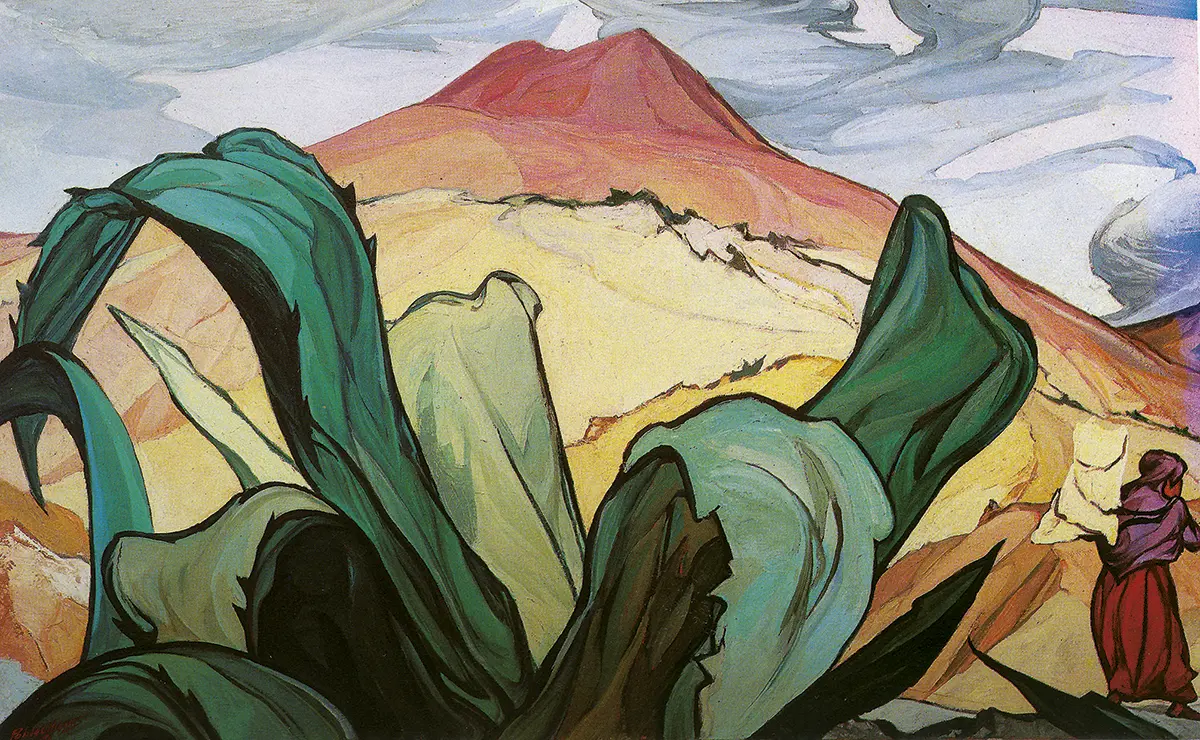
O’Higgins’s rural landscapes, such as Alrededores de Milpa alta (oil on linen, 1969) and Milpa alta (oil on canvas, 1976), possess a spectacularly colorful palette of ochres, greens, blues, oranges, and pinks. The majestic green maguey in the foreground comes alive and becomes the composition’s protagonist. In the background, a red and orange volcano lies majestically before the grayish panorama of the sky. This image brings to mind Gabriel Figueroa’s cinematography in Un día de amor, where the image of a living maguey plant is represented in black and white with a chiaroscuro contrast of mountains in the background, framing the same image from a low angle. The influence of artists like Van Gogh is evident in paintings like La carreta (oil on linen, 1966), both in its quick brushstroke and in the object represented.
The contents of this exhibition were suggested by a chronological line that in turn was framed by the different techniques used by the artist. The last gallery displayed computers for the viewer to access further information about the works, as well as biographical data and historical context, in a greatly didactic way. Despite the fact that exhibitions of O’Higgins’s work tend to privilege content, namely, his themes of social struggle and justice, form is equally important in his case: one needs to consider his brushstroke and his compositions, which are very important in any understanding of the artist’s work.
This show fulfilled its mission of showing the historical environment of the nation in which O’Higgins’s painting developed, as well as his political and social preferences.
VALERIA BRACAMONTES