
In recent years, the Palacio de Cristal in Retiro has been used for contemporary art exhibitions with mixed results. The building is entirely transparent in emulation of London’s famous Crystal Palace built by Joseph Paxton in 1851, and coexists in a complex way with current art and, in general, the best results have been achieved by the more discreet interventions—with some exceptions, like the shows by Panamarenko and Cildo Meireles. Regina Silveira also employs a great economy of means and centers her proposal on the primordial element that informs both her work and the building itself: light.
Taking advantage of the site’s iron-and-glass structure, Silveira developed three distinct but complementary pieces that, under the title of Lumen, modify and visually affect the place more than merely occupy it.
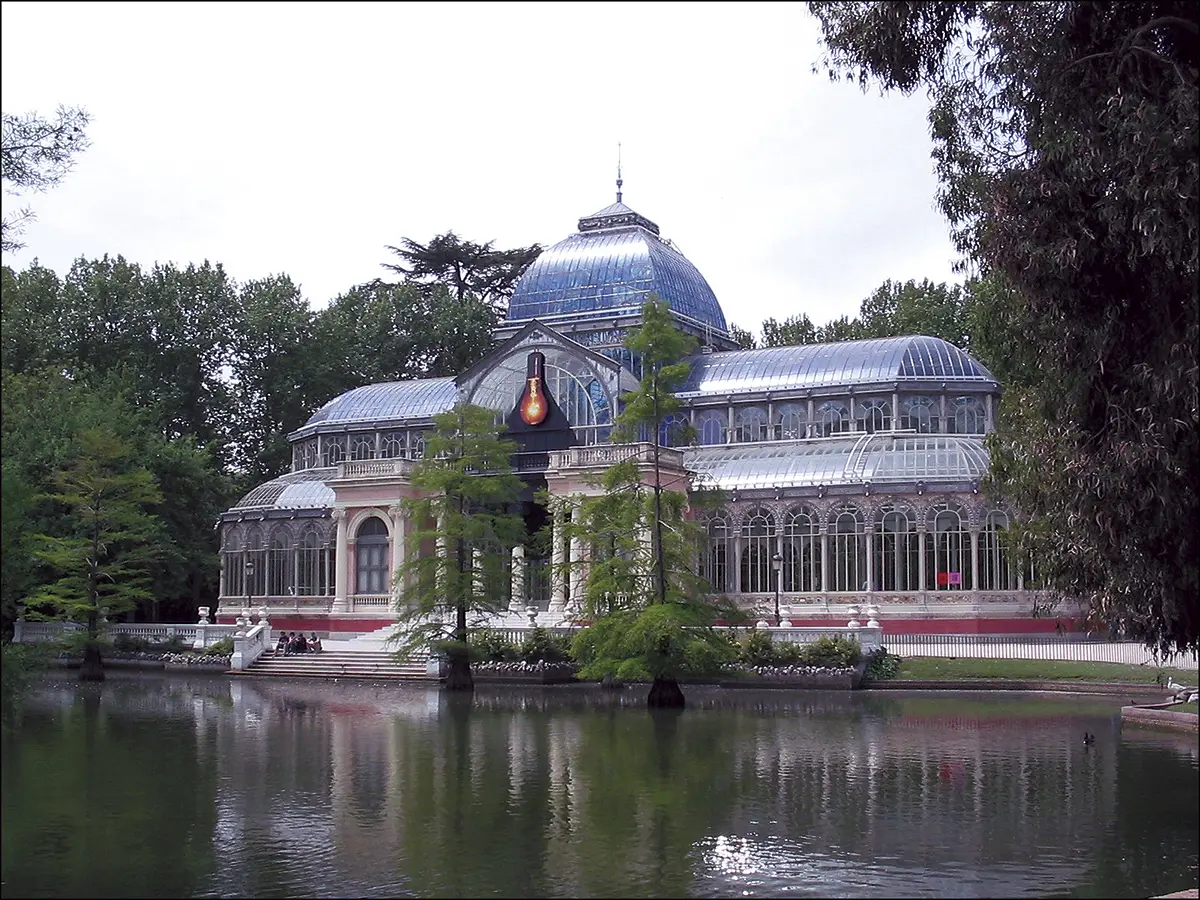
At the entrance we find Quimera. It is the image of a giant, illuminated light bulb that instead of projecting light, projects an enormous shadow on the front façade that provides access to the Palacio. The image is in itself a paradox, a lit light bulb out in the open that somehow turns the transparency of the Palacio into a virtual interior where, unlike a closed and opaque space that needs to be lighted, the large shadow functions as a metaphorical counterbalance for the excess of luminosity that is characteristic of the site. The working process developed by Silveira in preparation for her project consisted of drawing on large photocopies of Palacio’s architectural plans. In fact, her large vinyl light bulb and its shadow are a sort of “drawing” on the façade, one that nevertheless works better, visually, in photographs taken from a distance, where it appears as a plane covering a large portion of the entrance.
One of the Palacio’s domes has also been covered with a transparent, blue vinyl adhesive, on which the word “LUZ” (“LIGHT”) has been carved. It is only through the giant letters that we can see the sky, and the space recovers its original transparency. The rest of the intensely blue vinyl works again as a kind of “artificial sky” in contrast with the real one seen through the carved letters. This piece, titled Transluz also works as a drawing, literally writing on space. In a way, Silveira plays with the building’s transparency; the building itself is transformed into a kind of diagram, a structural plan on which to draw, trace, and color that results in two reiterative pieces where the transition from drawing to three-dimensionality detracts from the aesthetic result.
In contrast, Memoriazul, the central piece that occupies the whole cover of the building’s transverse axis, is effective in all of its postulates. Like the two previous pieces, Silveira has covered the domes with adhesive vinyl —in this case translucent— on which she has printed photographed fragments of the Palacio itself: iron and glass veins at various angles and at different times of the day so that different hues of blue are produced directly by the sky through the windows at the time they were photographed. The fragmentation and juxtaposition of these images produce, in an aleatory fashion, an effect similar to that of broken glass. Looking upward, the composition seems to congeal the fictional image of the collapsing domes. To the geometric order that indeed supports the building, Silveira sets in opposition a fictional image that is chaotic and explosive —albeit serene— and that possesses great beauty. The fundamental element in her proposal, light, also generates a multitude of refractions in blue hues that forcefully occupy the interior of the Palacio. This effect is reiterated by a reproduction of the intervention above on the floor, which also becomes, through the use of adhesive vinyl, a false glass space.
In general, Silveira’s proposal is difficult to appreciate if one does not pay attention to the small atmospheric changes generated by the interplay of light and transparencies. While Quimera and Transluz are extremely literal, Memoriazul is, on the contrary, a subtle piece that requires time and contemplation. Perhaps the greatest virtue of the intervention as a whole is the way it plays with the dimensions of the Palacio de Cristal as if it were a model, and transforms it into the subject of the intervention, creating a kind of tautology where glass and light establish an interplay of reflections and refractions that, contrary to the majority of interventions that seek to connect space with its natural surroundings, in this case, causes it to close on itself, as a transparent and diaphanous floating bubble.
ISSA Mª BENÍTEZ DUEÑAS