
Discípulos, an exhibition of work by Puerto Rico-based Cuban artist Rigoberto Quintana, was on display at the Museo de Arte Contemporáneo in San Juan from May 20 through July 26, 2005. This exhibition includes seven desks of the kind used in schools placed atop small pedestals and arranged so that their backs are turned towards a blackboard with white lines. The pedestals elevate these traditional school items from the gallery floor as if they were sculptures. From their height, the desks seem in turn to elevate school-age graffiti to the category of artistic subjects. This issue, suggested at first glance by the images painted on the desktops, is a timely allusion to one of the shapes assumed by the student’s own critique of education and of current teachings through the resources of anonymous graffiti. These desks, built using industrial materials with their tops painted by Quintana, are constrained in the installation by a scheme, a painstaking order, and the museum’s aseptic, immaculate space. The suggested contrast between the blank blackboard that lacks a written lesson, and the desktops covered with images is a contrast between the rigor and the authoritarian discipline of modern pedagogy, and the informality of postmodern education.
An artist and a teacher, with the blank blackboard and the images on the desktops Roberto Quintana, seem to allude to the way in which today’s students value the education he received as a student, which was characterized by hard work, self-sacrifice, and the need to follow strict norms. Contemporary students don’t seem to be interested in whatever is written on the blackboard; rather, they create their own “lesson” in the images on their desktops. The written word disappears from the realm of the visual. An enlightenment-based education is questioned by a student body that does not see its relevance but rejoices in a barrage of mass media images. An analysis of the visual universe evoked by Quintana reveals that it is not that of an average student; it is the artist’s own visual universe, dazzling in its erudition, cultural baggage, and technical virtuosity. It is the artist who makes possible the meeting of many elements from “high” and “low” contemporary culture. The juxtaposition of many visual motives, their coming together on the same pictorial plane and on ignoble support is an example of the potential of current art in the use of appropriation, kitsch, useful objects, and techniques.
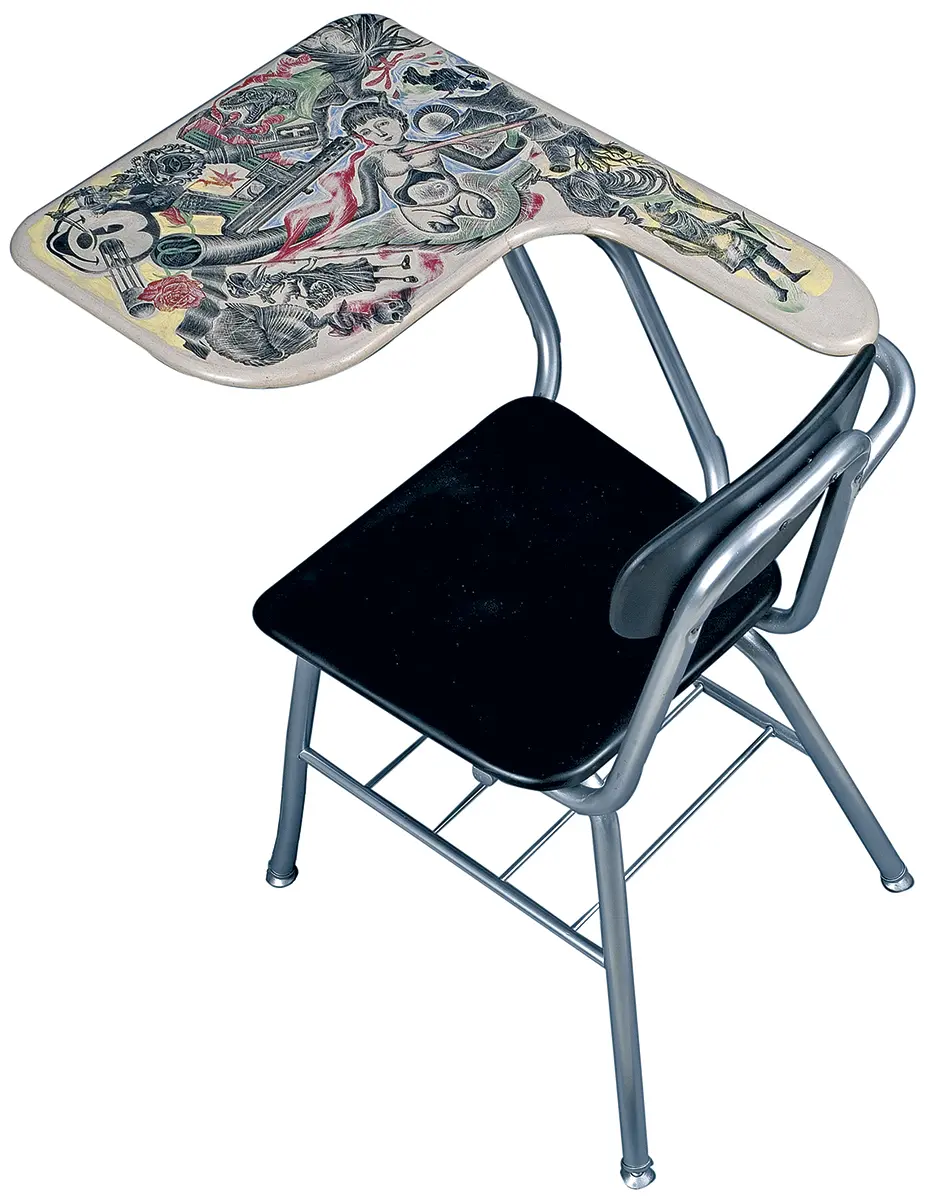
Quintana’s “graffiti,” painted like a tattoo on the desktops, includes a series of diverse motifs taken from the history of local and international art, comic strips, movies, and literature. Happily coexisting on a single plane devoid of spatial orientation are images inspired by the jíbaro from Ramón Frade’s paintings; characters from Manga, the Statue of Liberty; the daughters of Governor Castro, in portraits by José Campeche; or Michelangelo’s Moses. Changing our point of view we can discover the diversity of motifs. Quintana’s figures, objects, flora, and fauna are not proportional in terms of scale, and they are not painted in descriptive colors. Their details are suggested by fine lines that resemble xylography.
The graffiti painted on these desks is a symbol of the critique of a presence, absent in the representation, which questions the relevance of institutional knowledge and asserts the bankruptcy of humanistic education. The linear classifications and hierarchies imposed by Enlightenment-derived disciplines and education, which served to provide an order for the natural and human worlds in the natural and human sciences, in the painted landscape, in historical paintings, and in other genres, are subverted and exploded in these images. The borders established by the order of differences between the natural and the artificial in classical epistemology are impossible in Quintana’s graffiti, as impossible as it is for students who often lack the aesthetic and ethical criteria that in the past guided taste and knowledge to value the various meanings of these images. Rigoberto Quintana’s drawing confronts the diversity of images and meanings with a similitude: the same texture for each motif. It would seem that the natural and the artificial are made of the same coexistence of the dissimilar.
Discípulos is attuned to the rise of a generation that seems to turn its back to institutional order, discipline, and knowledge. This show indirectly alludes to the triumph of mass culture in the age of personalization, the triumph of the self-centered subject, a subject focused on its own existence and for whom the blank slate of a school desk is the place to unbridle one’s creative imagination. His horror of a visual vacuum, the metaphor of its existential counterpart, is tempered by a repertoire of icons as engorged as the one represented by Quintana in these images.
The exhibition is also an example of the intellectualized view of an enlightened artist, who believes in a paideia that fosters critical analysis, the artist who knows history, aesthetic criteria, hierarchies, and differences, and can achieve a significant synthesis of the most disparate elements of our culture. Artists like Quintana are able to bring together several orders, tending bridges and locating the connecting vessels in a cultural map that resembles a rhizome.
INGRID MARÍA JIMÉNEZ MARTÍNEZ