
Rubén Alpízar’s one-person exhibition, Cuban Barbecue Express, presented at the Havana Club Foundation, constituted a statement around Néstor García Canclini’s idea that “postmodernity is not a style but the tumultuous copresence of all styles, the site where the chapters of the history of art and of folklore cross paths and rub against the new cultural technologies.”
The work that also provides the title of the show —which included sixteen pieces— grew out of traditional Cuban customs. In the innocuous style typical of his painting and with caustic wit, Alpízar presented three possibilities for cooking food. He juxtaposed the sophisticated food preparation methods that derive from the affluence of some diners to the simplicity of a broiled, skewered chicken, more within reach of the less well-off. And, at a precise precarious point, it suddenly became a scene where, under the light of an incandescent light bulb, a woman –borrowed from Botero and simulating Velásquez’s La Venus del espejo— was “cooked” on a barbecue next to a black angel who holds the mirror that reflects the voluminous behind of this ample “beauty”; barbacoa, or barbecue, is the name used by Cubans to refer to rooms improvised atop small houses, where many people survive in close proximity.
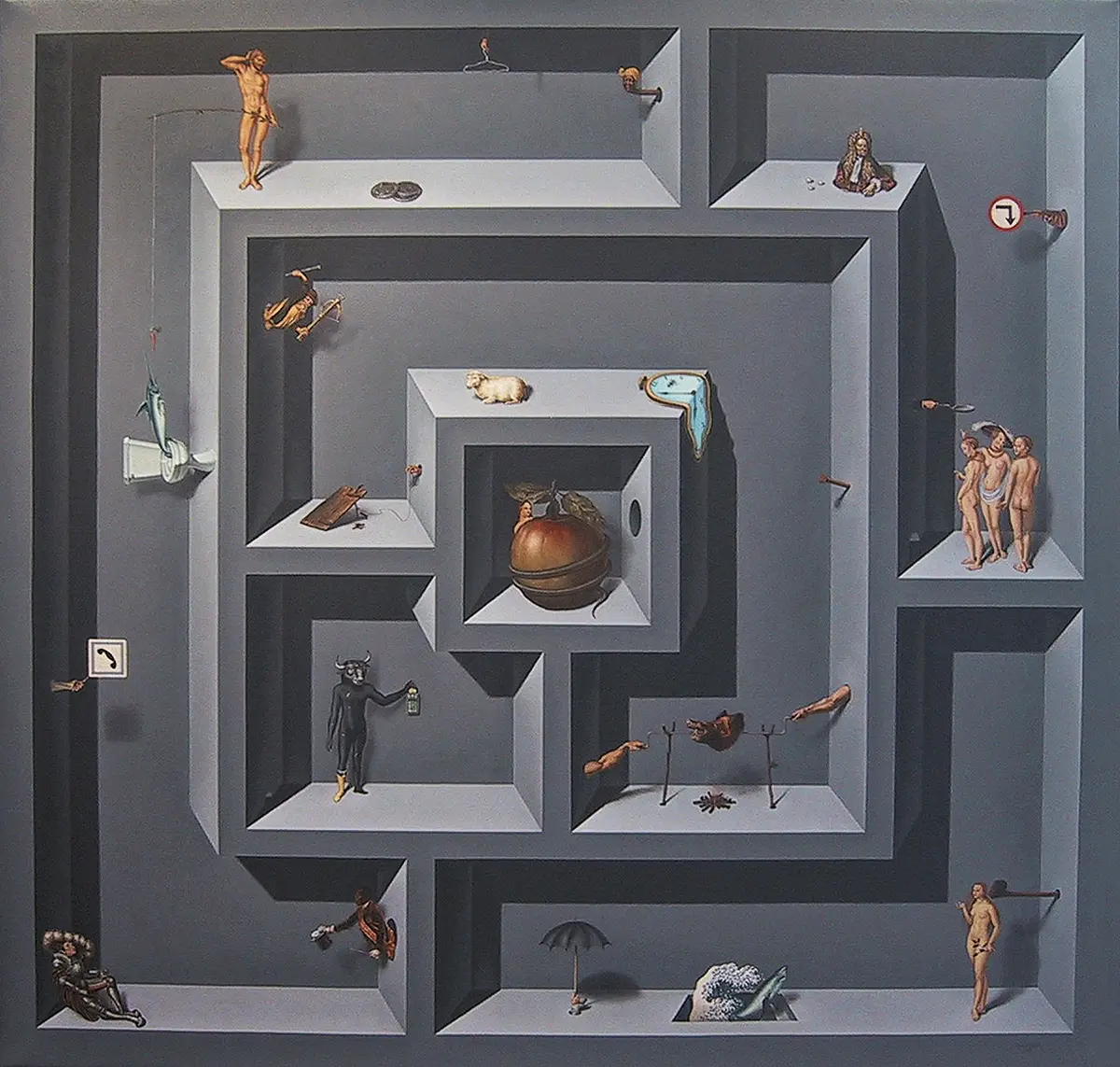
Cuban Barbecue Express presented a world of parodies. At its foundation it asked about being and about the present without letting go of the past, seeking not a lesson or a moral to the story, but a way to mark the place of injury. The constructions created by Rubén Alpízar for this show had the flavor of collage —and of neohistory— but above all, they were a pastiche.
His series: El vértigo de la libertad; Que vida más sana, que mente más perversa; El gran juego; and Retrato inconcluso del genoma humano converged and mingled with other pieces where the artist portrayed himself for the first time, like El sabor de las lágrimas and El sonido del silencio.
Niches, windows, drawers, buildings, and labyrinths are backgrounds based on a new way of applying acrylic to canvas; spaces become colder and more impersonal in an analogy of the new media, videogames, and websites.
Alpízar’s works use the surface as an ideal place for mixture. The mixture results from his taste for quotations and for hybrid forms. Thus we find elements taken from Hieronymus Bosch, Brueghel, Manet, Degas, Duchamp, Dalí, Magritte, Max Ernst, and Keith Haring, alongside Landaluze’s blacks, Víctor Manuel’s Gitana tropical, and the appropriation of images of people from Cuban daily newspapers.
The dialogue of such dissimilar times and discourses produces a complex and expanded analysis. Games speak of broken dreams, manipulations, deceptions, failures, anxieties, doubts, an ever-present danger, and the emergence of life and its mysteries.
There was a gap, however, where jokes and playfulness were paramount. El bayú de Fontana, created in collaboration with Reinerio Tamayo, transformed the cut canvases that spatial artist Lucio Fontana created in the 1940s. In the interior of open vulvas a variety of characters enjoyed orgiastic pleasures and eroticism exploded with a delicacy and a poetic candor that was the point of negotiation and compromise between the two artists.
The presence of Reinerio Tamayo as a guest artist in the show was not gratuitous. Tamayo reinforced, from his own discourse, his connection to some of the reflections posited by Alpízar. This “other” more sarcastic Tamayo referred to madness as the world’s behavioral parameter, to our haunting insecurity, to war as a danger and real threat of extermination that begins in the hands of children thanks to video games and is ultimately decided in the hallways of power. Good Bye Magritte, Planeta bélico, and The Last Game pointed to the latent possibility of genocide.
After seeing this show, perhaps some were left only with the forceful evidence, as pointed out before by Stefania Mosca, that “in the Caribbean, we are all hybrid, bitter, sardonic, and sentimental.” But if one saw Rubén Alpízar, his back towards us looking out to the sea, and understood how he was able to dive into those waters in order to contrast his tears with that ocean that is our limit, one also had the certainty that there are those who reach even further. Noble in spirit, pure, and capable of pointing to the place where our heart breaks they salvage what we once were.
CARIDAD BLANCO DE LA CRUZ