
The art critics
circles—detractors and apologists alike1—still remember Magiciens de la Terre as a
controversial exhibition. Undoubtedly for its curator, Jean-Hubert Martin, it
was an excellent wager that he repeated with Altars at the Museum Kunst
Palast in Düsseldorf, once he was appointed its Director.2 This
trend toward the exotic, or more precisely, toward those visual forms that
break from the narrative of the dominant art centers is and continues to be,
Martin’s best bet. Today he repeats his success with the mega-production Africa Remix: Contemporary Art of a Continent, and begins his role as a
visual DJ by gathering 88 artists in Kunst Palast; the exhibition later travels
to the Hayward Gallery, London; the Centre Georges Pompidou, Paris; and
finally, the Mori Art Museum in Japan. Martin undertook the general
administration while the curatorial proposal was led by Simon Njami, a young
curator of African origin who resides in Paris, and a representative group of
each of the institutions involved, thus ensuring the exhibition’s tour of the
capital cities.3
Africa Remix, as its title indicates, makes reference to the form in which popular music has been produced and consumed since the 1980s. In music, remixing takes existing tracks that are mixed and manipulated again in the studio to create a new contemporary music rhythm.4 Despite this somewhat fashionable and amusing re-contextualization, the mega-exhibition is no less pretentious and impressive for those of us who are not totally familiar with the contemporary art of a continent which began to have certain visibility in the European circuit barely fifteen years ago.5 Except for some names, among which are the participants in the last Kassel Documenta (11), under the direction of Okwui Enwezor, most of the participants were unknown to the German public, although the forms of representation of many of their proposals were not. I am referring, of course, not to collections of masks and totems, but to the mixture of expressions, methods, and techniques that occur today in any of the main artistic capitals.
Africa Remix starts by questioning what contemporary art in Africa is and how the hybrid character of a multiplicity of cultures can be represented in a globalized context. According to its curators, the inclusion of artists from the entire African continent —north, central, and south— is one of the innovative features of the exhibition. Parallel to the idea of the transnational, it integrated artists born outside of and those who do not currently reside on the continent —almost 40%– but who maintain contact with their places of origin or have African roots. This is a feature, however, that the curators did not especially want to underline, nor did they dwell deep into the topic of diaspora.6 The result is the presence of “black,” Islamic, and postcolonial Christian Africa, and representatives of the diaspora. This phenomenon of transmigration introduces the topic of mobility and of fluctuating or opposing identities to be defined in the social construct of an ethnic-racial or sexual stereotype, not properly explored in the exhibition.
The “mix” of this complex Africa where ancestral traditions collide with remarkably tense economic and political situations resulting from the postcolonial reorganization process and coinciding with globalization and a Europe-bound migration process, casts some doubt on the curatorial ambivalence of presenting an entire continent and its problems under the idea of a hybrid culture. The term identity reaches a particular relevance here, unavoidable in the current debate because it not only concerns Africa, but also those cultures relegated to the undefined procedural condition of “transculturation,” chaos, and postmodern bricolage.
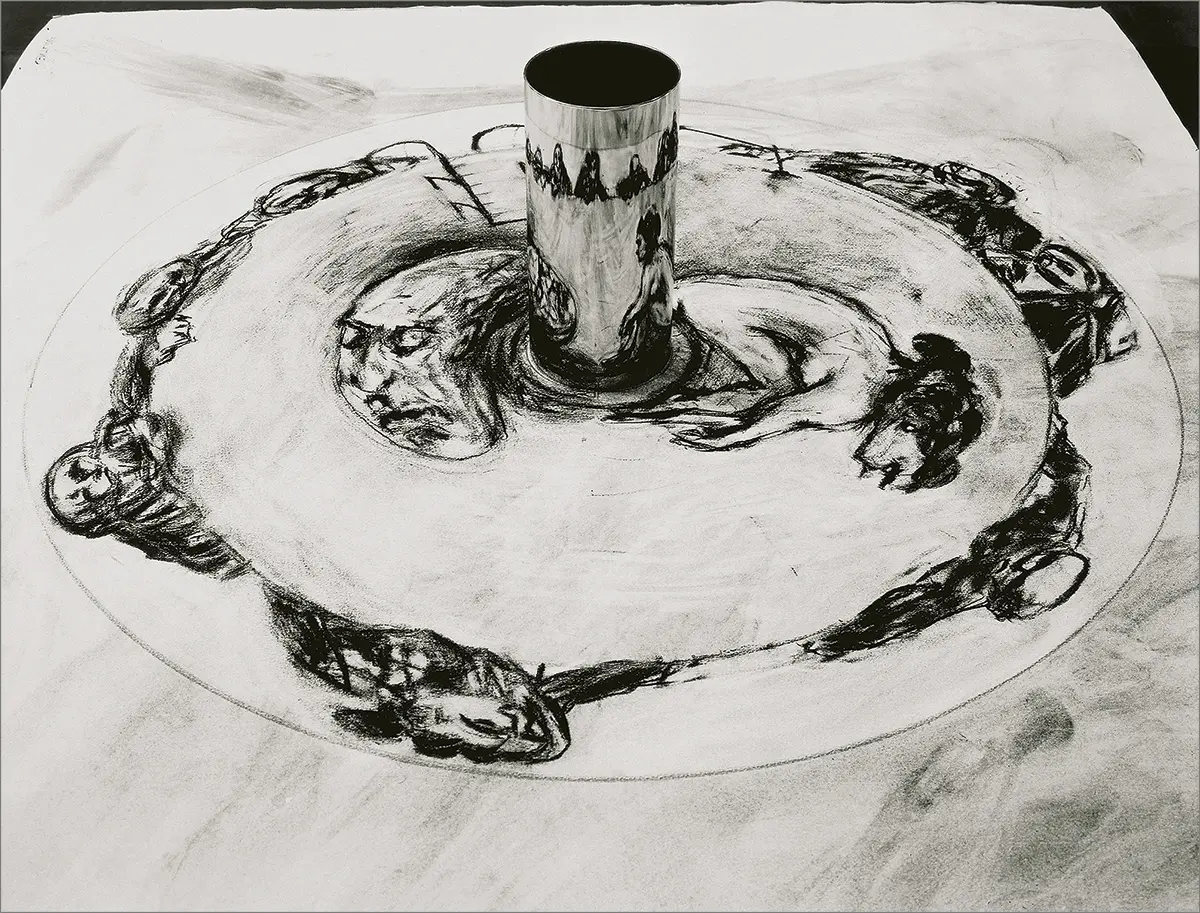
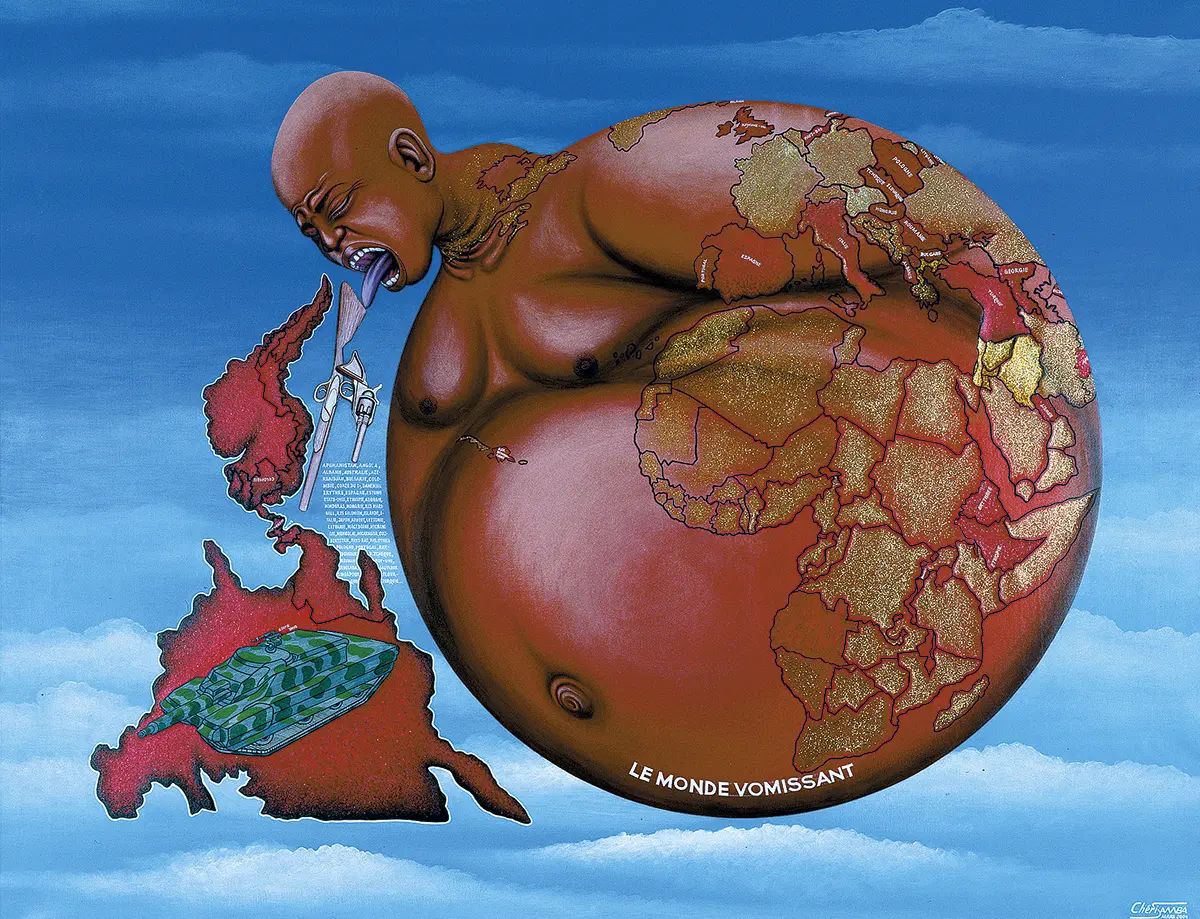
The idea of chaos is particularly emphasized by curator Simon Njami who underlines “that chronic illness,” the unmanageable situation, and the balkanization of a continent lacking idiomatic, economic, political, cultural, and religious unity.7 However, the exhibition does not emphasize or analyze this galvanizing political situation found in William Kentridge’s films, Chéri Samba’s paintings, Willie Bester’s figures assembled with pieces of weapons and metal, and Gonçalo Mabunda’s armed Eiffel Tower, just to mention a few. Therefore, our attention is drawn on one hand to the classification and to the conceptual and spatial division of the exhibition into what is so familiar for many mega-exhibitions on Latin America: Body & Soul, History & Identity, and a recurrent fashionable topic, City & Land. On the other hand, it is a paradox that Africa appears entirely undifferentiated and blended (remixed) in the 137 works of the exhibition, which also includes a section for music.
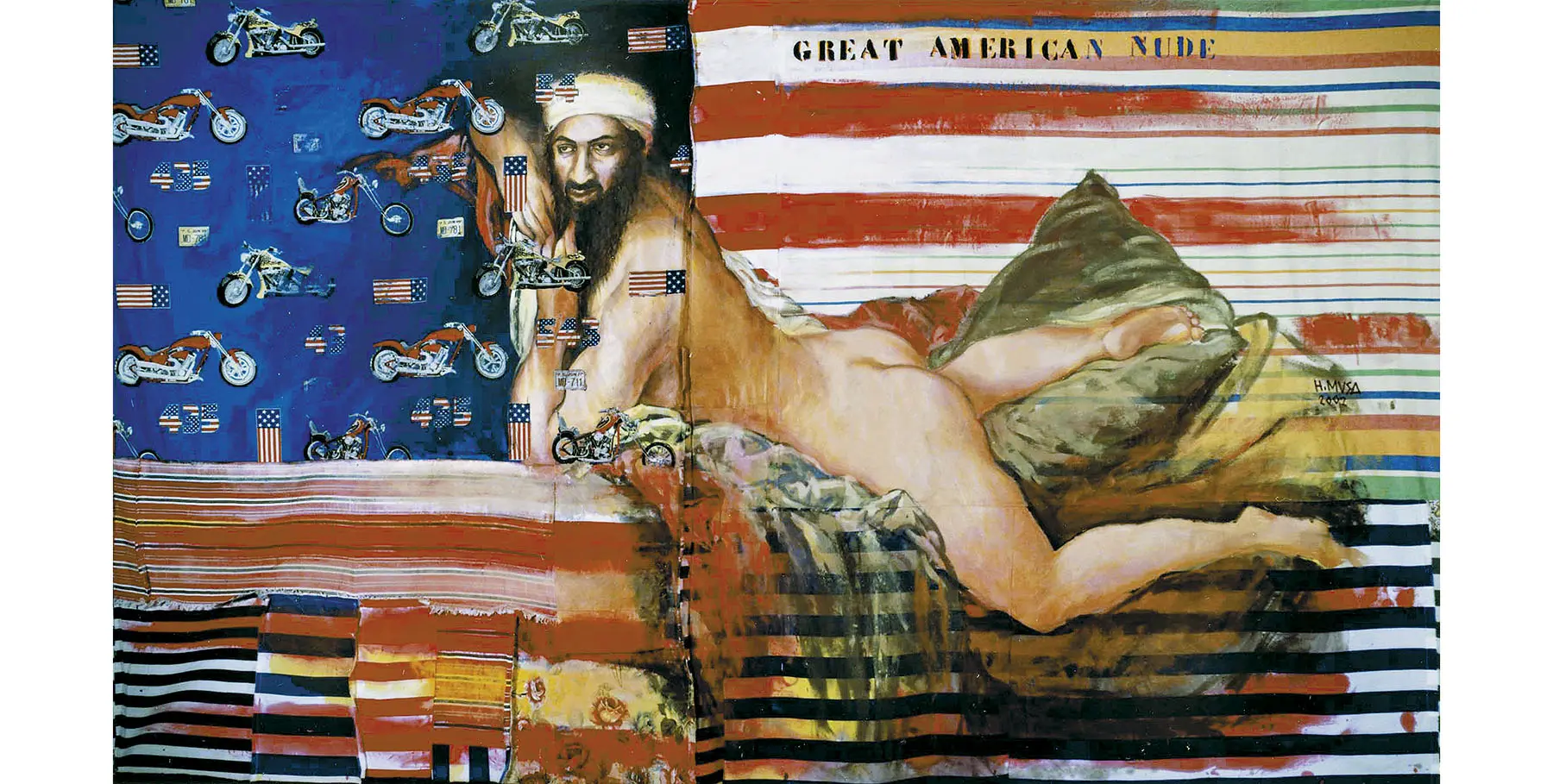
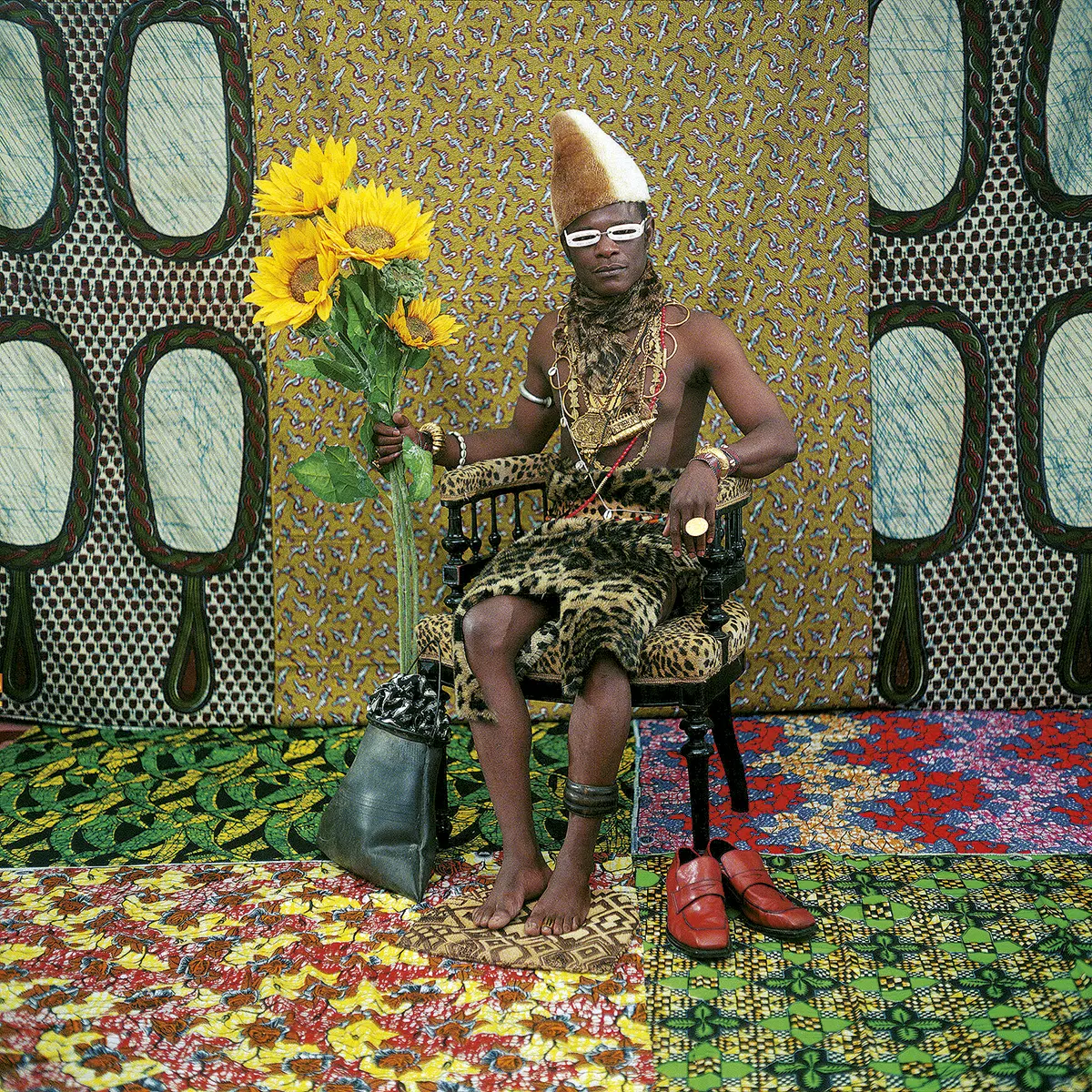
Diversity, be it aesthetic-formal or in its approach to the artistic event, the polysemic character of many works and their cultural complexity was mediated by the exhibition’s arbitrary division and by the market-mall immediacy with which the objects were arranged in the four galleries of the Kunst Palast’s three floors. The continent was reordered as a set of classifiable and identifiable consumer objects for a western public (in this case, German) used to seeing exhibits with ethnic-anthropological interest (remember Altars). This classification of the works by groups also had the problem of establishing a nonexistent relationship among them. Le chef qui a vendu l'Afrique aux colons, one of Samuel Fosso’s photographs belonging to the Tati Self-portraits series (1997), was the image representing Africa Remix. Placed in the section of "Identity & History," this photograph was the perfect image to illustrate the idea of the exhibition, while at the same time, subverting it in a subtle manner. The photograph shows an African tribal chief with the symbols of power: leopard skin, head covered with a typical hat, necklaces, and gold. Seated in the typical pose of an ethnographic photograph in a set with colored textiles indicative of the “African”—evidently prepared by a Westerner—he does not hold a scepter in his manicured hand, but a bouquet of plastic sunflowers. With cheap shoes and a wallet on both sides of the chair, probably bought together with the fabrics in the Tati store of Montmartre—the cheapest place in Paris and whose aesthetics have been assumed by immigrants—he looks at us through sunglasses without lenses. Like other photographs where Fosso appears as a bourgeois woman, a sailor, a pirate, and an American woman, this travesty shows more than the hybrid nature of an identity that resists being classified. It transcends the mere fact of being the cultural product of a postcolonial country and of an immigrant; it is also the defense of a different transsexual identity. In front of Foso’s photographs, Hassan Musa’s controversial painting Great American Nude (2002), a spectacular nude portrait of Osama Bin Laden who, in an openly erotic posture, rests on a background suggestive of the U. S. flag.
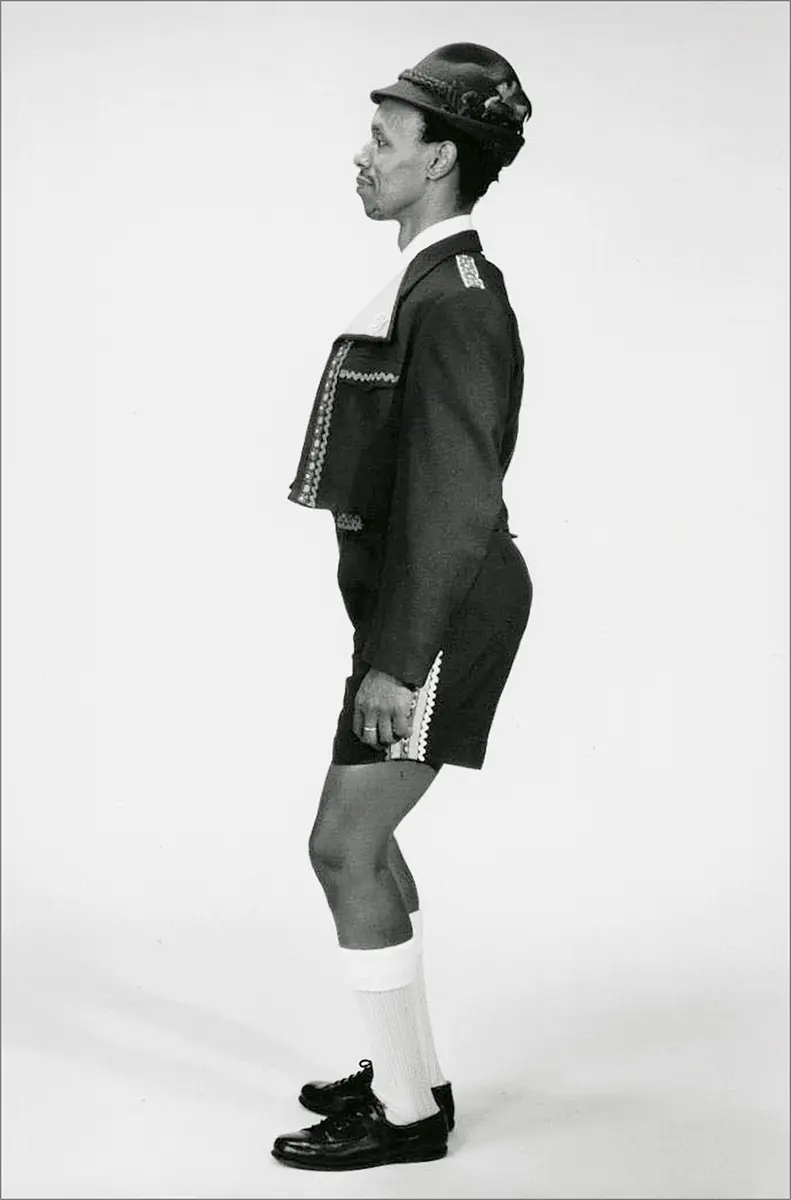
Identity and history are not only emphasized with regard to the collective destiny, but also from the standpoint of the individual artist. In the catalog, Njami insists on the impossibility of representing African identity per se, or of a homogeneous ethnic-racial group from the perspective of the artists here represented, something that is not totally true. The opposite is evidenced by Ymane Fakhir’s photographs, celebrating the food and dances of Moroccan Arab culture; Andries Botha’s installations that refer to the political reality of the cult to the chief’s image, with its traditional sculptural repetition; Willie Bester’s sculptures assembled with metal and war material, using soldier and dog to show the violence with which the police invaded the ghettos; Kentridge’s films, alluding to the feeling of guilt of a racial and political class in South Africa, as well as Omar D’s portraits of women (in spite of having being placed in the "Body & Soul" section). On the contrary, Martin’s essay subtly implies that the African artists and their artistic practices are only linked to the representation of an ethnic collective.8 In the reception of African art, autonomy has unquestionably been denied to the individual identity in a discourse historically constructed from the West.9
Precisely because of this, many artists are trying to break with the stereotyped image, to break with this exoticism and identification with which Europe has invented Africa. In a very personal way, they are researching topics that go beyond geography or folklore. When historically they have been marginalized by the hegemonic centers of art for not wearing masks or for not being the standard-bearer of ethnicity, such an individualistic attitude, parallel to the inclusion of global contemporary discourse, reveals great courage.
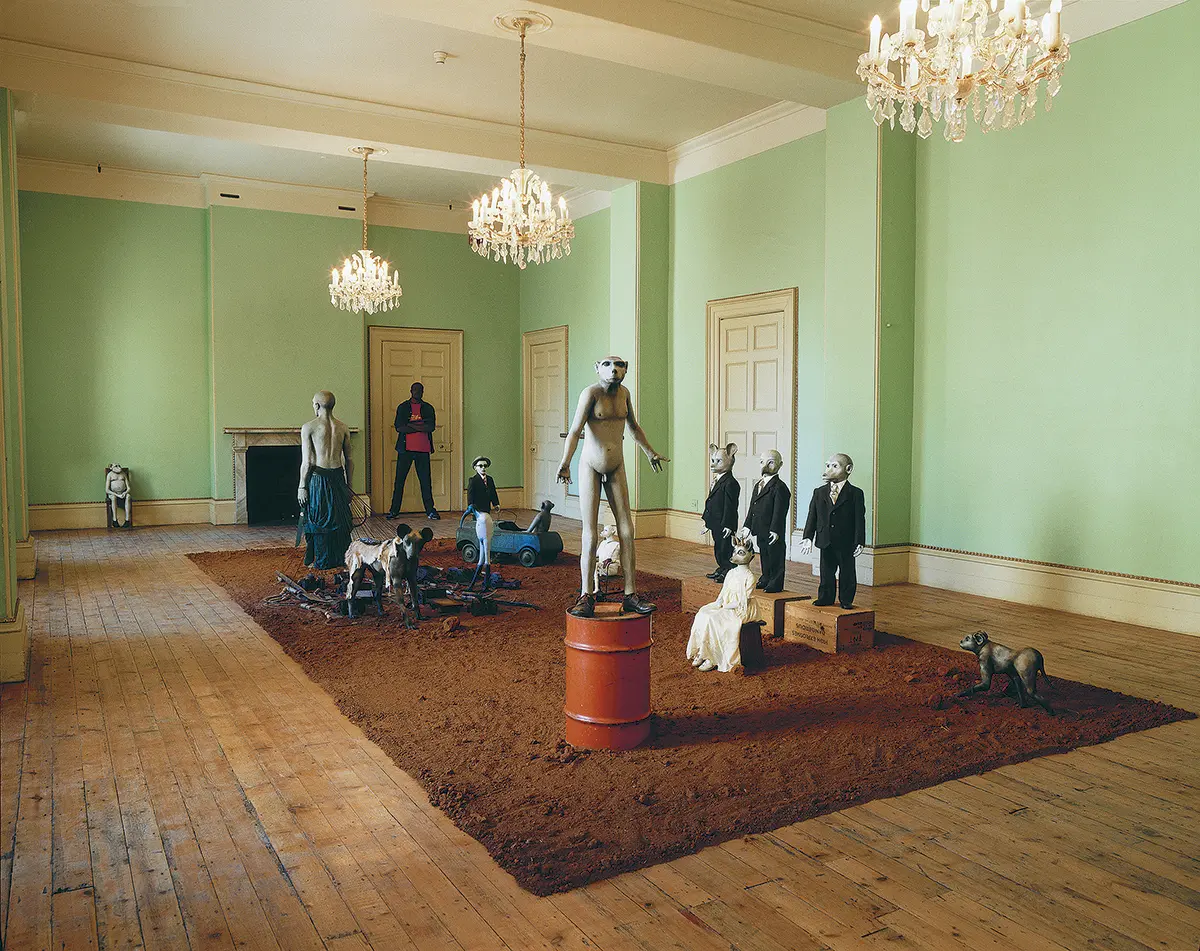
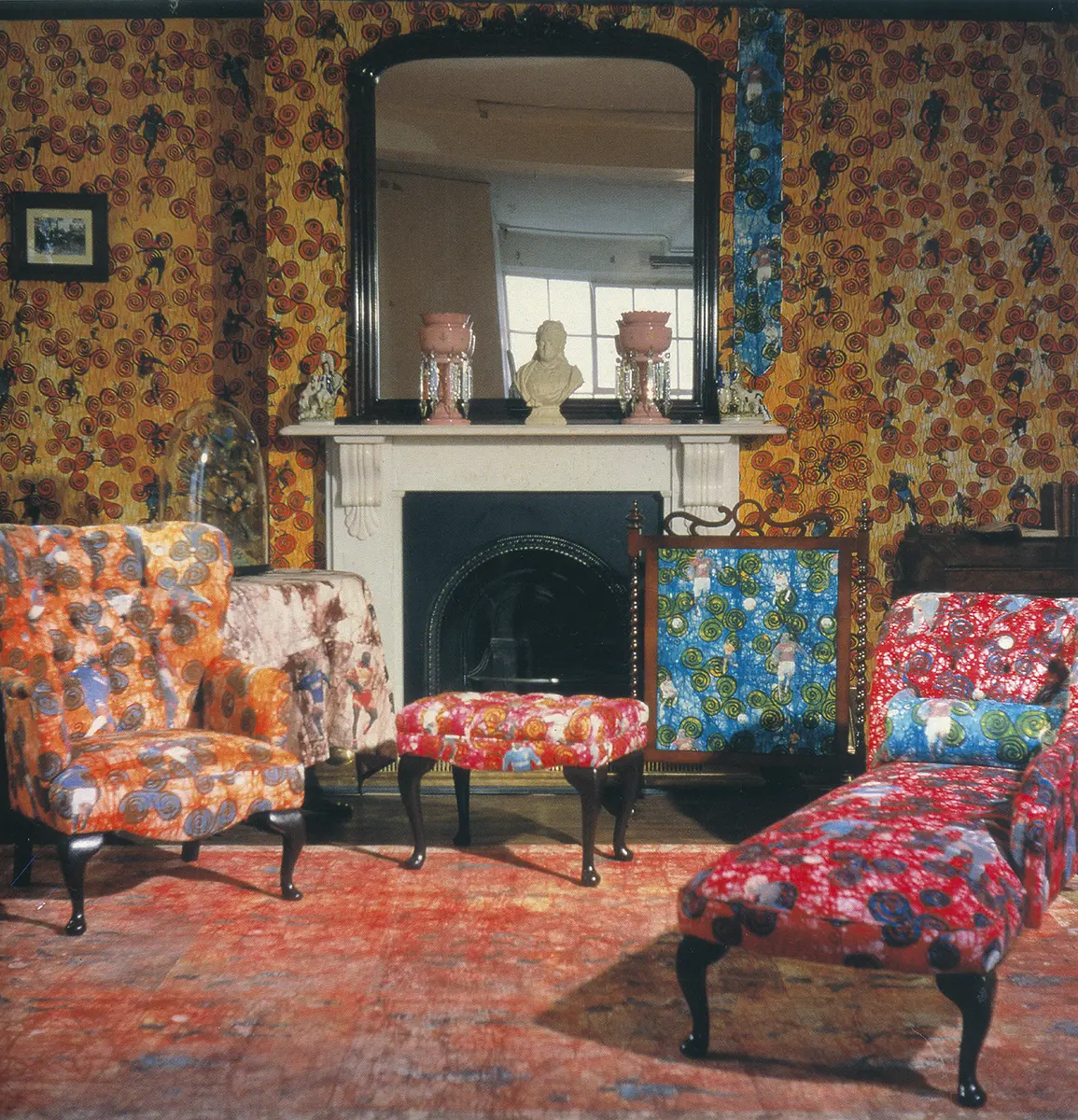
Considering that certain criteria regarding the so-called black continent still prevail in the eurocentric perception, we will be able to understand the existing tension and the constant reference to “black and white.” Certain contradictory viewpoints become evident —in the curator’s visión— precisely in the way each of the curators introduces the topics of identity and individuality. In his essay, Simon Njami starts by quoting Sartre to refer to identity in crisis in countries in a process of decolonization as a consequence of an education designed by the Eurocentrist whites.10 In Jane Alexander’s installation African adventure (1999-2002), this tension is evident in those beings transformed by masks glued to their faces and in the western clothing they wear, in a context totally cut off from their “costumes.” Black identity as opposed to the European colonial identity is also a topic in Wir (2003), the photographic series by Aimé Ntakiyica, although placed in the "City & Earth" section. Another installation revealing the assimilation of a superimposed culture, or rather the collision between Europe and Africa, is Victorian Philanthropist Parlour (1996-1997) by Yinka Shonibare, with its Victorian atmosphere, but whose designs of African motifs and colors deconstruct —in terms of almost viral contamination— what originally should have been vegetal motifs.
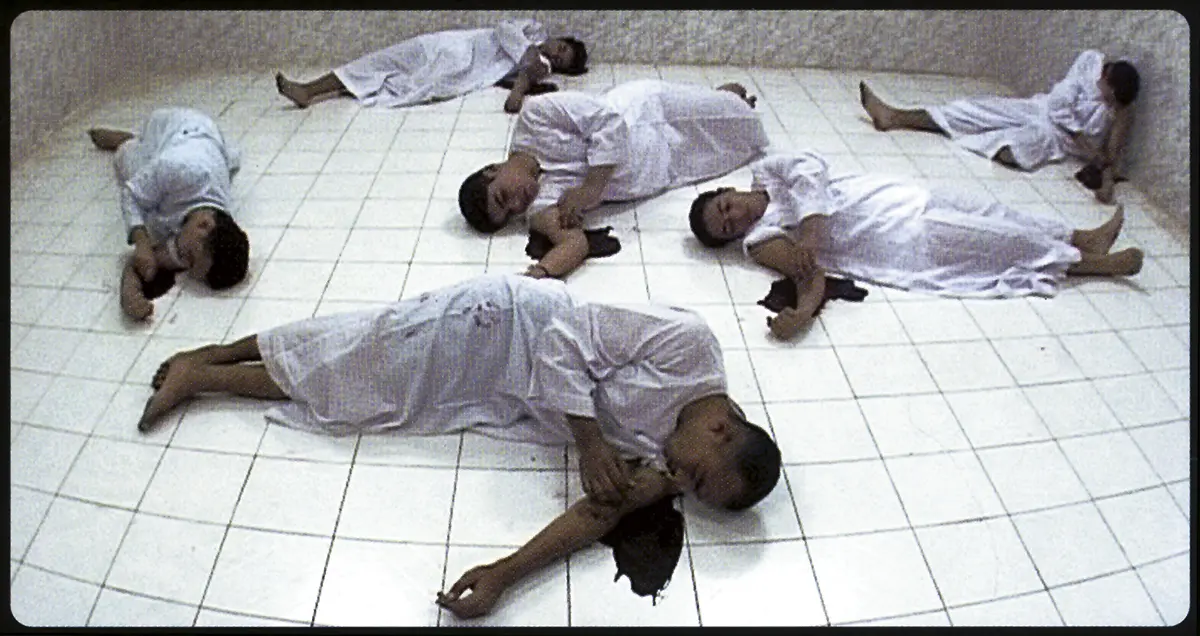
Body & Soul began with the representation of the body, but whose? Was the body white, black, or mestizo? Was it perhaps the sexual, the erotic, the bisexual body, that of AIDS victims, or those displaced or forced to migrate? On the other hand, was it maybe the body defining a collective, a geographical place, a specific situation, a religion, or perhaps all in one? It is not very clear, not even for the Njami himself, who speaks of a soul different from the Christian soul and of a body that is inseparable from the African spirit. This segment of the show gave the impression of being the space for works that did not have a place in the other two galleries. Many of them could have been included in the "Identity & History" section to generate a more political and social dialogue than in this, which was presented in such an abstract way. The subtle embroidery on the surface of cloth with floral motifs camouflaging the erotic female bodies in sexual intercourse by Ghada Amer could not relate to Loulou Cherinet’s video Bleeding Men (2003). Neither could we classify Frédéric Bruly Bouabré’s “naive” drawings in these terms, with their semiotic game of meaning (concept or name) and visual reference. Amal and Abd El Ghany Kenawy’s video installation Frozen Memory (2003) regarding the topic of memory linked to the experience of Islamic culture could hardly be related to the sculptures in painted wood by Georges Lilanga Di Nyama in reference to their daily reality, or with Paulo Capela’s altar, mixing various religious experiences with politics and also with daily life. If anything could define these disparate relationships is indeed the complexity of the African continent that cannot be explained in terms of mixing or hybridization but in terms of the insurmountable differences in colonial history, religion, geography, and later in the process of transition of the new African nations.
By all means, the "City & Earth" section is the most interesting in Africa Remix. In the enormous high-ceilinged gallery on the first floor, a wide platform was put up with scaffolds and chipboards, in order to have two floors appear to be a building under construction. The facilities and large-format sculptures flowed in the gallery without interruption, simulating an orderly urban space. The main stairway and lateral stairs provided access to the second mezzanine that as a balcony opened other possibilities for the exhibition’s tour while offering a bird’s eye view of the ensemble below.
A corridor made up of the scaffold’s metal tubes led the spectator to the gallery, whose walls were lined with photographs—mostly documentaries—by several artists. Marginal images of extreme urban poverty and illustrative of daily life and religion revealed an Africa with which we are familiar through mass media. In the back could be seen what seemed to be an enormous tapestry with abstract forms and color by El Anatsui. On approach, it is apparent that the “fabric” had been sewn with bottle caps of domestic and imported beverages painstakingly joined with metal wire. On one side, Antonio Ole’s wall, assembled with materials of diverse origin—metal sheets, door parts, and advertisements—created a pictorial abstract design. On the other side, the spectator was introduced to Pascale Marthine Tayou’s installation that simulated an improvised workshop with large boxes and tools on a wall, video shows, photographs on the floor, computers, and paper and crayons, so that the public could draw.
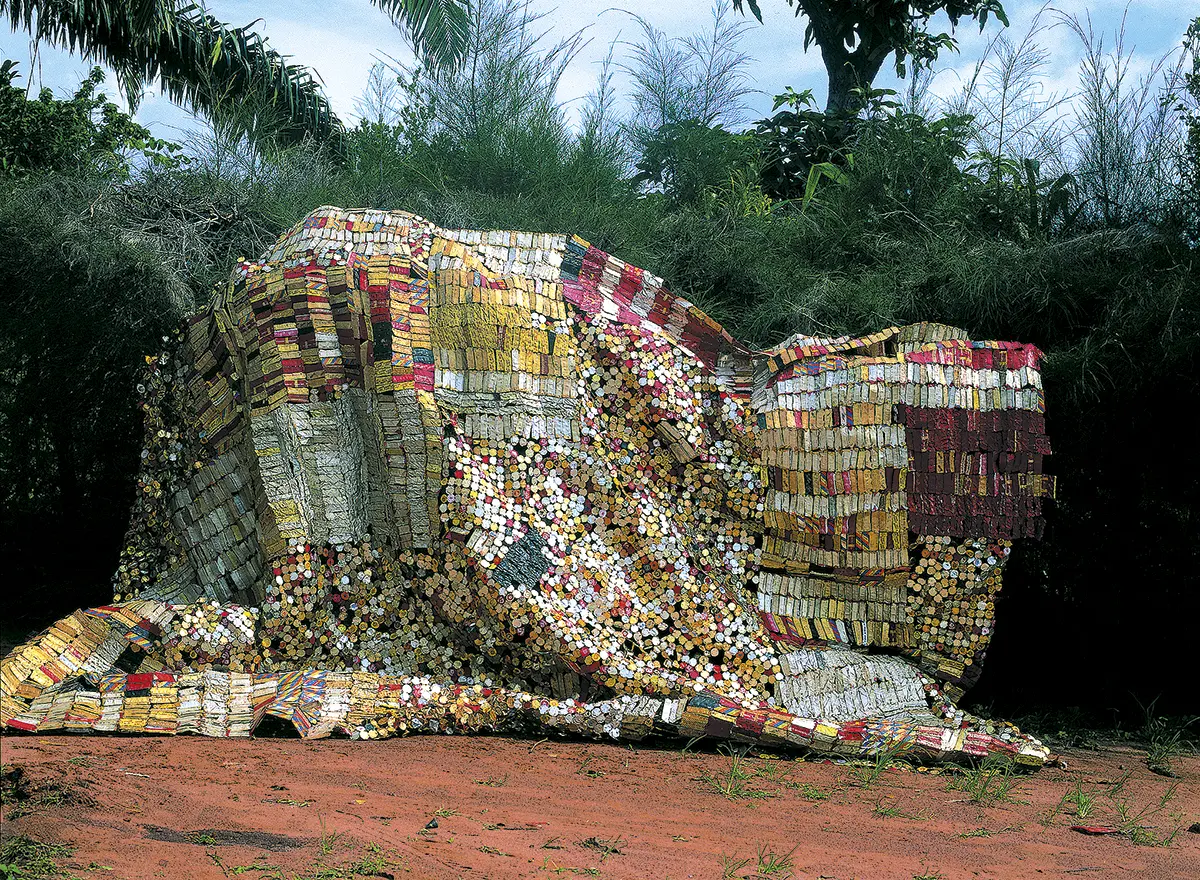
Such aesthetics of poverty, waste material, and perhaps everything that is affordable and common in the city, was transformed, moving from the contingent to materialize a work that narrates within itself the conditions of the precariousness of transition of societies in almost emerging condition. The use of dissimilar materials did not mean an exhibition of urban anthropology, but an attitude and artistic experience in which art, like daily life, shares a sort of temporary precariousness, where the ephemeral becomes a temporary gesture and “ingenuity” for survival. In the city, everything can be reformulated and given a new function to acquire another aesthetic-conceptual dimension, whether Romuald Hazoumé’s plastic tanks in Bidon armé (2004); Titos’s airplanes made from waste materials; Dilomprizulike’s mixed media Waiting for Bus (2003); or Gonçalo Mabunda’s use of firearms to build an Eiffel Tower.
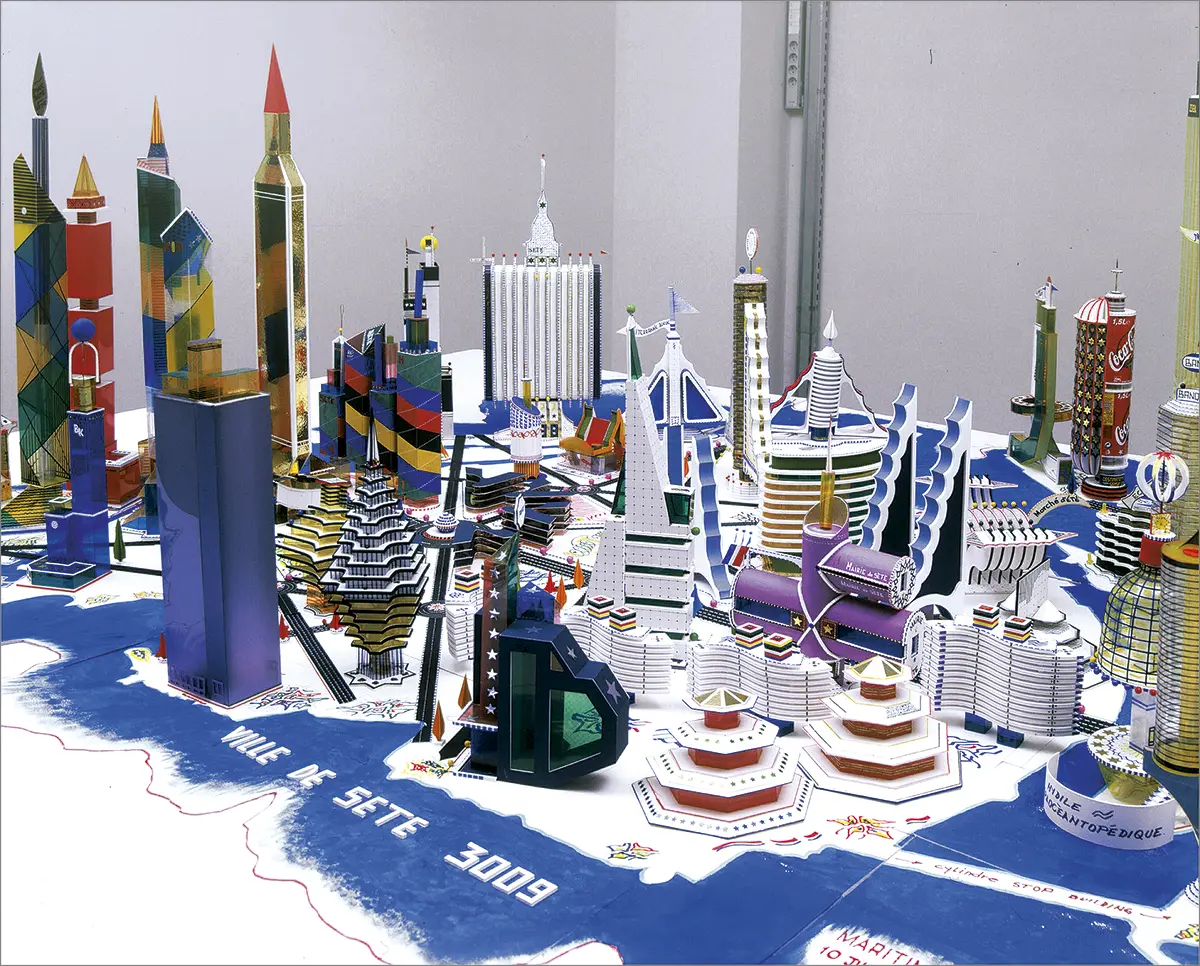
The idea of the city as a chaotic, irregular place of great contrasts with its poor suburban districts, the orderly colonial administrative center, and the exclusive neighborhoods separated from the ghettos, the expression of this modernity transplanted in the black Africa of the villages was sharply expressed in David Goldblatt’s photographs. The earth is and continues to be a reference for the uprooted because the city still spreads out to the suburban area where the other economy of agrarian societies and underdevelopment coexist. Currently, the city, a symbolic image of colonization, has become the center of commercial life, of the traffic of goods and immigrants from the countryside, and of everything imaginable, as we see in those scaled models by Allan de Souza, and in the idea of the postmodern Africa Remix brought to the Kunst Palast. However, such a chaotic city is also the place for the possible utopia of Bodys Isek Kingelez’s scale models and perhaps for the centralized future of the new African republics in the process of transition and economic and social transformation.
Going back to the initial questions on whether or not Africa Remix could represent contemporary Africa, it would be worthwhile to ask what type of contemporaneity the curators would be defined in the face of such comprehensive complexity. To what extent should Africa be “contemporary” in a Eurocentrist sense? Wouldn’t this search for the contemporary in Africa be an attempt at reaffirmation by a culture that does not allow others to have its own development, or should we surmise that Africa is being updated for the European market? Other questions emerge, for example, whether or not the artists who live and work in the metropolis want to be “Africanized,” while those of the continent is “temporized” next to those of the diaspora.
I believe that Africa should define its contemporaneity according to its own parameters and historical experience. In the meantime, we will tour these African and Latin American Remixes with a taste of exoticism and the wonder of discovering how contemporary we can be after all.
NOTES
1. Magiciens de la Terre opened in July 1989, in the Centre Georges Pompidou in Paris. Its opening coincided that year with the fall of the Berlin Wall and the end of Apartheid in South Africa.
2. Altars and Shrines of the World, were exhibited in the Museum Kunst Palast in Düsseldorf (September 2001–January 2002). Sixty-six altars from Asia, Africa, America, Europe, and Oceania were built under the guidance of the practitioners of their respective religions. One of the arguments put forward in favor of an exhibition with evident ethnic-anthropological “interest” for an art museum was the affinity with contemporary art, specifically with installation.
3. The exhibition team includes Marie-Laure Bernadac, Curator of Contemporary Art of the Louvre and of the Centre Georges Pompidou; David Elliott, Director of the Mori Art Museum of Tokyo; Roger Marbert, Curator of the Hayward Gallery in London; Jean-Hubert Martin, General Director of the Museum Kunst Palast of Düsseldorf; and Els van der Plas, director of the Prince Claus den Haag Foundation in Holland.
4. It is ironic to say that historically the art of postcolonial or peripheral countries has been consumed as recycling of what is produced at the center. However, at the same time we could speak of a dominant art that has assimilated exotic forms—and artists—incorporating them into the narrative of the western culture as the Other: dark, unmanageable, but ultimately domesticated and colonized.
5. It would be worthwhile mentioning that in the official release issued by the press conference, Jean-Hubert Martin affirms that, “‘Africa Remix’ is also an answer to the disappointment of the last Documenta. I think I am speaking on behalf of all fellow curators when I say that the small number of African artists shown by Okwui Enwezor in Kassel was found unsatisfactory by many.”
6. In the catalogue, Jean-Hubert Martin states that there is no analysis between the diaspora and the artists who live on the continent. This is not a parameter to follow since artists in general are citizens of the world who constantly travel or live between Africa and other continents. Jean-Hubert Martin, "Die Rezeption Zeitgenössischer Afrikanischer Kunst und ihre Entwicklung," in Africa Remix-Zeitgenössische Kunst eines Kontinents (Ostfildern, Germany: Hatje Cantz Verlag, 2004), p. 33.
7. Simon Njami reveals a pessimistic vision of Africa. His skepticism even transcends his political opinions when he refers to the Organization of African Unity (OAU). This attitude supports the image of the Other or “otherness”—understood as the idea of what is African from a colonial point of view—as opposed to Western as a disordered, passive, irrational, and chaotic world without a homogeneous identity and definition. Simon Njami "Chaos und Verwandlung zur Ausstellung Africa Remix," in Africa Remix, pp. 14–15.
8. Jean-Hubert Martin, Die Rezeption Zeitgenössischer, in Africa Remix, pp. 34–35. It is revealing that Martin believes that the individualistic bourgeois spirit is a western paradigm that cannot be applied to the shaman or “magician of the earth,” that is to say, to the African or the “oriental.” Colonial modernity per se discovered the African art of the mask and post-modernity has given individuality to the artist of the black continent.
9. “Autonomy... self-articulation, autography. . . These are contested territories in which the contemporary African artists find themselves locked in a struggle for survival, a struggle against displacement by the numerous strategies of regulation and surveillance that today characterize Western attitudes towards African Art.” Olu Oguibe, “Art, Identity, Boundaries: Postmodernism and Contemporary African Art,” in Reading the Contemporary African Art from theory to the Marketplace, ed. Olu Oguibe and Okwui Enwezor (London: The Institute of International Visual Arts, 1999).
10. Simon Njami, Identität & Geschichte, Africa Remix, pp. 70-71.
DERMIS PÉREZ LEÓN
Art critic and independent curator.