
A series of maps affixed to the canvas and turned into lambs by way of minimal charcoal tracings, march towards a group of spears-mere lines in the distance. The background is blurred so that the gaze focuses on that kind of procession of souls ready for sacrifice. These are Antonio Martorell’s Corderos y soldados, in an exhibition titled Quijotextos, a tribute to Cervantes’ 400-year-old novel.
The figures in this painting are symbols, responding to a codified cultural referent. For example, the maps are maps of Puerto Rico and appear in zoomorphic guise because that animal —St. John the Baptist’s lamb, carrying a white flag stamped with a red cross— is used to represent the island in its emblem. On the other hand, the motif of weapons is a quotation from Diego Velázquez’s historical painting La rendición de Breda (1635.) It is the attribute of the troops in the middle of a cease-fire, as indicated by their vertical position.
This combinatory produces many resonances; it wily comments on Puerto Rico’s current political situation, in particular its participation in Bush’s war —where thousands of soldiers are sacrificed like lambs—; it challenges the official version that celebrates in its national symbols the country’s colonial past —and thus its capitulation in the presen—; and, no less important, it uses the one mechanism of cultural production that can render the modern project of universality truly meaningful: hybridism, in terms of a dialectic of oneself and the Other.
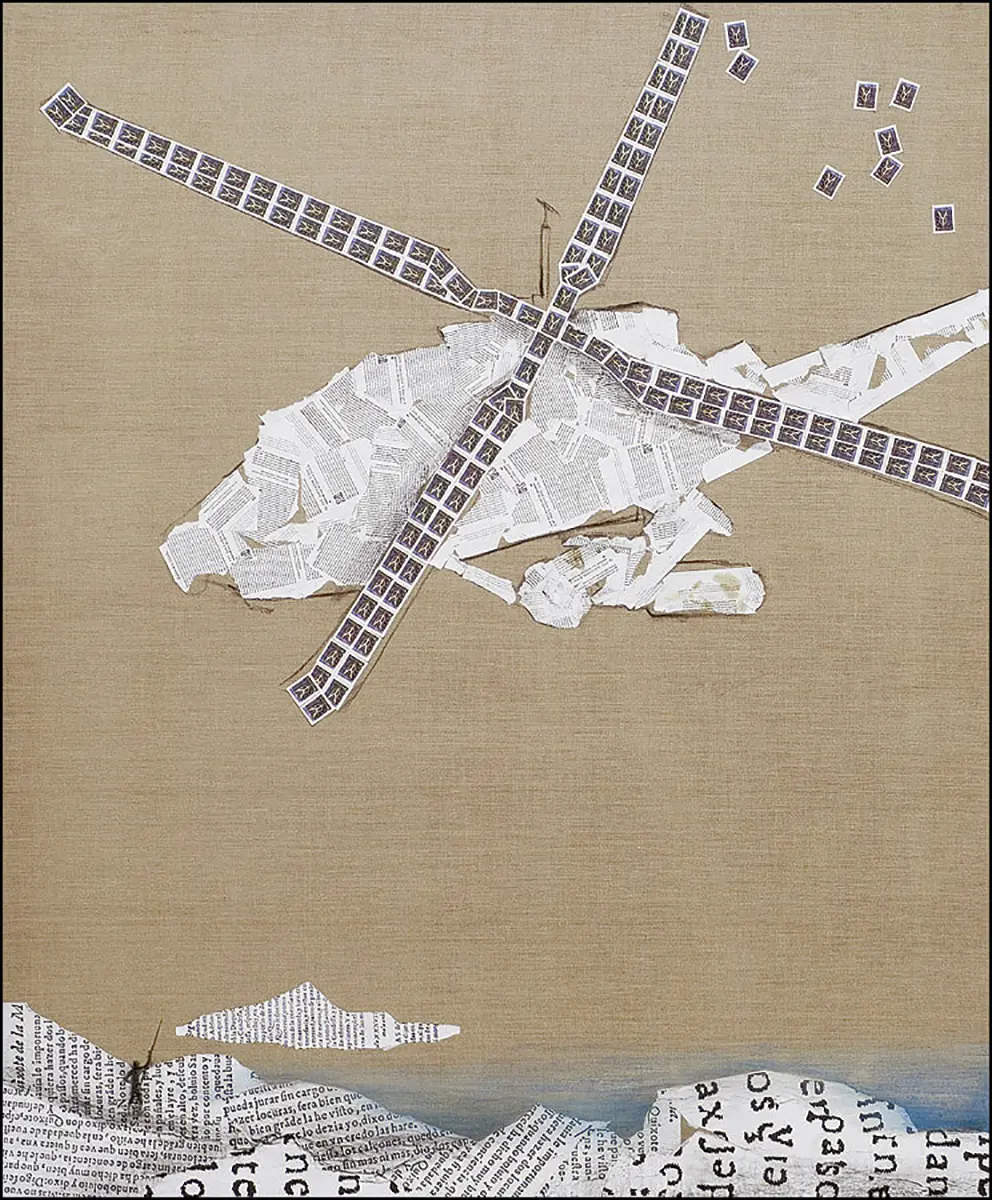
The show’s title, Quijotextos, is an example of just that mechanism. The term can work as a category implying the textual nature of the character, this is to say, the fact that his apparition as a subject requires the materialization of an object, the book. This is why Martorell uses photocopies of printed pages to create physical features such as mountains, theater curtains, and clothes. It is the reality of the written word, which finds a major poetic expression in Borges’ blind eyes.
But the title can also refer to an entity, the “quixotext,” understood as the derivations that the same character has motivated in the history of literature and art. such is the case of authors —like Borges himself– who have picked up Cervantes’s thread to create characters that are indebted to Don Quixote. A section of the show includes portraits of these authors, like Avellaneda, the inventor of a false saga that prompted the writing of the novel’s second part, or Miguel de Unamuno, a clear-eyed student of Cervantes’s work.
The invention of new words by means of phonetic and conceptual hybridization is a constant resource in the work of Antonio Martorell, who is also a widely praised writer. Such words support his explorations in the visual arts, especially in the genre of installation. For example, more than a decade ago he presented a show titled Sementerio, in allusion to the AIDS epidemic. Last year he did Jaulabra, around a group of words that evoke the wealth and misery of human experiences, such as love, democracy, justice, fatherland, and truth. And so on.
The current show is comprised of a growing number of works, because the artist decided to transfer a section of his workshop to the ample spaces of Cuartel de Ballajá, an old seat of military power on the island of Puerto Rico, in order to continue producing. There are installations, sculptures, prints, paintings in a variety of formats, and photographs of the whole process taken by Guillermo del Real. There abound portraits, landscapes, studies of motifs, and tableaux. n abundant production that takes as its starting point an alphabet of engravings in wood created by the artist in 1970 for a never-finished edition of Don Quixote.
In his artistic exploration of elements associated with the novel, Martorell has made valuable finds. For example, a parallel between the design of a medieval suit of armor and a cubist composition, or between a windmill and a helicopter that flies over a territory invaded in the name of modernity. In another instance, Sancho Panza’s belly becomes a globe that flies propelled by anonymous, but surely powerful, hands.
But the most successful Quixotext is Corderos y soldados. The procession takes place in the vast Castilian plain, the backdrop for a nomadic shepherding culture. This is a privileged topic in the Hispanic tradition that in Martorell’s hands represents the problem of exodus, the fallacious escape of the inhabitants of an island divided between the silence of the lambs and the soldiers’ deathly screams.
ELVIS FUENTES