
This is the first
French retrospective of this Brazilian artist who settled in Paris in 1937 and
lived here until his death in 2003 at the age of 95. The 75 watercolors and
paintings, first exhibited at the Oscar Niemeyer Museum in Curitiba, come from
a variety of public and private collections in São Paulo, Rio de Janeiro,
Recife, Curitiba, and Belo Horizonte. Most of the works were selected by Jean
Boghici, the eminent curator of twentieth-century Brazilian painting, in
association with Brazil’s Cícero Dias Committee.
The exhibition, along with Adriana Varejão’s show at Fondation Cartier, was featured inaugurating the Year of Brazil in France, Brazil, Brazils. The Dias show was devoted exclusively to the 1920s and 1930s and shed a special light on this major figure of modern Brazilian art. Dias’s career is unique in being divided between two shores, France and Brazil; between two opposite interpretations of reality and form (fantastic figuration and later an abstraction that was at times geometric); and between two schools: the Surrealists in Paris on his arrival in 1937, and from the early 1950s the abstract artists of the Paris School.
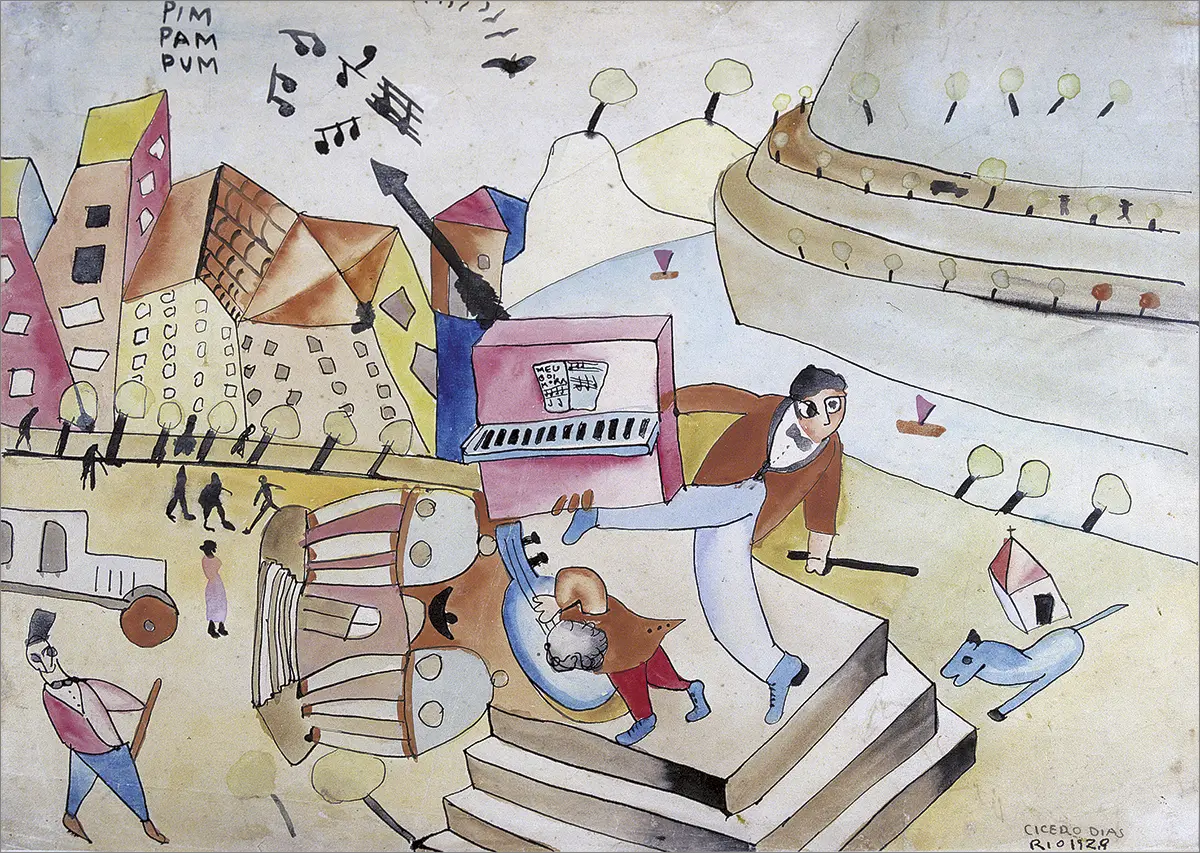
Cícero Dias had his first individual show in Rio de Janeiro when he was barely twenty years old, and only five years after the Modern Art Week held in São Paulo in 1922. At that moment Vicente do Rêgo Monteiro, who was also from Pernambuco, was one of the most active among the artists behind the restoring impulses that had been shaking Brazilian art since the late 1910s. In the 1920s, artists of the same generation like Ismaël Néry, Tarsila do Amaral, and Antônio Gomide left Brazil in order to travel and take in European modern art —especially French modernity— the Brazilian scene built its own modern movements from one manifesto to the next. The decade was rich in events that linked poets and artists by their spirit of critique and search for certainties. In 1924 in São Paulo, the poet Oswald de Andrade published his manifesto of Pau-Brasil poetry, in which he writes: “To work against naturalistic detail —in favor of synthesis: against romantic morbidity— through geometric equilibrium and technical finish; against copying-through invention and surprise... To react against the copy. Replace naturalistic visual with a perspective of a different order: sentimental, ironic, naive.” In 1925, it was modern architecture’s turn with Gregori Warchavchik’s manifesto; and in Recife that same year Gilberto Freire launched his Nationalist Manifesto, twenty points in defense of the culture, values, architecture, literature, and culinary traditions of northeast Brazil. In São Paulo, in 1928, Oswald de Andrade’s Anthropophagic Manifesto marked the symbolic high point of an effervescence shared by all creators. That text argues for a break with the rational dimension of creativity, the exaltation of culture, and national or regional values. Young Cícero Dias was not indifferent to the climate generated by the echoes of this intellectual fervor for new values —the values of a Brazil yet to be discovered and appreciated— as opposed to the static academicism devoid of links to national culture, and outdated, sclerotic models that were not appropriate for local realities. More than a thousand kilometers away on a different continent, another group of artists with different horizons in view also struggled to do away with an obsolete order and gain independence from an antiquated, imposed formalism. On the periphery of the more traditional Mexican School, which favored political and nationalistic art, another generation gained space with artists like María Izquierdo, Agustín Lazo, Antonio Ruiz, and Julio Castellanos. These painters combined the desire and the pleasure of experimenting with imagination and fused it with the quest for a personal Mexican identity instead of the blind application of Manichean stereotypes and national and international archetypes.
Cícero Dias shares that spirit of the surreal and is associated with formal quests that owe their singularity neither to surrealism nor to any of the many isms of the period —which were quickly assimilated by most artists— but rather to a personal magical realism similar to the one that later developed in the literature. While it is true that this current of freedom from academic models is found in varying degrees throughout Latin America, in Brazil painters wanted to give priority to the senses and feelings and poetically capture reality; in his way, Cícero Dias partook of Brazil’s thirst for newness. During the 1920s, while an artist like Ismaël Néry, in direct contact with Europe, assimilated surrealism and Marc Chagall’s universe, Cícero Dias, who had yet to travel outside his native country, sought to renovate both form and inspiration in a dream-like discourse with the deepest part of Brazil, its exuberant nature, and daily life in its native northeast.
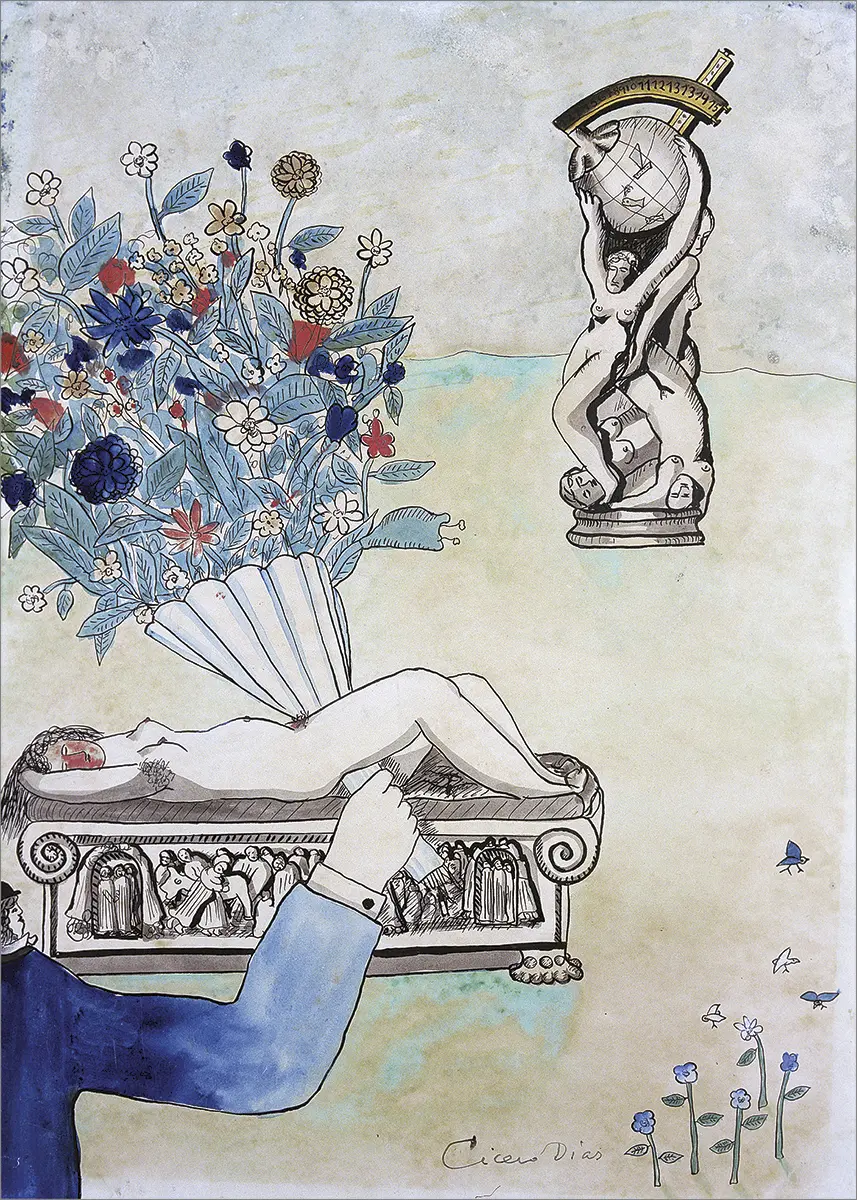
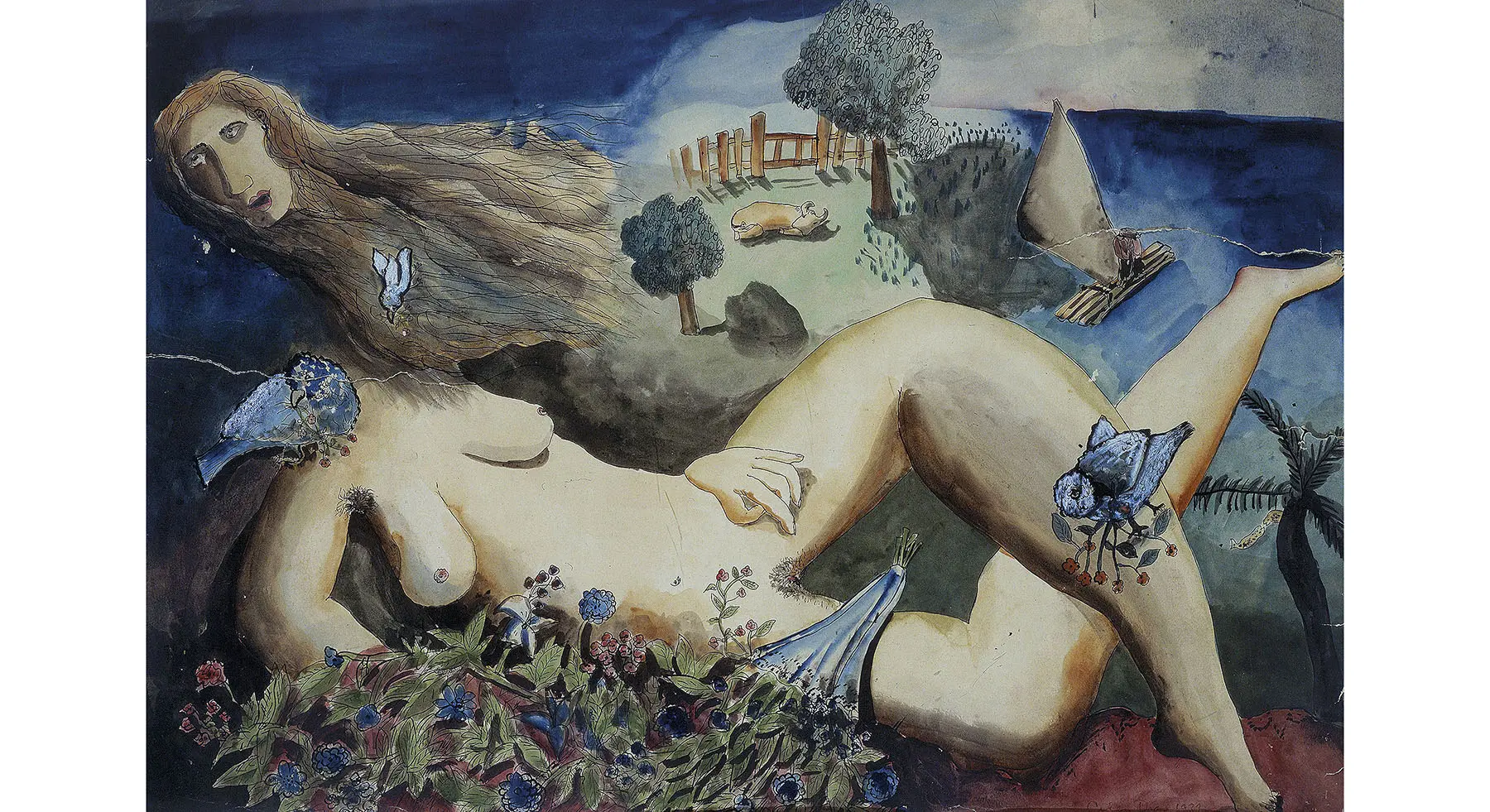
The watercolors, drawings, and paintings from Cícero Dias’s early period included in the exhibition at Latin America House correspond, as Roberto Pontual has written, “both to a will to integrate himself into the process of renewal and updating of Brazilian art, according to external models, and to the project of holding on to his region and the specific circumstances of his birth in order to reencounter, among lyricism and childhood, the softer memory of dreams, in the landscape of Recife or Olinda, of dreams that coalesce around the tender figure of a woman.”1 Whether on topics centered on separation and departure, or on nudes, games, love, dream, friendship, or the circus, Cícero Dias was a chronicler in love with life. He studied the northeast he so loved as an entomologist would, but introduced an element of madness into that world, in which he perceived ephemeral and unstable pleasures with a certain nostalgia, perhaps a premonition of his own destiny in exile. His watercolors on paper are stories that tell of the passing of time. The latter work is a surprising piece where an arm holding a white kerchief emerges from a beribboned boot in the middle of a prairie surrounded by mountains. Love, women, and a discrete and playful eroticism are also present in the show, with watercolors like Saudade (1920s), Aurora mujer (1928), Mujer nadando (1930), Ella (década de 1920), Amo (1933), Lirismo (1929), and Idilio (1920s). In these works, Dias’s tenderness toward his characters is evident. In aesthetic terms, he brings to mind De Chirico; the floating universe of Chagall’s lovers; and some drawings by Jean Cocteau, but in his works of this period, there is much more than reminiscence. They are dominated by a free spirit that wanders at the whim of dreams, ghosts, and nostalgia, creating what can be called visual “neologisms” of a suspended world that is extremely difficult to forget.
Cícero Dias’ provincial youth, his closeness to the world of sugar plantations, the surrounding landscapes, and rural characters like Cavallero y moza en la ventana (1930), belonged to a privileged boy who did not feel particularly affected by the issues of negritude or by the exaltation of a mestizo identity. In this show, few works contradict this. The detailed descriptions we find in Casa grande de Engenho Noruega (1933), or Condenación de los usineiros (1930s) are in the spirit of costumbrista painting and more similar to the work of Uruguayan painter Pedro Figari who settled in France around that time, than to art that sought to denounce given situations. Represión obrera (1928) is the sole piece here that links Dias with Portinari or Di Cavalcanti through aspects of social testimony. We see a soldier guarding a hut in which black and mestizo women and their children are holding a wake. In the distance, some factory chimneys indicate that those huts could be workers’ homes.
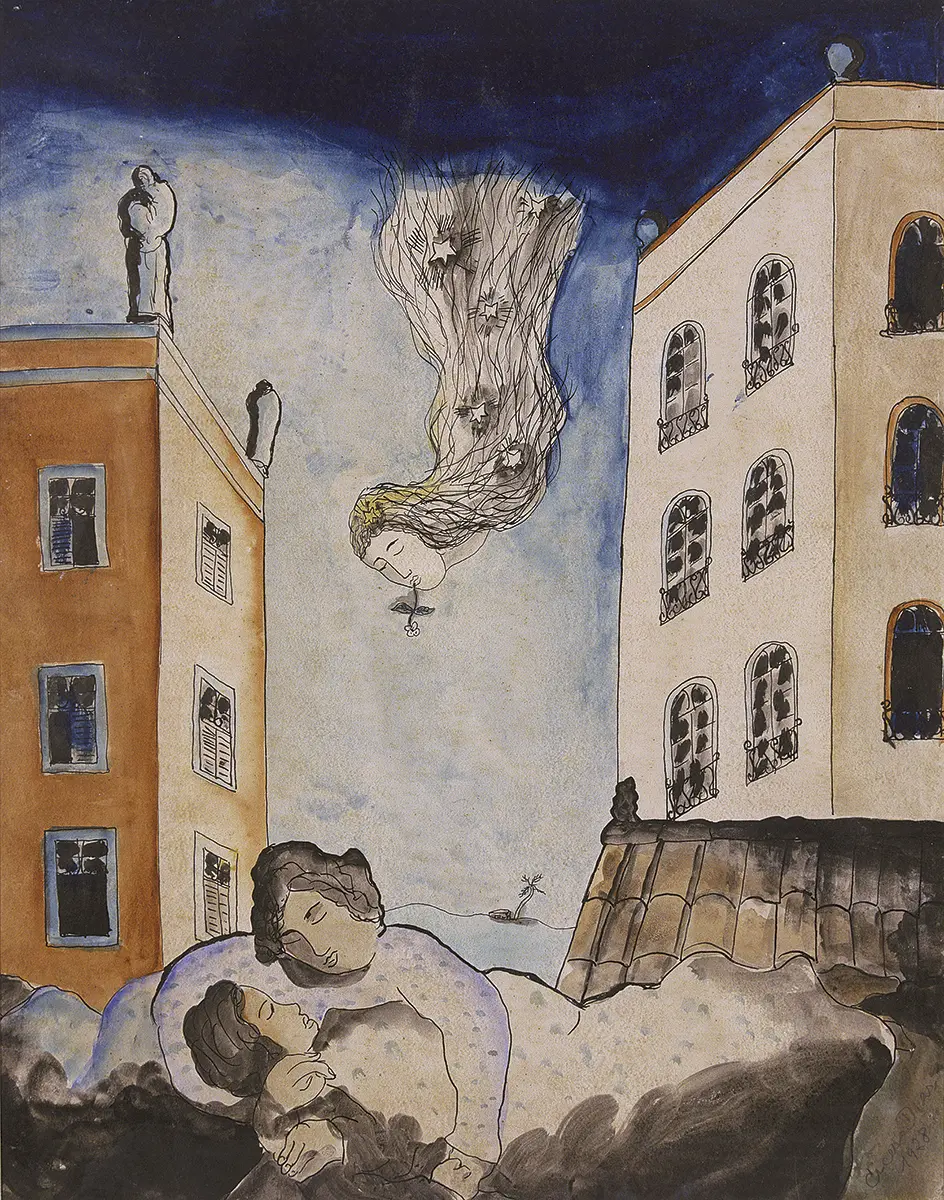
In the large basement gallery, which holds the show’s few oil-on-canvas works, two medium-format paintings confront each other: Recife lírico (1930s) displays a scene where the love for the port and human love come together in the foreground image of a newlywed couple; and Familia de luto (1929), the somber portrait of a grieving, probably well-to-do family. This theatrical scene speaks of death, as does a watercolor on paper titled Muerte (1928) installed not too far away. But, what we find in this piece is no longer the dignified contriteness of the bourgeoisie inside a well-appointed room, but the raw, unbearable truth of pain and despair represented by a woman who cries next to a vulture-eaten corpse. If drawing and watercolor give Cícero Dias’s spaces transparency and levity that adds to the formal subtlety of the works mentioned before, his oil paintings seem to fix the image’s potential for movement and slow down the artist’s wandering vein, that side of his that prefers the irrational and creates the unique climate of his Brazilian years.
In its eclecticism of inspiration, complicities, and (belied) aesthetic references, Cícero Dias’s regionalism is not only costumbrista. It is driven by a poetic feeling of humor and love, impregnated with a dream-like vein in which opposite forms coexist and float in space, and with references to tropical vegetation and scenes resembling “atmospheres in surreal gravity.” More than anything else his draftsmanship resembles the imagery of northeast folk; his preferred themes are those of sugarcane plantations and the rural world rather than the technological modernism explored by Tarsila do Amaral. The Brazil he loves and wants to show the world is a simple Brazil of the people. What distinguished the especially lovely selection presented in this show is the freedom of his draftsmanship and the richness of images sometimes impregnated with a light, playful eroticism. Far from being limited by aesthetic conventions or theories, the artist creates an atmosphere where the pleasures of painting predominate.
During the German occupation of France, Cícero Dias took Paul Eluard’s poem Freedom to the forces of the French Resistance in London. Thousands of copies of the poem were printed and dropped by the RAF on French territory. Cícero Dias, the painter, and watercolor artist was also a messenger of freedom.
NOTE
1. Roberto Pontual, in Art Brésil Aujourd’hui-50 ans après, ed. Collectivo, São Paulo, 1973.
CHRISTINE FRÈROT
Art historian and critic, École des Hautes en Sciences Sociales, Paris, whose work involves both research and teaching.