
This first anthology exhibition of works by Claudio Perna (Milan, Italy, 1938 - Holguín, Cuba, 1997), a decisive figure in Venezuela’s artistic scene of recent decades and someone to take into account when considering a broader and more inclusive reading of Latin American visual culture, has been many years in the making. Awarded the Premio Nacional de Fotografía (1994) and the Premio Nacional de Artes Plásticas (1995), Perna was a versatile artist equally comfortable in a variety of media: working as a photographer, videographer, draftsman, painter, geographer, and teacher.
The exhibition, organized by the National Art Gallery under the curatorship of Zuleiva Vivas, gathers more than six hundred pieces, among them objects, artist’s books, installations, slides, drawings, collages, intervened maps, photographs, and paintings, all from the period 1966–1995. It follows Perna’s own reflections and notes, and the texts displayed in each section of the show are by the artist. Despite the size and heterogeneity of the whole, Carmen Araújo’s micrographic mise en scène is sober and highly readable, yet it doesn’t hide that “managed dispersion” that characterized Perna’s creative behavior.
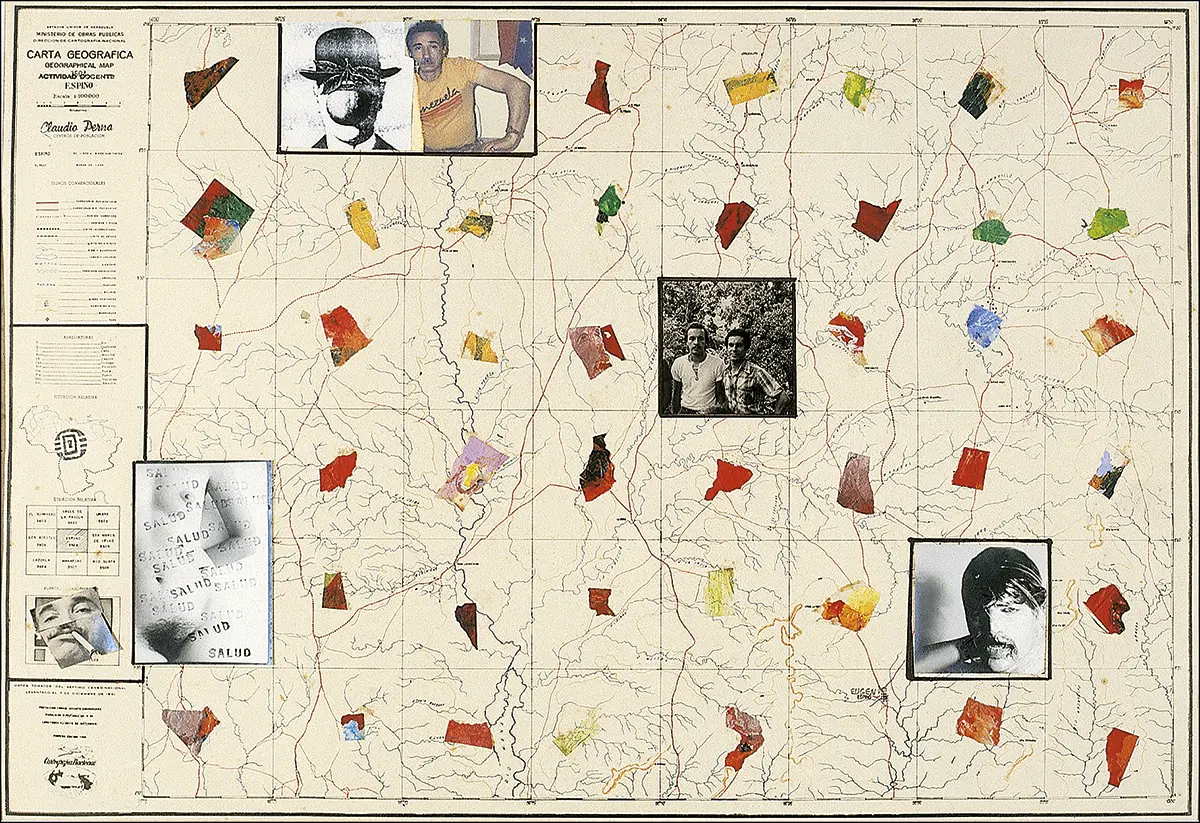
Starting from these assumptions, the show’s trajectory is structured around the reconstruction of some of the most important projects conceived, organized, and/or developed by Perna. Among them we find the I Festival Venezolano de Diapositivas (Sala Mendoza, Caracas, 1977), the show Fotografía Anónima de Venezuela (National Art Gallery, Caracas, 1977), and the installation Venezuela y sus detalles (National Art Gallery, Caracas, 1991). Adding to this is a recreation of the artist’s workspace, which includes his archives, library, and art collection, most of which can be consulted by the visitor.
Besides the points already mentioned, the exhibition also includes Perna’s Fotos dirigidas (1967–1968), a series that marks a rapprochement with objects, nature, and man; Autocopias (1975), which takes advantage of the instantaneous reproduction afforded by photocopying and gives it an autobiographical character; Infiltraciones (1975), conceived as a non-conventional means of insertion into institutional spaces; and Acupinturas (1981), created by juxtaposing male figures and images of fruits and flowers. The show also presents the Fotoinformes, based on newspaper materials, and Objetos inquietantes, comprised of artifacts of various origins diverted from their original context and altered to extraordinary effect.
Favoring a “converging contemporaneity,” Perna took advantage of the communicative and symbolic potential of different forms of knowledge in order to establish a polyphonic discursivity of great contextual gravity, not devoid of references to foreign cultures. In this sense, his work proposes a dialogue between thought and feeling, a strategy that brings to the fore contradictory impulses, from the transcendental to everyday and from the intimate to the public, including concerns of a socio-environmental nature.
One of the initiators of conceptual art in Venezuela, Perna assumes the dominant role of ideas in art and the preeminence of process over results but goes beyond the self-referential impenetrability of tautological statements in order to explore different aspects of his affective and cultural surroundings. His proposal is not limited to emphasizing meaning; he also tries to point out the connection between art and life, which distinguishes him from orthodox conceptual art. More than a mere vernacular adaptation, this break with respect to the hegemonic canon presupposes a situational perspective that intelligently reconciles the rational and the subjective, the systematic and the fortuitous, the local and the global.
In Perna’s case, the idea of a socially committed art is not necessarily a mass product, much less an easily digestible one. His is an art that questions the exclusivity of the beautiful as a guarantor of value, an art that ironically appropriates mass-media and institutional strategies of representation in order to interrogate their ideological texture, and which, finally, gives the individual a substantive role, both in his private dimension and in his condition as a participant in a collective enterprise.
FÉLIX SUAZO