
We are not unique. We are like others. We have the same concerns. We live in a world where thoughts flow together, the problems we face are similar, and many people interrelate without knowing it. There exist networks of twined thoughts that remain unaware of each other but interact, unknowingly, in different parts of the planet. This world is at once discontinuous and continuous, impacted by forces of nature, laws of change, forced or voluntary migrations, and, of course, violence. A recent World Health Organization statistic reveals that the twentieth century was one of history’s most violent; close to 191 million people, half of them civilians, lost their lives in armed conflicts. Violence is among the main causes of death. “The most impressive aspect of this is the size of the problem, regardless of country, region, or religion. Violence is unacceptably high in every country,” said Etienne Krug, author of this first report, the most complete document about the cruelty inflicted by humans upon humans.
Diana Drews, a young Colombian artist, voluntarily exiled for some years, lived and worked in Germany and there her vision changed as she realized that human beings and their problems are the same the world over and that the violence that marks and has marked our country can be similar to that of many other countries. These reflections are the starting point of her most recent work, which can resemble a personal journal that brings together different values for the appreciation of departure, waiting, pain, introspection, and sojourn. Being away from her country made possible her series Tiempo de espera, Al otro lado del mundo, and Emptiness, which have as their common denominator a painting that explores human beings on the basis of their belongings: clothing, suitcases, and furniture. For example, she created a group of small-format paintings that resemble travel suitcases protected with bubble wrap as though lacking a fixed place of residence; as though everything migrated without announcing departures or arrivals; as though needing to abandon a place for no reason or for many reasons at once; as though the owner of this luggage didn’t have a destination.
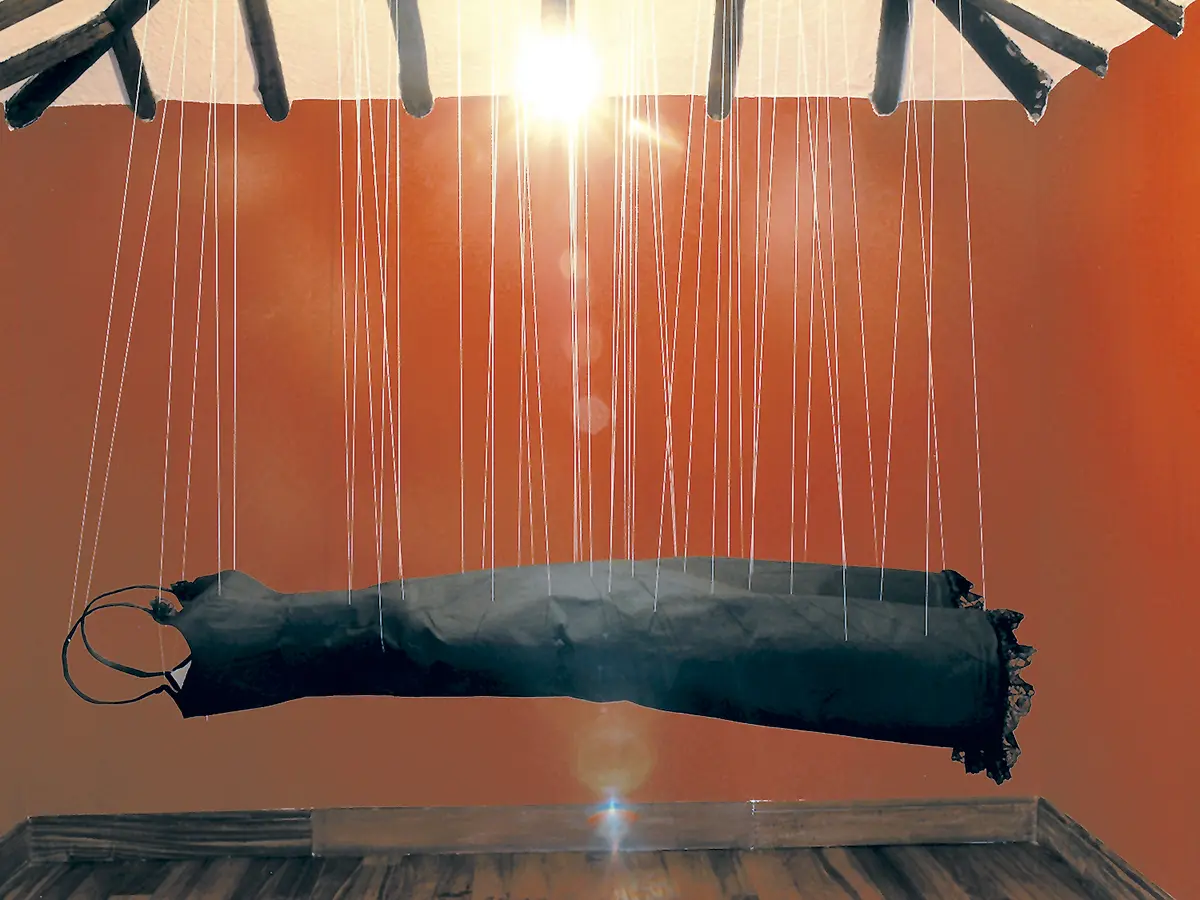
Recently, Drews worked on a series of black dresses titled Doble luto where duality is exposed. White and black dresses prompt reflection about the duality of human beings and give us the option of looking at ourselves in our own duality, like a house inhabited at the same time by bodies and spirits and opposing principles of good and evil.
On this occasion, Banco de la República has invited Drews to enter a dialogue with work from its collection, and she has chosen Alejandro Obregón’s Violencia, a 1962 painting in which the artist looks at the period of violence in the country. The theme of this piece displays a pregnant, mutilated woman in a horizontal position, subtly painted in shades of gray and white. It is an emblematic, very significant work in which Obregón reveals the drama and protests against the indolence of a conflict that has not ceased in our country but could correspond to anywhere in a war-torn world. For her response to this work, Diana Drews creates a black dress in scale; its color makes us think of long grief. The dress hangs from small and subtle white threads and is subtly lighted and presented as the Jesus of Michelangelo’s Pietá, but the female character is here absent and at the same time forcefully present, because the dress is a trace of the human. Death encompasses the mystery of the mortal instant, the fragility of existence; the dress is what covers us, what protects us, what unifies us. The conversation between these two works of art is to not forget human tragedy devoid of territory, its victim nameless, just like the delicate woman who appears in John Everet Millais’s work, or Hamlet’s Ophelia, dead in madness and outside of time, empty and sublime in time.
MARÍA ELVIRA ARDILA