
The issue of the United States-Mexico border is central to the art Jaime Ruiz Otis. What makes his work distinctive is that he avoids typical imagery associated with this genre, working instead with a minimalist aesthetic and successfully merging social and economic concerns with abstract forms. Seven projects from this line of investigation made up his recent exhibition at the Museum of Contemporary Art, San Diego. In this show, each object was essentially made from a single pre-fabricated item. Frequently, the materials became nearly unrecognizable in their new form, as in the installation in the ground floor gallery. Introfotosensiproyecta (2005), the first work the visitor encountered, consists of dozens of rigid grey plastic panels, all uniform in size (approximately 3 x 5 feet). Some were clipped together to construct walls and barriers while others hung freely at various heights and angles to one another. They partitioned the room into alcoves obstructing free movement through the space and creating an almost maze-like effect. Motion sensors detected when a visitor had entered the dimly lit gallery and triggered a flashing and clicking of lights behind various plastic constructions. Only after reading the object label could one recognize the panels as screens from plasma televisions, which explained their slight curvature and the alternating opacity and reflectivity of different sides. These screens probably originated from discarded television sets or were disposed of by the factory at the time of assembly. This is not an unusual source for Ruiz Otis. In fact, he constructs all of his works with materials recovered from the trash bins of the maquiladoras, or factories, in Tijuana.
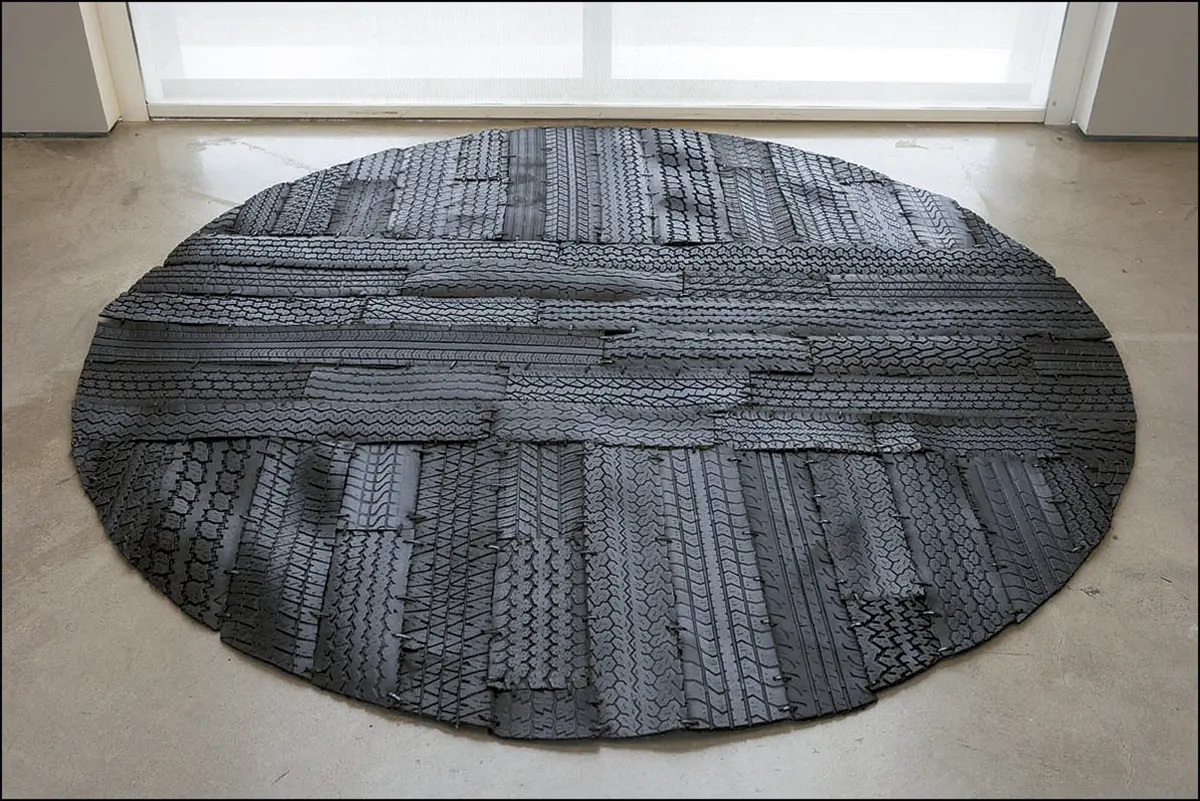
The rest of the show was installed in a second-floor gallery. Here one could see Ruiz Otis working through the conventions of various other media, such as painting, sculpture, and printmaking. For example, in Tapete radial (Radial Rug, 2001), the artist fastened together segments of old radial tires into a round sculptural “rug” that lies directly on the floor. Its circular form echoes the shape of its source, a tire. What is immediately noticeable in the glossy black surface is the diversity of textures and patterns of the assorted treads, a seldom acknowledged feature converted into an object for aesthetic contemplation. Estela (1998–2005), confronts the genre of abstract painting. It initially appears to be a traditional oil-on-canvas painting and only on close inspection can one see that it is a piece of industrially dyed fabric stretched over a wooden frame. Ruiz Otis’s media are generally found materials and therefore free of charge, highlighting the irony of their role in a commodity-oriented culture. These materials have entered and re-entered the market at several points: as the original raw resources that were shipped to the factories, later as consumer products, and most recently as artworks. This irony is exaggerated to great effect by the newfound cleanliness and care that these waste products receive once they enter the museum world. It is likely that the rubber in Tapete radial was never so clean or shiny before it was purchased by the museum.
The United States-Mexico border is only a launching point for Ruiz Otis. His work actually looks at the larger dynamics of the relationship between the United States and Mexico. The industrial waste generated by the maquiladoras that were established in border towns as a result of NAFTA in the early 1990s provides him with a point of entry into this relationship. Some objects, such as Tapete radial, are made from waste —in this case, tires— that the United States chooses not to dispose of due to national environmental laws, and instead has sent to Mexico to be dealt with. These works comment on larger questions of international business and policy and easily characterize the United States’s relationship with a number of nations. Global references are also evident in Ruiz Otis’s formal language. The fabric paintings by German artist Blinky Palermo, the neo-concrete Nuclei of Brazilian Hélio Oiticica as well as the floor works by U.S. Minimalist Carl André all seem to converge in his visual language. This work resonates far beyond the local politics of the border between San Diego and Tijuana.
This exhibition was installed in the museum’s satellite gallery space in downtown San Diego. Although it only received two small galleries, curator Rachel Teagle made excellent use of every inch of space, including the landing wall in the stairway connecting the galleries. The show was part of the museum’s Cerca series of more informal exhibitions designed to showcase emerging local artists and draw a more diverse audience. Ruiz Otis is also the first recipient of the museum’s Art up Award for new talent, which is certainly well deserved.
ALECA LE BLANC