
Currently deemed a tropical metropolis—the tropical metropolis— Miami’s South Beach is the hub of a cosmopolitan nocturnal scene of lavish clubs, where the latest trends and fashions consist of sumptuous brand names on display. Colombian artist Juan Raúl Hoyos’ exhibit Natural Flavors, in Alejandra von Hartz Fine Arts gallery, gives the public a taste of Miami—an experience of both, day and nightlife in the city. The exhibit is made up of large-scale acrylics on canvas and smaller groups of square modules that work extremely well when placed together. All of the works were done and completed between 2004 and 2005. Hoyos’ artworks are made up of two basic elements: the background, and an icon that detracts the public’s attention from it. His technique consists of using brushstrokes to paint an expressionist layer as a primer on the canvas. He proceeds to cover the primed canvas with a series of square and rectangular serigraphs. The prints are not perfectly aligned and allow the colors used in the first layer to show through without interrupting the cleanliness of the work. Finally, a thin, see-through layer of paint is applied to veil the canvas. What grasps the viewers’ attention is an icon, usually a human figure or a silhouette that differs from the rest of the artwork and consequently, blurs the attention given to the backdrop, which is a key and focal point of Hoyos’ artwork.
Skilled in serigraphy, Hoyos presents us with simple and fast images that have the commercial feel entertainment art uses heavily in publicity and sales ads. Hoyos subliminally camouflages his message to create iconographic voyeurism, which results in fascinating as the viewer unravels and learns how to read the layers within each artwork.
In the case of National Recognition 1, a large-scale acrylic on canvas (84” x 110”), the figure of a man wearing a suit stands out from a red and yellow background that resembles a hound’s-tooth check fabric. The blue outline of a male figure drawn on a white square breaks the pattern. Hoyos paints the figure with such detail that it appears to be a stencil instead. The man’s pursuit of affluence and power conditions him to maintain a socially acceptable image. The man welcomes the audience to his corporate world, where the cliché “what you see is not what you get” applies to its fullest.
In Almost American, the black silhouette of a classy, chic woman appears to be taken out of the page of some high-fashion magazine, which is perhaps why the artwork appeals immediately to the public. Hoyos captures the simple action of her stride so precisely that she appears to be a photograph, with her right arm swinging forward and the heel from her right foot lifting from the ground to take the next step. The background, however, is made up of pages taken from hardcore pornographic magazines, contrasting with the image of the woman.
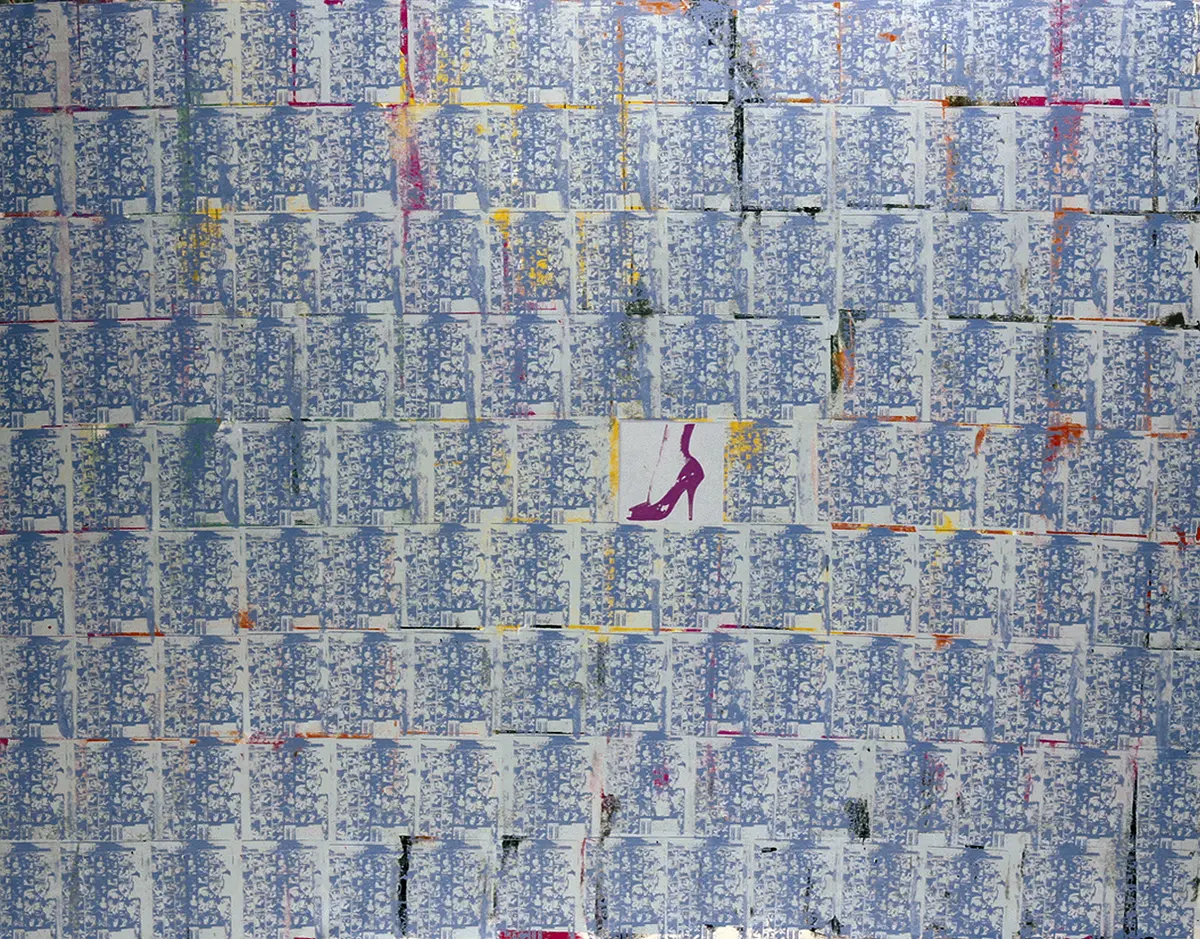
In Uncensored Purple Figure, a woman’s foot wearing a violet high-heel is the focus of the large-format acrylic. Feet and shoes have long been the center of attention in psychological theories and sexual deviances. Hoyos appears focused on working along the lines of Sigmund Freud, who suggests that in cases related to dreams one word triggers a series of associations: shoes lead to clothes, clothes lead to the closet, and the closet leads to a place that safeguards or hides, and hence, hiding leads to the concept of secrets.
Whether deliberately or not, Hoyos is able to make his way into viewers’ minds, to allure them long enough to imprint his images on their psyche. He talks in a universal language that pertains to a consumer society that seeks pleasure and entertainment within the realms of luxury, in a place whose members are willing to present facades that mask socially unacceptable behavior. A key element to those pleasures is their impermissibility, the moral taboo attached to them, and the secrecy under which they have to be performed.
Hoyos is not a dissident nor does he seek to protest the establishment of social norms. He is an observer and presents his artworks as such. He declares himself part of this social ambiance through his artworks, admitting that only those who integrate this social circuit are able to understand how it works. Through his work, Hoyos admits that we are a corporation within a corporation, where images are sold to acquire an acceptable social status in a place like Miami, which is a country within a country.
CARINA GALLEGOS