
This outstanding exhibition of sculptures by the octogenarian Mexican artist Juan Soriano remained open through the end of July. For Soriano, born in Guadalajara in 1920, this event marks a return to the Universidad Nacional Autónoma de México, which 40 years ago hosted his first individual show.
The show comprises 11 large-format pieces in bronze that allude, above all, to oviparous animals and even to a certain mythical fauna. Soriano’s monumental sculptures were presented in the front garden of UNAM’s Architecture School, next to the Museo Universitario de Ciencias y Artes (MUCA) and very close to the Torre de Rectoría field. Soriano’s oeuvre, seen in perspective, brings to mind a kind of contemporary beatific farm, a space for fantastic zoologies that acquires movement as the viewer moves around it. The show’s museography, in that sense, achieves an independent dimension and presents itself as an aesthetic proposal alternative to each sculpture’s individual value. Exhibited among trees and garden plots, the show is perceived, then, as a consummated bestiary that triggers the viewer’s fantasy and generates an indomitable, feral atmosphere. This selection is an effort to amalgamate pieces that reside permanently in different art spaces throughout the country, among others Garrido Canabal Park, in Villahermosa; Marco in Monterrey; Guadalajara’s World Trade Center; the Auditorio Nacional and Loreto Square, both in Mexico City.
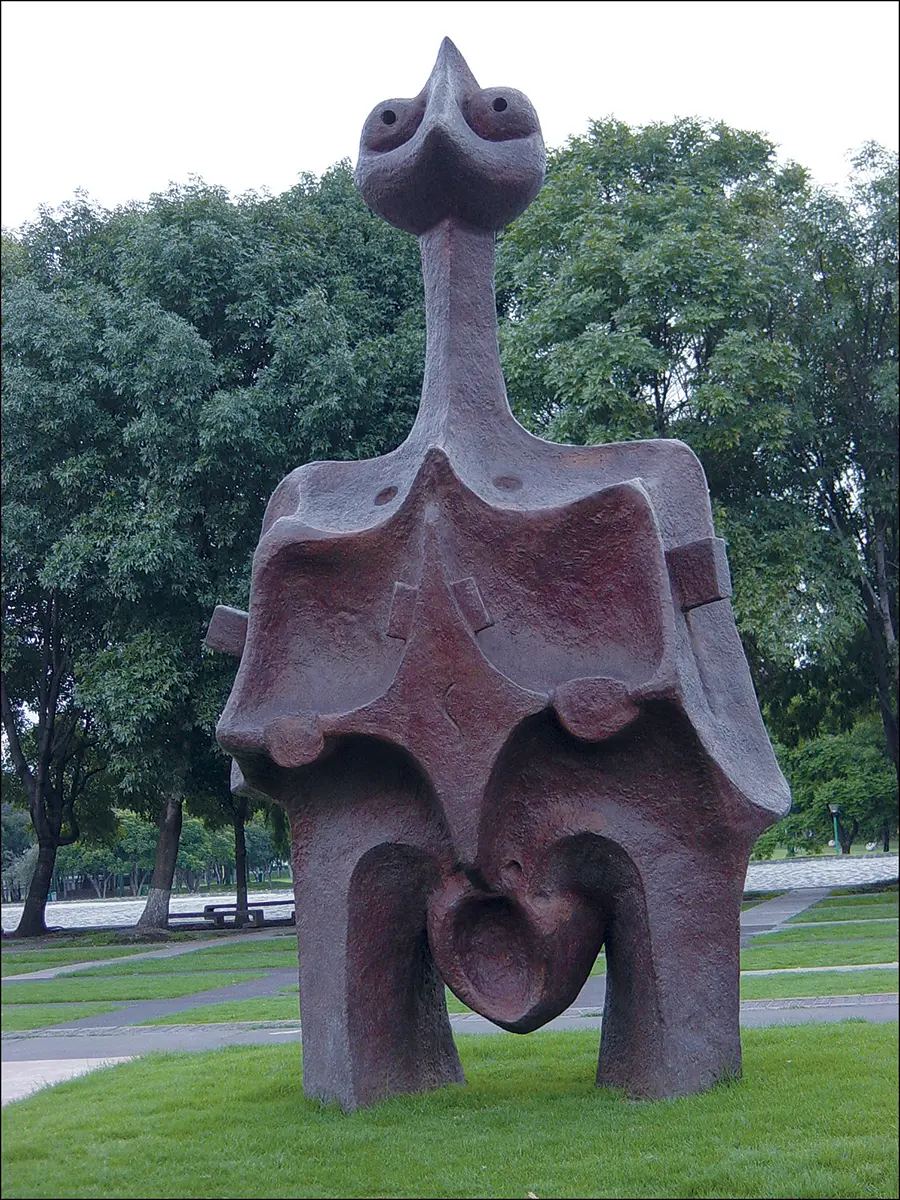
All these sculptures are made in bronze and most of them were made in the year 2000, since, for instance, El pato is from 1989, and Gallo, from 1994. The first piece, La paloma, which opens, so to speak, the show, because it is placed first in a north-south direction, is a structure more than 3 meters tall and 3 meters wide, installed in the field’s initial platform, clearly suggesting the beginning of the flight. In the case of Toro, the only piece that does not exceed a height of 1 meter, while referring to the powerful bovine, the fact that it is represented at rest on the grass lessens the savagery of its essence and presents it as a languid, innocuous being. There are, on the other hand, four sculptures defined by their name: Pájaro sobre la ola, Gallo sobre la bola, El pato, and Gallo. The effigies of these animals are placed on a wide base that simulates the pedestal on which they are standing. It is important to note that each of these four pieces presents a paradoxical suggestion regarding the element on which, it is said at the beginning, the animals lay; the oviparous extremities are but another extension of their base. A kind of ambiguous, Siamese branching between both objects.
Pájaro de dos caras, another structure over three meters tall, gives the show another turn of the screw; here the “realistic” aspect of the animal representations is left aside, and the artist moves in the direction of a more intense stage of abstraction. Our perception of this sculpture, more than referring to a two-headed, chimerical beast, tends towards a finer interpretation on the part of its viewers because it gives the impression of being a wingless animal. The “hinge” effect of this figure carries us to the pieces that close the exhibition: Planta (two-meter high vertical structure with an eroded texture,) Dafne (a giant hoop with the representation of a female silhouette in its diameter), Ofrenda II (symbolic simulation with various abstract elements), and Máquina de hacer dinero (perhaps the most anarchic and variegated piece, which could very well incarnate the abstraction from thought.)
Juan Soriano’s show, Espíritu de formas y escultura monumental, is not only a sublime ode to the idea of the monument in its more classical definition (the constitution of something grand and grandiloquent,) but also proof that the chain of works recreates itself as a kind of contemporary bestiary, a sylvan tribune of fantastic and colossal animals. With this exhibition, UNAM contributes to the celebrations for the new anniversary of Juan Soriano, coinciding with the Velázquez Prize for the Arts given to him by the Spanish crown a few weeks ago.
CARLOS ANTONIO DE LA SIERRA