
Lina Binkele (Colombia, 1957) presented her work for the first time in Atlanta in the Castleberry Art District, one of the city’s most frequented art zones. Located inside the metropolitan circuit, Castleberry is an example of how in recent times the big American cities are engaged in a process of restoring original architectural urban sites.
One bronze sculpture and five paintings in acrylic and ink on wood make up Anima, Binkele’s show at Skot Foreman Fine Art, an art gallery located in two recently renovated old buildings that are part of the district’s larger urban grid. Skot Foreman has been displaying Binkele’s work for several years now, first in Florida and at several art fairs, and now in Atlanta.
The horse and its relationship with human beings are the unifying themes in this show where the artist also displays an inclination toward naturalistic representations. Binkele’s naturalism is evident, for instance, in her drawing of muscular volumes that faithfully reproduce the horse’s anatomy in her painting Caballo con la cara siena (2001). On the other hand, her sculpture Jinete con riendas (1997), while making explicit her closeness to the real world, also communicates an expressionistic impulse in its dynamism and finish, which act as a destabilizing factor vis-à-vis naturalism.
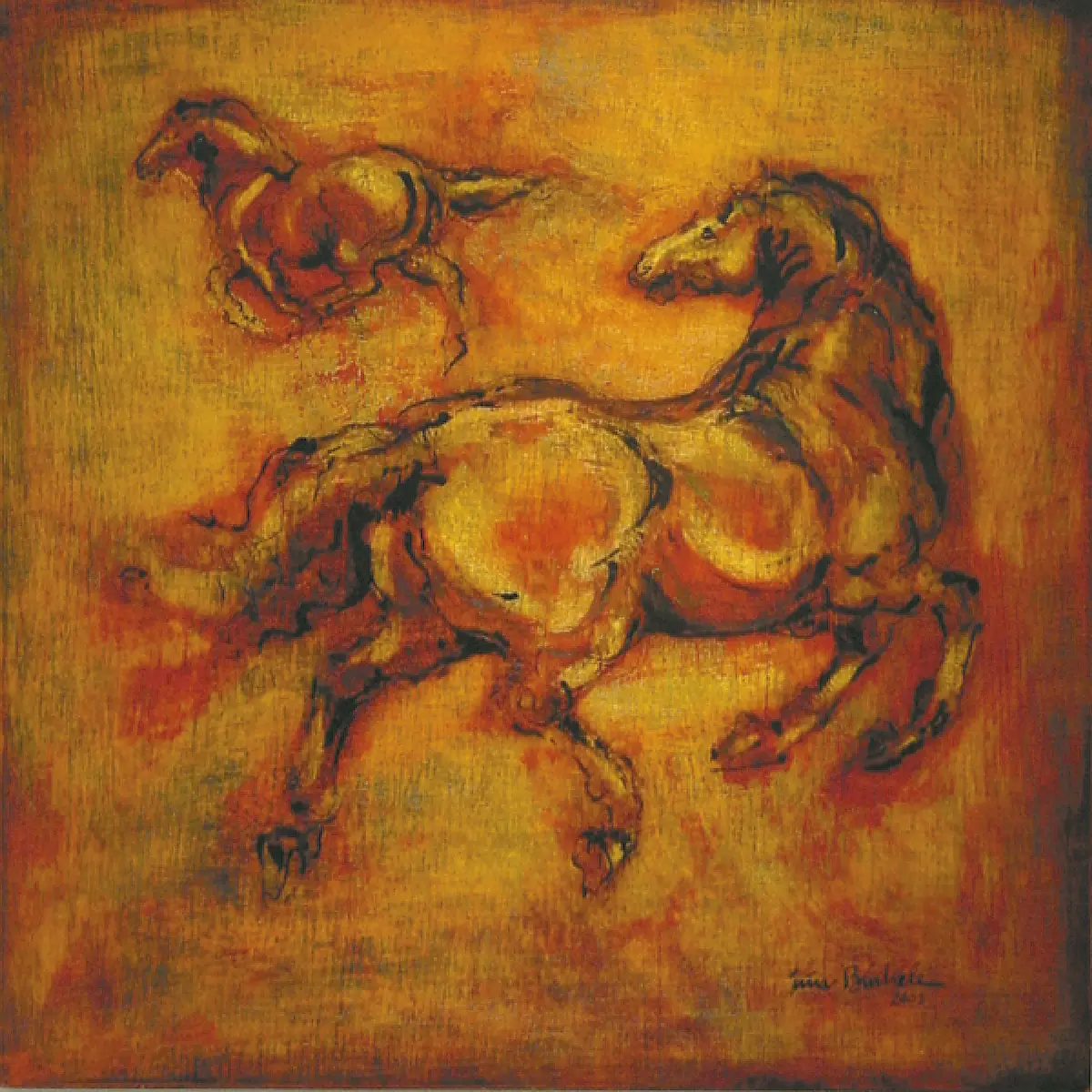
From a historical perspective, Binkele’s paintings can be aligned with a figurative tradition that sees brushstrokes and colors as traces of a kind of subjectivity. The lines that form her figures evoke, in general, a sketch, the study drawing that is repeated as an exercise in order to capture the features that are most expressive of an object’s character. Her painting Rupestre (1999) is a good example of this. Figuration in this work is reduced to a few loose, organic lines, which seem to emerge from continuous movements, interrupted only when necessary to make room for the expression of empty space. The result is an effect that is close to gesture and suggests the presence of a playful component in Binkele’s creative process.
Invariably in the five paintings presented at Skot Foreman Fine Art, figures are posited against planes dominated by a single color. For example in the case of Rupestre, the dominant color is red, while in the case of Río (1999), the dominant color is yellow. Planes of color have been used as backgrounds to avoid the description of specific spatial contexts and to infuse the works with a kind of lyrical, exalted illumination. The same resource, on the other hand, renders the bidimensionality of the pictorial surface tangible. In a recurring way, we also find that the artist uses her titles to describe the scenes that are represented visually, as in Caballos pisando (2002).
Lina Binkele recreates the grace and elegance of horses in her images. Through a varied representation of gestures, poses, and movements she celebrates the aesthetic nobility of these animals and a world where human beings and nature exist in harmony. Unconcerned with innovative formal quests or deep analytical propositions, Binkele wants to offer contemplation of her works as a moment of rest. It seems she prefers to please those among us who aspire to have an expressive space, a realm of private tranquility.
ANA M. FERNÁNDEZ