
Recently, the University of South Florida Contemporary Art Museum in Tampa presented the first retrospective in a United States museum of the work of Los Carpinteros. It included thirty works in various media dating from 1993 to 2005. The curators organized the presentation around a tripartite scheme—La plaza: el agua: la casa (the plaza, water, the house)—meant to suggest essential human needs. Although the arrangement was effective, it became clear that the work of Los Carpinteros refuses simple categorization.
Upon arrival the visitor is greeted by two relatively recent outdoor sculptures: Transportable City made for the 2000 Havana Biennial, and Watchtowers (2002). Composed of sleek, modernist forms in aluminum and polycarbonate, Watchtowers stood before the doors of the museum, an allusion to notions of surveillance in cultural institutions that also suggested police booths in Los Carpinteros’s native Havana. Both Watchtowers and Transportable City reference the idea of the plaza in terms of communal spaces and public architecture. They were particularly effective within a university campus, one of the few non-commercial public spaces in the suburban sprawl that characterizes the architecture of the United States.
As the outdoor sculptures demonstrate, the work of Los Carpinteros resonates differently depending on its context and the background of its viewers. Indeed, the collective has been able to negotiate the rocky terrain of the global and the local in masterful ways, and this probably accounts for the artists’ resounding success in the contemporary art world. The exhibition juxtaposed early works with recent ones that reveal the dramatic changes experienced in Los Carpinteros’s art, leading them away from the local toward the universal. Havana Country Club (1994), very grounded in Cuban experience, showcases their early concerns. An oil painting with an elaborately carved wooden frame, Havana Country Club depicts the three original members of Los Carpinteros posed in front of the Superior Institute of Art, formerly a country club, and mimicking poses originally found in photographs of a golf match between Fidel Castro and Che Guevara. The three men, Marco Antonio Castillo, Dagoberto Rodríguez, and Alexandre Arrechea (who left the group in November 2003), however, are not playing golf; instead, two of them hold long sticks in the manner of golf clubs, and all look at the ground at nothing in particular. Modestly dressed, they embody Cuban youth and suggest a sense of futility. The piece collapses the categories of high art and craft and further juxtaposes the commodity of easel painting with Cuban social reality.
Alongside this painting stood Jewelry Case (1999), a large-scale representation of a grenade (over two meters high) roughly constructed in wood, which reveals new directions in their art. Instead of the usual ridges, this grenade has working drawers transforming it into a functional object. The piece embodies several contradictions, such as the disparity in scale between an actual grenade and this sculpture; craft and technology; and weapon and commodity. These odd juxtapositions that defy expectations have led critics to aptly relate Los Carpinteros’s oeuvre to Surrealism.
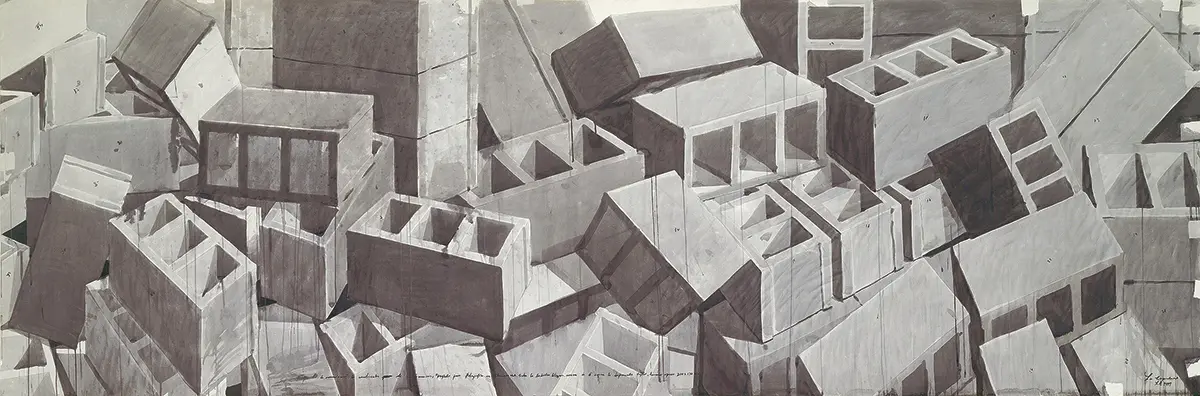
The work of Los Carpinteros exhibits both continuity in theme as well as great differences in terms of style and subject matter. A major distinction between the earliest work and the most recent is the absence of the human figure in the latter. This creates a sense of emptiness in their works that was particularly evident in the section of the exhibition with the theme of the house. It included impossible appliances such as Hot Sofa (2001), made of white painted steel with gas burners where the seats should be, Staircase (2001) with electric burners on the steps, and Big Drawer (2001), a file cabinet with an enormous wooden drawer jutting out. Also in this section were large-scale chests of drawers in wood that referred to specific buildings in Havana and a set of lovely watercolors representing unexpected constructions or building materials. One of the most spectacular is Project of Accumulation of Materials (1999) from the collection of The Museum of Modern Art, which depicts cinderblocks piled every which way that fill up the entire picture plane. Perhaps signaling the end of the utopian project of modernism, the drawing boasts a rich pictorial surface that would seem to undermine this message.
The last section of the exhibition related to the theme of water and presented a set of thought-provoking drawings and constructions dealing with Los Carpinteros’s continued interest in swimming pools. These objects also set forth the unexpected juxtapositions so characteristic of their work, and the drawings evince a mastery of pictorial technique that has remained consistent in the artists’ trajectory. Overall, this thoughtful exhibition, along with its lavishly illustrated catalogue with an excellent collection of essays and an interview with the artists, made an important contribution to the study of the work of Los Carpinteros.
TATIANA FLORES