
The show presented by Mabel Rubli at Centro Cultural Recoleta in Buenos Aires during the months of April and May confirms a brilliant career that has made her an outstanding figure in the Argentinean and international scenes.
To her technical excellence and her rigorous academic training, this artist has always added interesting conceptual propositions and a pressing humanist interest. She has always surprised us with her imaginative displays and her continuous renewal.
Her new show is titled La vida inmóvil and it is a tribute to the victims of the Holocaust.
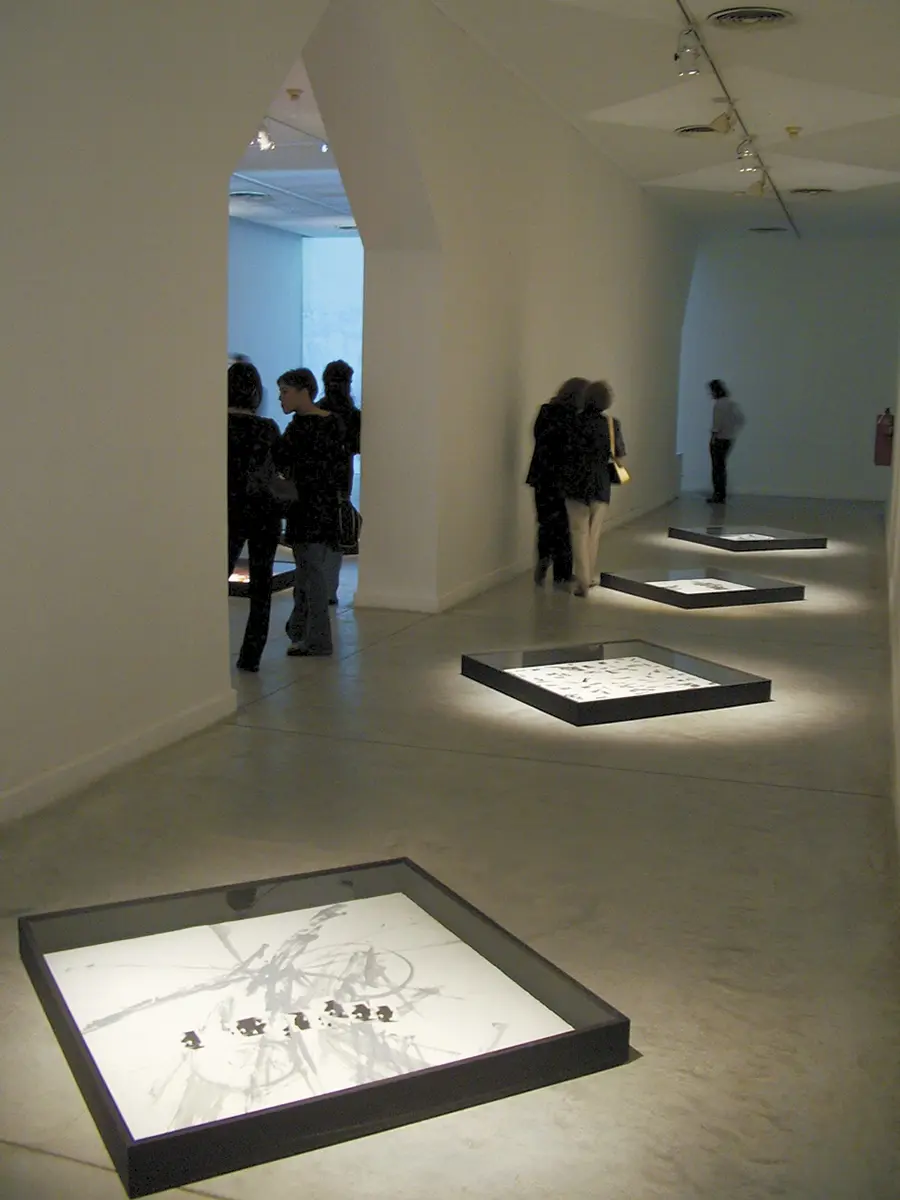
To the image of Death implicit in her theme, Rubli opposes the dynamic force of enormous boxes, in serial order, placed on the ground and exhibiting multiple images: drawn, painted, scanned, and digitalized.
The register, the trace, is present in cut-ups, collages, blotches, and graphics.
To see these outsized boxes, viewers must move to study them from different angles, lean forward, stop to connect fragments, see them plastically, and take part, their spirit enraged, in the pain inflicted by Man on Man.
The show is complemented by a large wall projection of the scene of the arrival of a train to one of the concentration camps. Women, children, elderly people, and protagonists of horror and fear, are all alternatingly lighted, defined, and brought forward from the rest, only to slowly fade and disappear. As if in a movement of systole/diastole capable of bringing them back to life for our attention and compassion, they complete their cycle of light and shadow and repeat it constantly, as if reality itself were disintegrating.
The eyes that look at us are the eyes of the dead, and they remind us of the iniquities of a century that saw them in excess.
The viewer is called and mobilized from the screen and by the trajectory established through the labyrinth of boxes on the ground.
This show s extraordinarily coherent with Mabel Rubli’s previous work, where she has established a line of research into all the techniques that have been incorporated in printmaking.
Rubli has previously expressed a taste for serialized work in which a certain number of pieces echo and amplify each other.
She had previously found unsettling photographs like that of a girl running in Vietnam, and also fragmented and multiplied images that she used to express her concern for Man subjected to the most adverse occurrences of contemporary life.
This show is an answer to Adorno’s famous dictum, also cited by Elena Olivera in the excellent catalog: “Is it possible to write poems after Auschwitz?” Our artist answered with a yes. It is possible.
If art has historically established a chain of continuities to affirm the human if Auschwitz seems to have gone beyond that limit and has exploded any formal attempt at meaning, artists of our time need to find new possibilities of integration between form and represented emotion, new possibilities for affirmation, new patterns.
The interesting thing about Mabel Rubli’s exhibition is that at no point does the artist's ethical commitment invade us; rather, it slides subtly and moves us through the grave eloquence of the means used.
NELLY PERAZZO