
Marco Mojica’s show, “mágenes, open through the end of July at El Museo Gallery, comprises innumerable references to images that populate the viewer’s visual universe: images in dialogue with events in the history of contemporary art; images reminiscent of the aesthetic of posters and ads; images that bring to mind the absurd and the dream-like; images that converse with each other and place themselves in an ambiguous zone that is plastic by definition but borrows elements from aesthetics other that the plastic arts.
This show encompasses two kinds of visual universes that are different but share the same plastic language. There are several works inscribed within discourses that are close to the graphic arts or to advertising; the use of these visual codes is a response to their ubiquity in contemporary everyday life and the way in which they inexorably become important components of the artist’s and the viewer’s visual imaginaries. At the same time, several works appear that, while possessing a strictly figurative visual language, represent circumstances that are loaded with dreamlike —and in some cases nightmarelike— absurdities.
Although Mojica’s production is concentrated on drawing and painting, some of the works exhibited here are interesting for their use of materials that are alien to both those media. Evolución [Silla], for instance, consists of the image of a chair —entirely free of context— and its projected shadow, which is reproduced in the dust on the glass that protects the charcoal drawing. This piece is a clear example of the literal nature of the Barranquilla native’s pictorial language; the textures of the leather and chromed steel used to make the chair appear in it exactly differentiated.
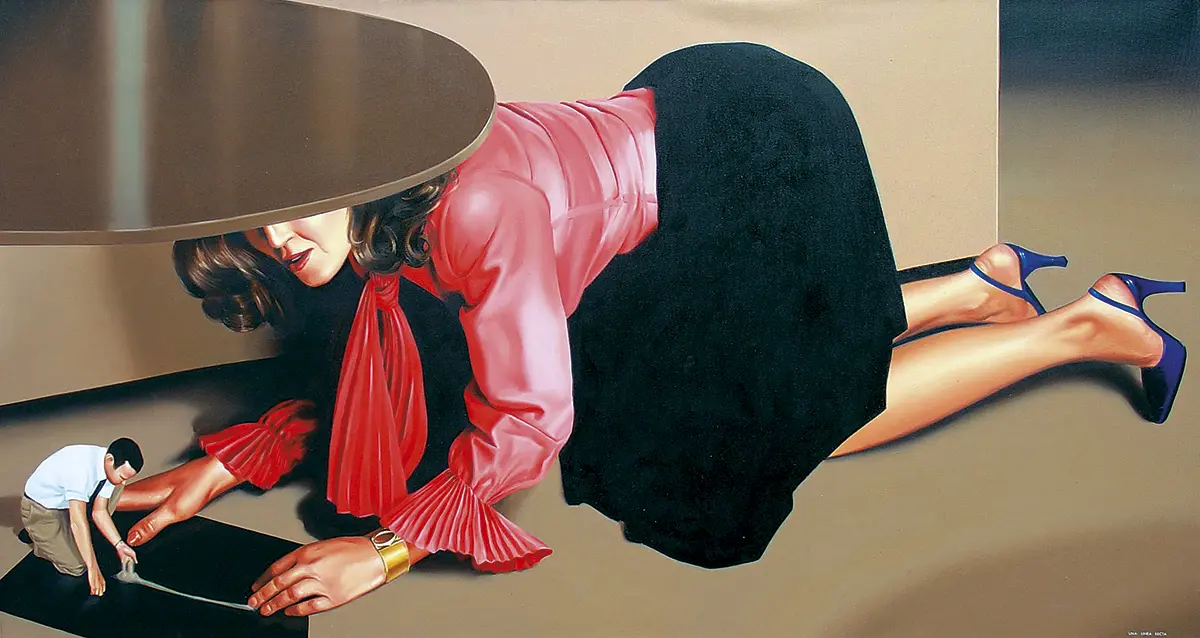
In formal terms, Mojica’s work displays a hyperrealist language, but one that in representing absurd situations and impossible games of scale breaks with the aesthetic of hyperrealism and transforms it into illusionist painting. Here, figuration is not at the service of representations that are rooted in concrete realities; rather, it serves as a medium for the materialization of impossible and extravagant visual universes. Works like La línea recta are evidence of the tension the artist creates between a literal, strict figuration and the hallucinated representation that populates his work. In this piece a woman crouches under a table in order to come close to a man who appears monstrously small and is drawing a straight line in white dust, an allusion to the use of cocaine. The result is strange and shocking, thanks to the radical impossibility of the scale, the characters’ relationship in space, and the dynamic established between them and the white dust scattered by the man.
At the same time, Marco Mojica’s work is nourished in a significant way by the dialogue he establishes with other artists. There are references to Marcel Duchamp in pieces like Evolución [Underwood], and reflections on artists like Elias Heim or Win Delvoye that translate their installations into painting. The origins of Incidente, the piece that recently won the Botero Prize of 2005 for Mojica, can be traced to Elias Heim’s installation Accumulated Atmospheres Extractor, and Mojica’s Óleo Machina has its roots in Delvoye’s Cloaca.
Installation is in essence a three-dimensional medium, and it is important to note here the tensions produced in the transfer of that language to the space of the canvas. Elias Heim is an artist who continuously examines the dynamics of museum spaces, while Delvoye’s Cloaca is concerned with an artistic practice and questions the figure of the artist as maker in a direct, ironic way.
Although works like Volumen 2 represent objects and situations that are inserted in a space that alludes to a museum or a gallery, the fact of eliminating three-dimensionality from the represented object already cleanses it of the pressures that an installation necessarily exercises on the space that contains it. In this way, the reflections in the motivating installation were of a spatial nature, in Mojica’s work become allusions to an artistic event; it becomes an artistic language that speaks of itself—metalanguage.
Cloaca has a temporal ingredient that is eliminated in Óleo Machina. Delvoye’s piece demands that a worker “feeds” the machine twice a day for it to produce excrement, but painting is not a temporal art and Óleo Machina can only present the moment when the residue is finished. Mojica translates Delvoye’s concerns into different terms: Delvoye employs irony to comment on the role of the artist, while Mojica’s dialogue is from his perspective as an artist who creates images. While Delvoye presents the artist as a maker of excrement, Mojica uses the analogy to talk about the very raw material of his work: oil paint.
PAULA SILVA