
Miky Fábrega is an artist whose paintings bring together an expressionist style and a neo-Pop attitude in images that employ graffiti, line drawing, and explosive color. With refreshing expressive freedom, he combines black contours, the blurry lines of spray paint, and dripped pigments in works on canvas or wood. His most recent exhibition —titled Nothing but Flowers in homage to a song by the legendary rock group Talking Heads— reflects the way in which this young Panamanian artist finds inspiration in urban and domestic life, politics, fashion, and advertising.
His connection to the world of advertising is evident, as this is his everyday professional field. More than a job, it seems to be a way of life because advertising—in spite of its inevitable commercial goals— is a daily endeavor that allows him to combine his passion for art, drawing, and the language of urban signs. Miky Fábrega’s artistic career began formally in the year 2000 when he held his first exhibition of paintings at the gallery of Panama’s National Institute of Culture. Under the title Motor, the exhibition was surprising in its simple but remarkable concept: that of using the visitors and the sounds they produced as the motor for an artwork based on sound. From the beginning, Fábrega has revealed a contemporary sensibility in addition to an impressive capacity for self-expression, although sometimes—due to the nature of his themes— he comes close to a dangerous superficiality.
Over the last five years, Miky Fábrega has held one-man shows almost annually and has participated in over twenty projects and group exhibitions. His list of participations in collaborative products is noteworthy because it reveals the breadth of his interests. Among other things, it includes the co-production of a short film, the creation of an urban periodical, and the art direction for a documentary film. Fábrega has also expressed himself through urban interventions with stenciling in public spaces; the creation of a video installation for a modern dance company; and fashion design for women.
In Nothing but Flowers, Fábrega flooded the exhibition space with art, not just with the installation of his sixteen paintings but also by literally painting the walls and allowing art to spill over from the artworks into the gallery’s space, both interior, and exterior. The song that provided the title for the show suggests a post-technological world in which we have returned to living in the country and consuming natural products, a lifestyle to which we are no longer able to adapt. Fábrega represents the natural world through botanical forms and large, brightly colored flowers that invade his compositions. The painting Salis Caprea —the title, like that of most of these paintings, is based on the botanical name of a plant— is a paradigmatic image in which energetic branches and flowers burst from a clothes dryer, taking over the electro-domestic world.
The artificial environment of the fashion world, of cool chicks with prototypical smiles and perfect bodies, is also raided by Fábrega’s flower power. His women are reminiscent of magazine models who wear fashionable outfits, bright lipstick, and long hair. In compositions such as Astrancia, the pretty face has been replaced by that of a wild cat with the smile of a clown. The body appears surrounded by a white halo within a botanical environment where there are no greens, only reds, and yellows. Nature appears to be both powerful and aggressive.
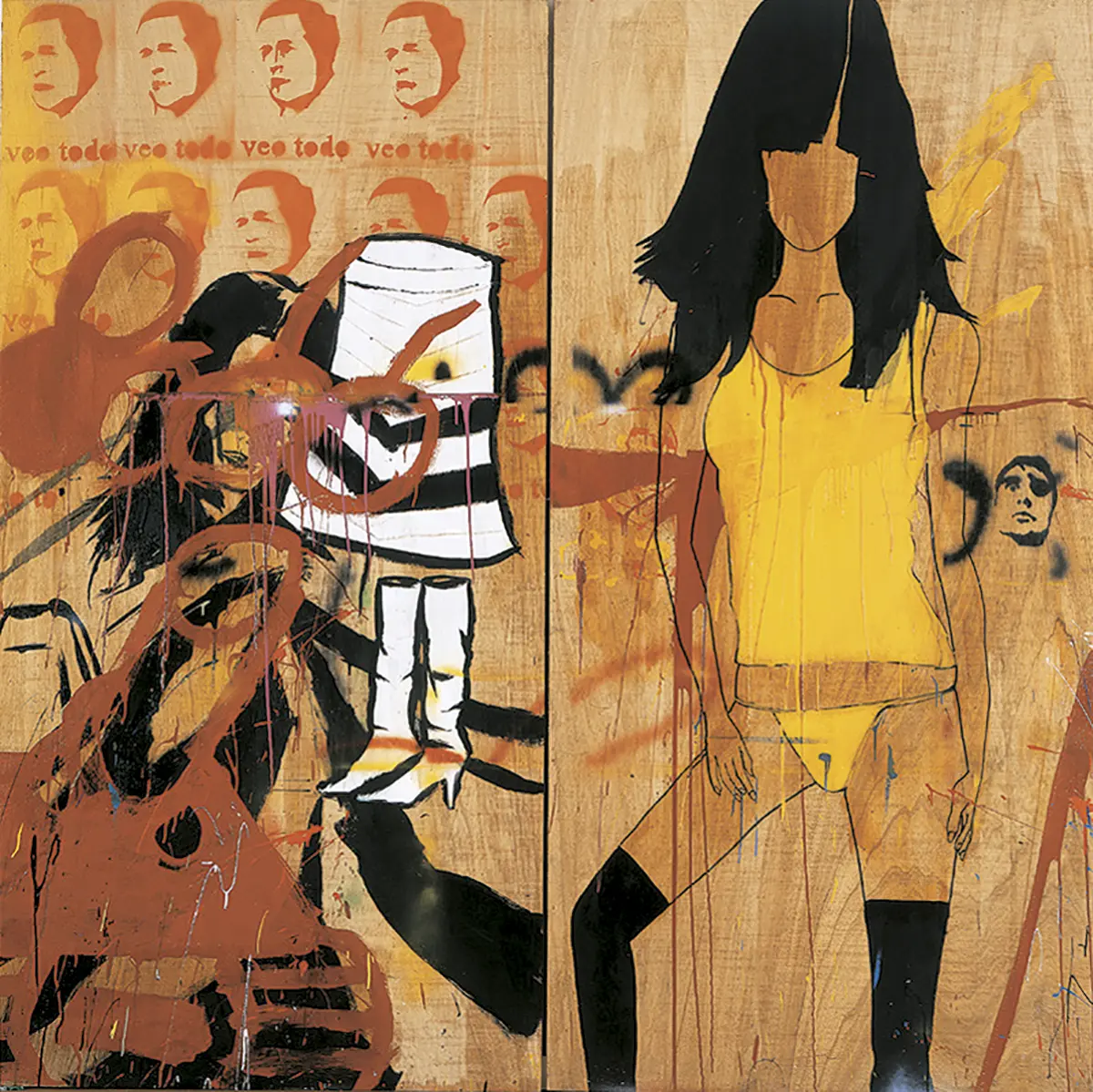
The attack becomes more sociopolitical in the large diptych on wood entitled Declaration of Nuclear War by the Central American Countries against Martha Stewart. On one side, a faceless model, dressed in a tanga and a little yellow top, poses suggestively. On the other is a woman whose face is covered by dripping, red graffiti. A blouse, miniskirt, and boots appear drawn in white paint like garments waiting for their owner or fashionable attire that can speak for itself, with no need to be worn by a human being. Finally, above everything else, there is the stenciled shape of the face of a man —who looks like George Bush— that appears repeatedly, along with the phrase “I see everything I see everything I see everything.”
It is Miky Fábrega who makes us see everything from an innovative point of view. He is creative in his response to society and the prevalent superficiality of our increasingly electronic and urbanized world, which would benefit if, for once, nature could take over and remind us from where we evolved.
MÓNICA E. KUPFER