
Despite being identified, under the title of Mayo, as a single exhibition, these shows by Rogério Canella and Nicolás Robbio comprised two individual events. Canella’s photographs of interiors in a process of construction or demolition were displayed on the ground floor of the dual exhibition space in which Galería Vermelho presents its programs; Robbio’s drawings were on the first floor, arranged on walls, windows, and staircases. The sole piece bridging both artists was a painting of a long black line, by Robbio, that coursed through the walls in the gallery’s main hall, on the ground floor, above Canella’s images, and invaded the upper floor with arrows in its ends, one pointing to the left and the other one to the right. Beyond this intervention, the exhibitions remain independent of each other.
Born in Argentina in 1975 and relocated to Brazil in 2001, Nicolás Robbio's work confers atypical meanings on the mundane aspects of urban life. Many apparently simple interferences widen the possible interpretations of “what is” the support in use or “what is it for”. An example of these is the sweatshirts displaying as print instructions for their users to tie them around their heads in the manner of street protestors, who use them to conceal their identities and protect themselves against the tear gas used by the police. The subversive potential of this article of clothing is inscribed at chest level, for use in case of urgent need.
In Mayo, on the side walls of his exhibition area, Robbio prepared black and white paintings of spaces of transit: a hallway to the left of the viewer who climbs the stairs, and a catwalk to the right. The sense of movement and the action in the environment were reinforced by the arrows that projected almost from floor to ceiling on the back wall, completing the graphic takeover of the gallery. On the wall located in front of the staircase, the artist organized from one extreme to the other a collection of small recent works, most of them conceived or created during public transportation rides in São Paulo, the city where he currently lives. Thus, his drawings on paper are of pedestrian crossings at street intersections, and of a garage’s or a commercial establishment’s iron doors. Neither of these drawings originates in pencil, ink, or pen lines; they are the result of gaps created by cutting paper. Drawings that, ultimately, have an infinite background.
It is common for Nicolás Robbio’s work to emerge from the opening of gaps, from cut-up surfaces, or from images that seem incomplete or that let themselves be hollowed out. Representations of holes, unoccupied boxes, or simply of “nothing,” are recurrent. When the artist builds the illusion of a rectangle using just the four corners of this geometric figure, we don’t expect the area thus delimited to be filled by an image with those measurements. The four 90˚ angles, isolated and equidistant, compose an image by themselves: an image of everything or nothing, or nothing in their totality as if it existed there and only there.
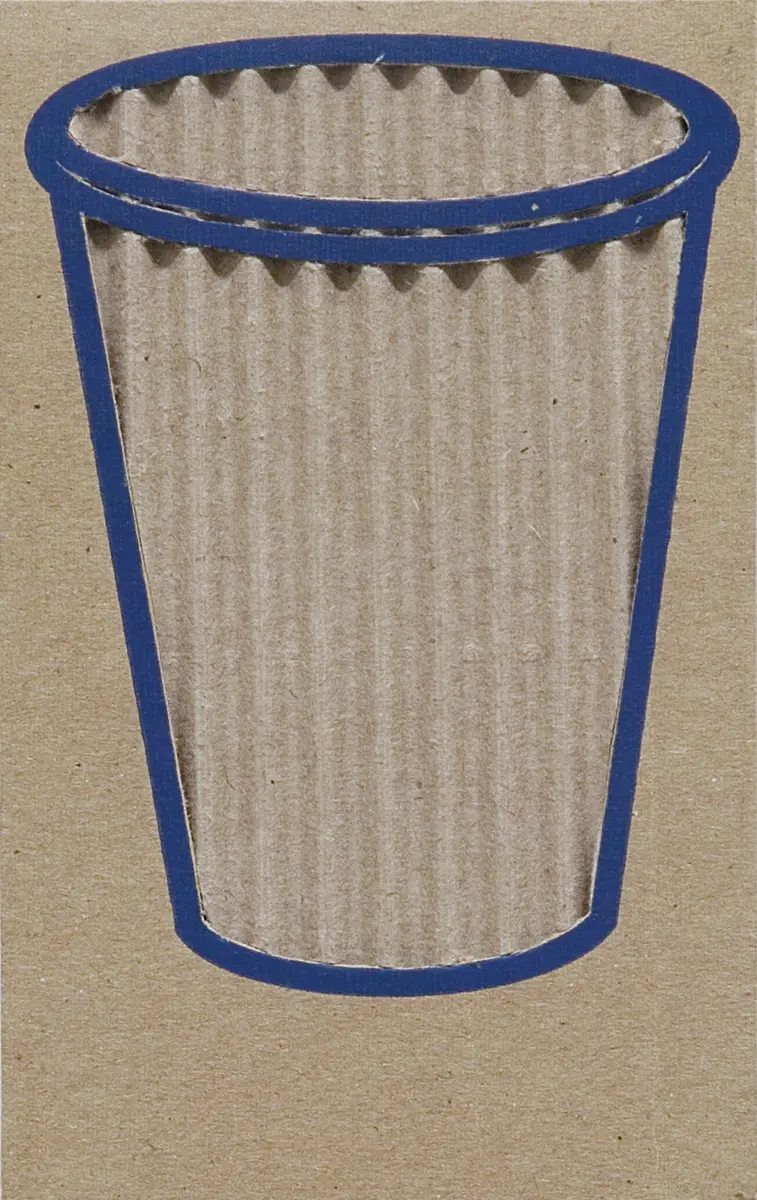
Robbie's drawings also emerge “through” the support, sometimes to borrow from it the elements that complete the meaning of the represented figures. Like the landscape with an iceberg, whose outline is scratched using a stiletto or a white expanded polyethylene tray. Another work on display here is formed by cutting out a portion of the smooth surface of a piece of corrugated paper, in the shape of a trash can; with the internal undulations that characterize one of the layers of this rigid paper, the figure acquires structural spindles, like those in the object of reference. On its part, the hole that serves to hang in display cases the packages of self-adhesive labels are reproduced serially, by hand, using a spherograophic pen, in each one of the labels of the envelope of adhesives conceived by the artist as a single piece.
Industrial labor, then, becomes manual labor through the relationships established by Robbio with technical drawing. And, in these transitions, the practice, the rules, of the media used change. On the one hand, there are lines traced by the artist in the observation of machines and tools, with surfaces that would contain instructions for use, all devoid of information; on the other hand, there are the illustrations that, under a pattern, guide the use of a product, but which will pass through appropriation and will see its message immediately nullified or altered. No system can resist being put in turmoil.
JOSÉ AUGUSTO RIBEIRO