
John Cage once said that any musical instrument is a work of art. With great originality, Paul Nenflidio’s work takes this notion to its extreme, creating objects that are technological artifacts and transforming them into sculptures. His exploration, however, is not that of a luthier who also aspires to the visual excellence of his constructions. His exploration is much closer to the activities of a scientist, whose work acquires meaning in experimentation and invention. This is why Nenflidio’s work is deeply tied to a term coined by the Brazilian poet and critic Augusto de Campos, “the music of invention,” and why it counts among its admirers musicians like Walter Smetak, Tom Zé, and Uataki, among others. Nenflidio approaches this exploration of categories related to the visual arts, from the representation of nature to sculpture in a widened field.
In his first individual show at the A Gentil Carioca Gallery, in Rio de Janeiro, Nenflidio gathered some of his engenhocas sonoras, a Brazilian term the artist translates as “sound gadgets” and which gives the show its title, order to create sequences of sound experiences in the exhibition space. According to the artist’s definition, an engenhoca sonora is: “any simple and creative machine whose purpose is to produce sound; an instrument designed to produce sound taking advantage of the actions of a natural agent (wind, man, electricity); a machine that produces autonomous music; a system design to produce sounds or music where the whole is more than the sum of its parts.”
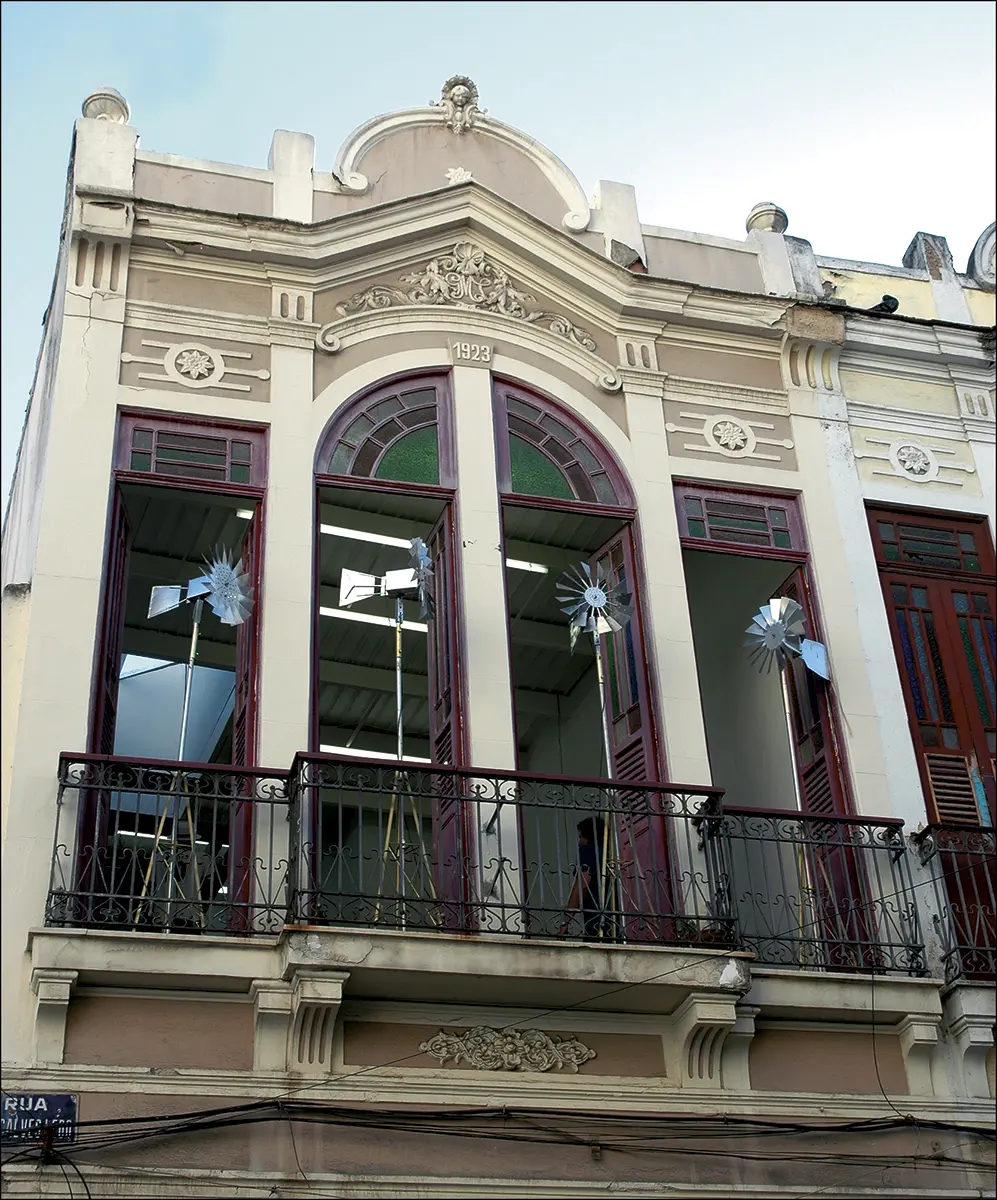
A pinwheel was installed on the gallery façade, its movement feeding Música dos ventos (2004,) the first of the show’s contraptions. The mechanical force generated by the pinwheels is converted into an electrical signal, which is transmitted to the gallery. Once received and codified, the signal is once again converted to a mechanical pulse, which actuates the instrument. This instrument is built like a piano, prepared with small hammers that hit 15 metal strings, tied to a wooden structure where the melody resonates after the action of the wind. This sound from the stings is captured and amplified, and it can be heard through an earpiece attached to the work, which isolates the viewer from the gallery but connects him or her to the sculptor's extension of nature. Each time it is heard, the piece is different, and silence itself is an important part of the experience.
On display in a back room in the gallery, the artist had Radionenflidio (2005), a “radio simulacrum” built like an old valve radio but containing in its interior an MP3 player. The radio programming (the tuning dial was transformed into a band selector) includes a conversation about Paulo Nenflidio’s work, noises, and radio static, as well as sound constructions and experiences created by the artist. Finally, it offers a platform for the artist to introduce himself and discuss the concepts behind his work, as well as a series of drawings on textiles, related to each of the two projects, to show the technical research needed for their execution.
Lusco-Fusco (2004) is a photo-sensitive music box. A natural clock is activated when the sun starts to set but it is not yet dark, or when it is already day but the sun is yet to come up. On this specific light, a light sensor activates a system of metallic tubes that emit sounds. As in Música dos ventos, Lusco-Fusco transforms the landscape into sound in an inventive a poetic way.
In bringing together these works, Paulo Nenflidio poses new challenges to the relationship between sound and its visualization, pointing to the limits and oppositions between the visual and the performance arts, representation, and materiality, time and space, intention and action, construction and nature.
RODRIGO MOURA