
One of the most symptomatic characteristics of young Costa Rican artist Priscilla Monge’s work is her chameleon-like skill to activate multiple strategies of meaning, without abandoning in the process the already stabilized conceptual precepts that since the early 1990s acted as coordinates for the orientation of her poetics. Her current exhibition at Madrid’s Juana de Aizpuru Gallery, inscribed on its own right in the Photoespaña 05 program, only confirms the thesis that Monge is a perspicacious creator with a broad mastery of irony and a genuine ability to move in paradoxical situations of an existential nature.
The sow, organized around fourteen large-format color photographs printed on metallic paper, would seem to provide continuity for stories and narratives that were conceived at a moment prior to the works’ present. And that is precisely another of the show’s salient qualities, perhaps a mark of its identity: to present itself as infinite versions of a single tale that acknowledges an ideo-aesthetic fixity, but under chance-driven yet precise incursions in the formal realms of a variety of at times opposed techniques and morphological registers.
From the beginning of her career as an artist who very soon achieved an indisputable international presence, the positing of a discourse, a thesis, or simply an idea -even a passing one- was never circumscribed to the hegemonic protagonism of a specific medium. Much to the contrary, Monge has made clear her transvestite condition, inasmuch as she moves among media with the same skill with which the most common of transvestites, thanks to the efficient concurrence of cosmetic corrections, runs through an alarming roster of identities and roles. Painting, installation, objectual revelations, videography treatment, and tropological uses of the photographic support attest to a poetic project that moors its ultimate meanings to all those media that will be capable of substantiating, on any given occasion, the concepts that are to be expressed.
In her attempt to become a commentator on life, Monge’s works are the recipients –in the interstices of metaphoric construction– of paradoxical reflections relative to violence, (in)subordination, habitus, the aggression of certain norms and phenomena associated with the emancipation of the subject (it doesn’t matter much whether feminine or masculine) from models of social behavior that are traversed by an infinite number of unfavorable prejudices. Thus her bold recourse to a kind of urban-popular imaginary that guards with true zeal a vast repertoire of almost atavistic stories, superstitions, and sentences that often precondition and suffocate the possibility of free performance in culture and life, but whose high level of everyday efficacy we couldn’t deny even if we wanted to, as they function as operative axioms in the crudest of everyday realms.
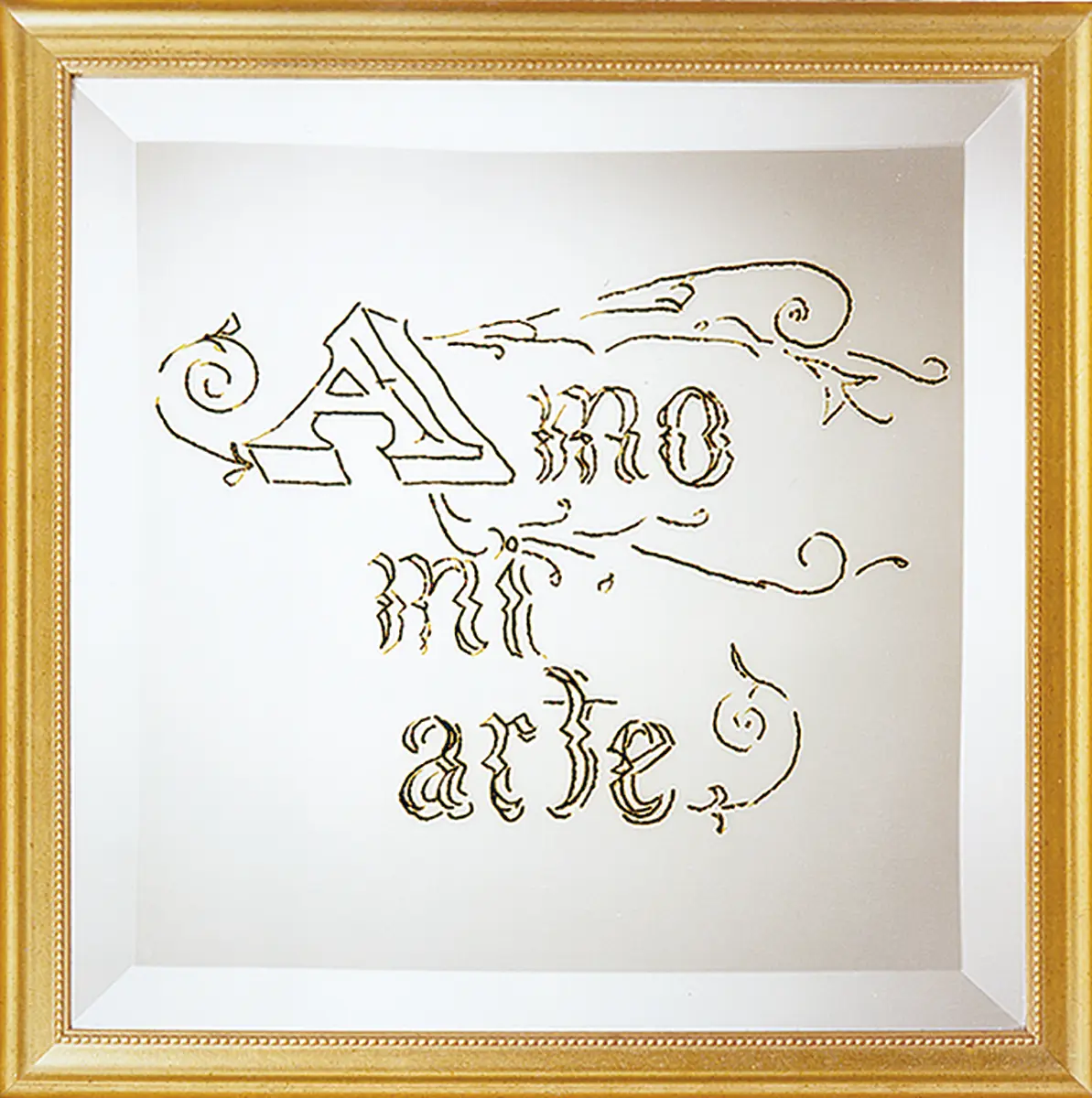
In one of this show’s sections, specifically, the section occupying one of the lateral gallery rooms the Espejo —as a specular surface of deep psychoanalytical and cultural implications, a tributary of identity conflicts— is revealed as a world-class protagonist. Once again, Monge’s works are oriented on the basis of an exercise in emancipation from, and exorcism of, her own and other people’s conflicts, with a kind of openly suggestive narcissistic practice as their allegorical resource and ironic subtext. Titles like Amo mi sexo, Amo mi arte, Amo mi vida, Amo mi piel, Amo mi corazón, and Amo mi muerte are outlined as demands of a convincing self-gaze that appeals to the authority of words, of discourse, to legitimize a posture. In that case, the force of words is substituted for the image, the replica of the artist inscribed like a reflected image on the mirror surface, thus invalidating —quite a paradox— the popular refrain that warns, “an image is worth a thousand words.” In this way, the photographs exhibited here seem to write the chronicle of one and many life experiences, exploring the corners and folds of the human psyche.
In the pieces located in the gallery’s second space, Priscilla Monge insists on going back to her aristocratic tea and coffee scenes, in order to de-stabilize certain conventions governed by the false legitimacy of politically correct positions. Texts written in the residual traces of both beverages end up constituting life and death reasons for many people, by virtue, of course, of the real transcendence that one or another issue put in play can possess for them. An exquisite tea set placed, with some stagecraft, on an old tapestry of excellent make, and the unsettling presence of those texts in which we discover allusion to representation, language, and to history, disconcert the logos of a critical gaze that ends up mistrusting the greatness of the metaphor where perhaps some will only be able to perceive the remains of a particular existence.
ANDRÉS ISAAC SANTANA