
Verónica Riedel has immortalized the women and children of Guatemala in her portraits using a technique that employs photographic montage, embroidery, writing, and the application of jewelry, artifacts, milagros or ex-votos, lace, feathers, and a wonderful variety of objects from the Pre-Columbian to the Colonial to the folkloric and modern. It is a technique that exactly parallels the history of her country with its complex juxtapositions of people and cultures, by layering historical narratives and imagery with the faces of the descendants of the Guatemalan Maya. Her intent to reinvent herself, the modern woman artist from Guatemala, reveals itself through the experiences of these women and who they represent, past and present. They tell their stories through her art.
The women she photographs are the descendants of the Maya and the other indigenous people of Guatemala conquered by the Spanish and forced to become Europeanized and Christian. Their stories of oppression, slavery, possession, and love have been passed down through oral traditions. To further understand and elucidate their plight, Riedel became a student of history, delving into chronicles and early documents in an effort to picture the people and inform her own work. Examples of early documents often become part of her montage as background for the women and their stories and captions for the photographs. Each caption is a poignant recounting of the past, now given dignity by the artist and her modern subjects. The women look directly at the viewer, the wisdom of the ages in their eyes, forcing each of us to see them in light of their history. However, this is more than an ethnological pretense to create a visual story. Their costumes, artifacts, decorative additions, and words reflect the syncretic process of socialization during the Conquest that also involved the application of layers of meaning to life’s existence, collectively and ritually. Indigenous peoples blended the teachings of Christianity with their own ancestral beliefs as a strategy for survival, and subterfuge in the worship of their true gods. This phenomenon is still very much alive in parts of the Americas, especially among the Maya.
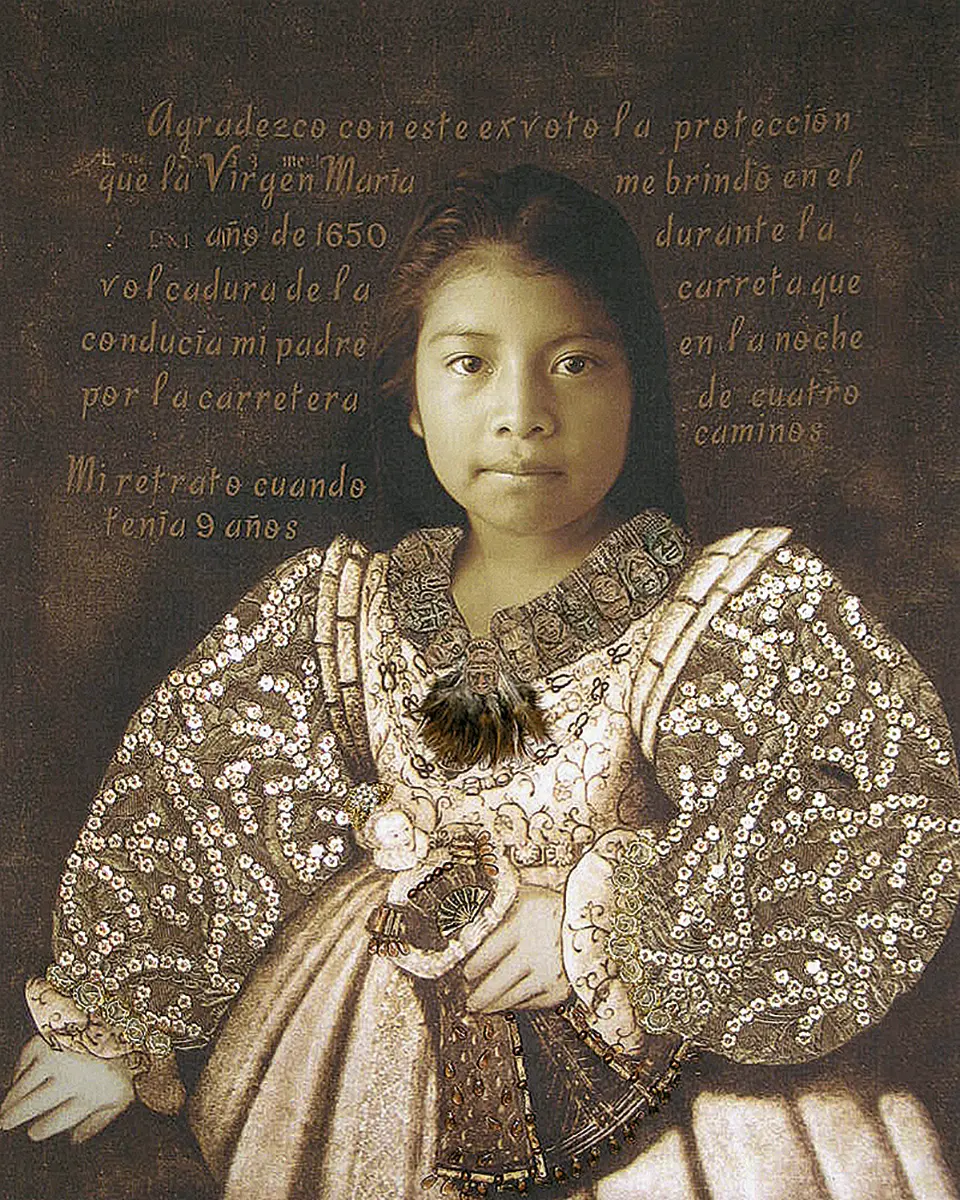
The application of embroidery to both decorate the surface and attach the objects and costume details is more than a convenient and interesting technique. Sewing is women’s work and the costumes they create represent status, location, and other valuable clues to their existence. Furthermore, Riedel discovered in her readings that there is a gap between the early years of Conquest, when the indigenous peoples did not wear clothes according to European standards, remaining almost completely naked or in simple white tunics, and the period when images recorded that they were clothed in combinations of Spanish and native dress, again based on status. The Guatemalan huipil that is now so familiar probably originated at this time. The huipil is described in Riedel’s portrait of Nicté embroidered with silver, feathers, wood, semiprecious stones, amber, ivory, and raw wool. Her caption states that [she] “was a slave in an enemy tribe until I became a gift for a conqueror.” Maya traditional dress, or what is now Maya traditional dress, serves as the canvas for the description of a woman of today reflecting upon the women of yesterday.
In order to befriend the local women for her project, many of whom were reluctant to cooperate with a “white Spaniard” or to share their experiences, Riedel approached the leader of an activist group, Doña Blanca, who eventually agreed to participate and encouraged others to so as well. Riedel became her “first white friend.” Doña Blanca, her family, and her women’s group are Riedel’s models. In the portrait of Doña Blanca, we see this proud leader dressed in her huipil and framed in an elaborate cartouche embroidered with silk, feathers, clay, pearls, and semiprecious stones. An antique map is a background and she plays the part of “the first indigenous woman from the Americas to arrive in Spain” as the wife of a conqueror. History is the source and the modern woman is the protagonist in a new war against oppression and discrimination, fueled by her strength, perseverance, and dignity.
There are stories of tyranny, slavery, and forced conversions, as well as stories about love, cooperation, and tenacious efforts at survival at all costs. The women of Guatemala are a mixture of races, religions, cultures, and identities. Verónica Riedel celebrates her subjects as the mothers of the Americas and immortalizes them as symbols of feminine power in the twenty-first century.
CAROL DAMIAN