
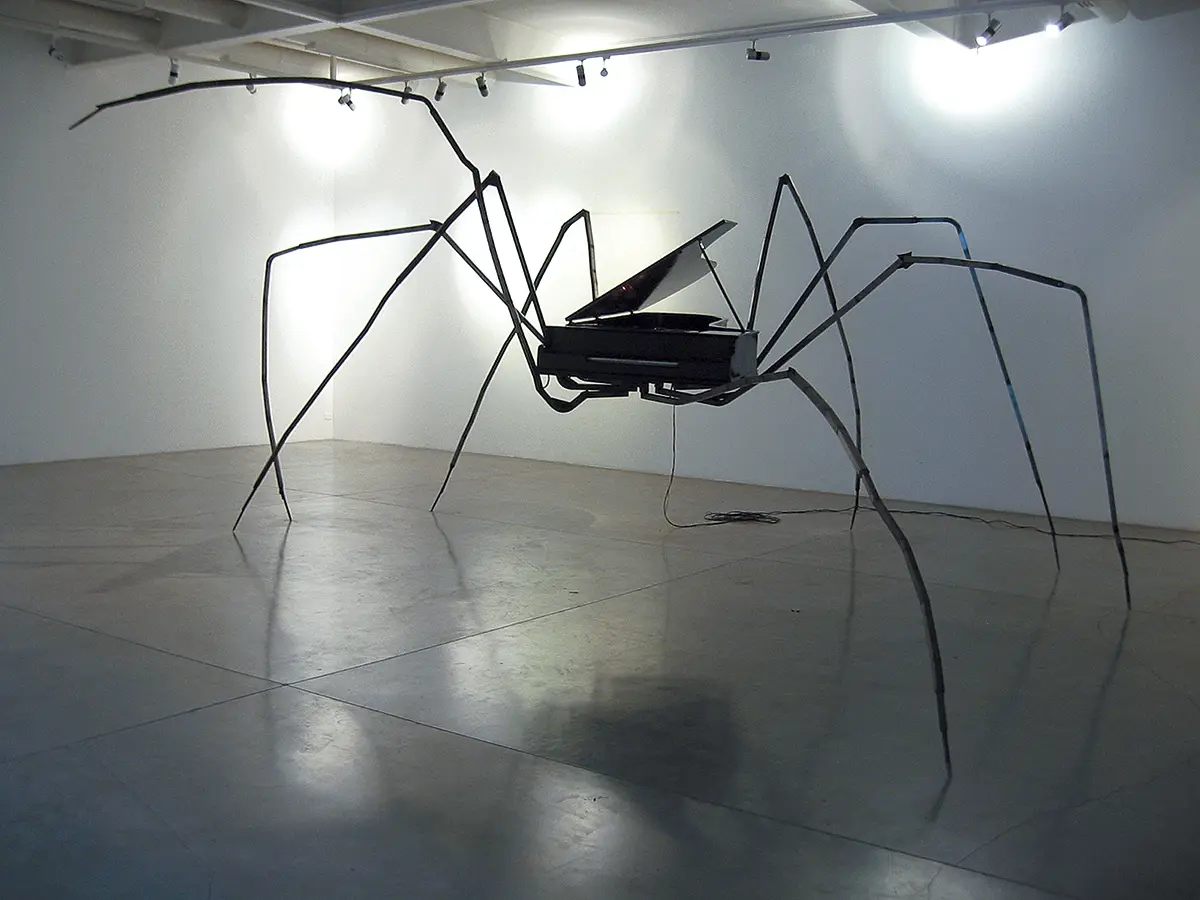
As one entered Galería Animal, a large body, at once threatening and seductive, occupied the center of the exhibition space. It was Víctor Hugo Bravo’s spider/piano, a hybrid entity that from its position stalked both the viewer and a two-dimensional object that hung, like a piece of meat, at the back of its left side. Evoking Louise Bourgeois’s mother spider that protects us under its mantle, this object’s eight elegantly curved iron legs created a feeling of movement, and its grand-piano body, built on a 1:1 scale, was captivating. The reference to Joseph Beuys was also inevitable, but there was a clear difference: it was signed by “another.” In cursive neo-gothic characters, we read the brand name Mano Zurda (Left Hand) and these provocative words in the original English: power & death. On close inspection, it could be seen that the inside of the piano was occupied not by the acoustic music box but by a flesh-like, reddish “cerebral mass” perceived through its reflection on the piano’s shiny lid.
It was then that the object/furniture placed at the entrance of the gallery acquired its full meaning. An old hutch, it covers a grand piano lid painted camouflage style, let us hear, through a hand-built loudspeaker, the instrument’s melody. Behind one of its inside windows, the artist’s left fist, molded in plaster, rotated in front of the viewer, like merchandise on display. Behind the other window was a small toy piano, cut through by an ax painted red. In between, inside the upper drawer was an olive green camouflaged ax. It was an ironic relationship between musical and war “toys,” within an everyday, familiar context.
In Mano Zurda, Víctor Hugo Bravo, a Chilean artist of the generation whose formative experiences occurred under the Pinochet dictatorship, has synthesized the path to meaning that his career has followed. His initial interest in the 1980s was painting. Later, in the 1990s, he stormed onto the national scene with a clear and mature aesthetic idea. His trademarks were wooden objects, hand-built as militaristic toys and entirely painted in camouflage patterns. Bravo’s painting-as-camouflage was an inversion and “invasion” gesture mediated by the color that transformed three-dimensional objects into dimensional objects without entirely obliterating their condition of “pictorial surface.” Simultaneously, there appeared provocative phrases like fornícame and others, alluding to power in sexual relationships and expressing domination by the state and denied rights.
His most controversial work was a parody of the Chilean national seal using representations of female genitalia. It constituted not only a subversion of national symbolism but also a representation of power and domination as matters of gender, symptomatically within the culture of military machismo. By transforming the vagina into a political icon, a fetish that interested the artist along with religious references and pointy objects suggesting weapons (as male symbols), his work created a nonexistent aesthetics. Relationships of power, politics, and sex were camouflaged, an allusion to the state of Chilean culture and society.
Undoubtedly, Bravo’s work goes beyond these iconographic references. It has also meant the unveiling of individual experience and the unmasking of power relationships within the family, drawn from his formative period as an individual.
The female presence in Mano Zurda is centered on the figure of Bravo’s mother, who had previously appeared as a motif in his paintings. The mother appears here in the hanging object/painting; she is the bait that will be devoured by the spider/piano. Painting is represented as a genre/gender, it is carnal matter, originating and maternal. On one side the artist’s mother’s hands “knead” some meat, and on the other, the painting itself is camouflaged meat.
The spider/piano could be an open reference to childhood and to the domineering power of a father figure. To a strict and repressive religious education, the father added pressure on his children to achieve technical excellence at the piano and the guitar.
In that sense, Mano Zurda is not only Bravo’s brand and signature—which also may allude within the Chilean context to the political left—but more accurately refers to Bravo’s own identity as a “left-handed” person, or to his lack of skill as a pianist. Painting as gesture appears camouflaged; it subtly disguises the violence contained in the objects, just as violence is metaphorically hidden by a rational and social-climbing order in today’s Chile.
DERMIS PÉREZ LEÓN