
One of the decisive factors in any precocious ascent to glory is knowing what it is that one wishes to obtain from the very moment one possesses the means to obtain it. In the context of contemporary art, there is no alternative given this demand but to privilege the strategy of ascent over any ethical or aesthetic consideration. Wilfredo Prieto was one aspirant to the national elite who did not hesitate when it came to choosing his path. His participation in group maneuvers on coming out of the Instituto Superior de Arte, as well as his efforts to become a perverse minimalist, demonstrates the focus of a pragmatic conception of art. This made it easy for him to avoid following “outdated” precepts such as “being faithful to oneself” or repeating the old dictum about fusing art and life.
Freed from personal/peripheral obsessions, the artist focused his gaze on demonstrably successful foreign paradigms. Unafraid of what Harold Bloom calls the “anxiety of contamination,” Prieto followed in the steps of Francis Alÿs, Cildo Meireles, Félix Gonzalez-Torres, and Wim Delvoye. But above all, he opted for the mixture of falsely haphazard appropriations that form Gabriel Orozco’s imaginary. This was Prieto’s main strategic model. Compatible with an unprejudiced humorous personality, the unfolding of this exercise in poetic links came with Apolítico (2002). Along with that paradoxical collision of opposites that is Eduardo Ponjuán’s Soy hombre no minimalista (2004), this installation belongs with the best of Cuban art produced in the current decade. Indeed, this set of black and white flags motivates an aching consciousness to assume a chameleonic attitude, capable of granting to a minimal visual operation the rank of supreme authority within contemporary transformism. Apolítico represents Wilfredo Prieto’s most complete symbolic self-portrait, complete enough to neutralize the suspicions of imposture that have surrounded his career.
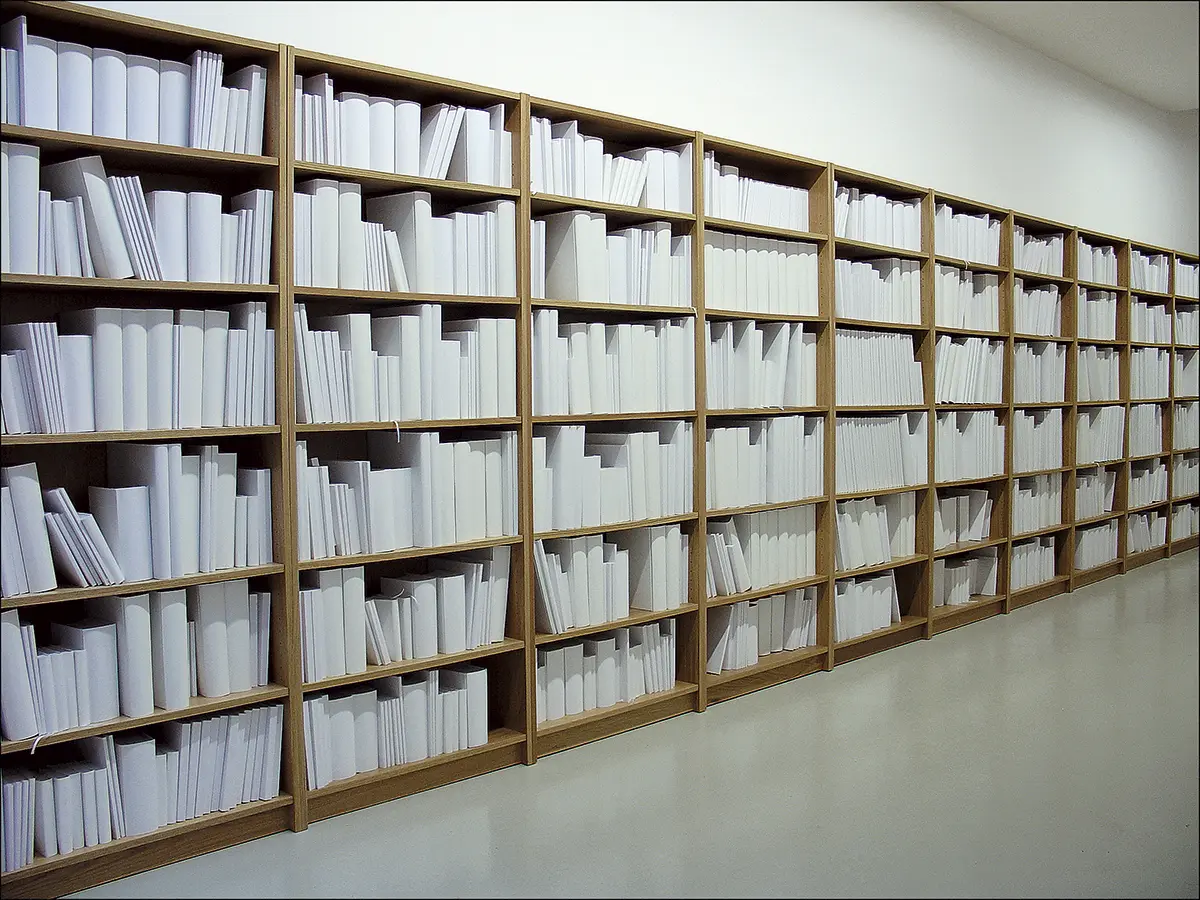
The international exhibition under the auspices of Galería Nogueras Blanchard in Barcelona implies another post-minimal gesture in which manipulation empties of content six thousand items from a library. It brings to mind various environments in the stage of contemporary art represented by Prieto’s predecessors like Claes Oldenburg (a store and a bedroom,) Jannis Kounellis (a horse stable), and Damien Hirst (a pharmacy). Joseph Kosuth even recreated a library. In a way, Prieto vindicates the Orwellian notion of rewriting history, where words can be reduced to a voluntary translation, or to their disappearance. In that sense, the intention of the commentary is as well-known as it is acceptable. Now, its degree of currency would have to be located in the fact that it alludes to the ravages of a virtual era when the written word is not the sole means to access information.
Following the operational formula he displayed in the configuration of Apolítico, Wilfredo Prieto insists on homogenizing ideology and betting on non-difference. This is organic in the political realm but not so in the realm of knowledge, where it is precisely diversity that is charged with making its legacy consistent. Despite this absurdity, the idea emanating from the piece is rendered absurdly credible in an age that seems intent on verifying the uselessness of reading. Like Apolítico, this blank library represents another living portrait of its creator, who openly confesses to an inexplicable dislike for reading. In this matter, its validity as self-parody evolves into a radically false self-criticism.
Like a snake biting its own tail, this piece ultimately contradicts itself. Isn’t it paradoxical to speak of emptiness from a position of fullness? Isn’t packing panels with books that say nothing a way of saying something? After these questions there emerges a utopia of negation, since their refutation encompasses an identical dose of suggestiveness. This contradiction evokes Cicero’s words: silence is the greatest eloquence. Thus, an apparent satire of reading reverts into a reaffirmation of the library as a vital space. However, what materializes in plastic terms is an exacerbation of that Western antagonism of essence and appearance, without any intention to transcend it or to focus “reading” on a meditation about emptiness beyond a spectacular impression. Against the tyranny of the black and white of the printed letter, the “political charge” of that attitude is limited to promoting the enjoyment of an image that is ready to fulminate the drama of censorship, ignorance, or the desire for erudition. Were this equivocation to be consummated, however, it would have more admirers than detractors.
Inscribed on a line of poetics based on the unpredictable, this piece remains faithful to the canons of an experimental tolerance that was conceived in order to enter the marketplace without difficulty. While it is true that the art world is plagued by process simulacra that begin in the streets and end up in auctions, it is also undeniable that these “cerebral folds” make dynamic the routines of what is born and dies as a museum-bound object. Paradoxically, that mass of inert pulp brings to mind Prieto’s own gesture when he left the imprint of his show on the renewed walls of the Museo Nacional de Bellas Artes in Havana (2001) to the “sole gaze” of the person who documented the action. This sneaky subversion activated a kind of silent alarm about the need to alter historical conventions despite the fact that is practically impossible to challenge or escape them. No other reason justifies the interests of sponsors and curators in artists who erode the notion of the museum in order to finally conquer it, like Cildo Meireles, Francis Alÿs, or Santiago Sierra and his incursion in the “economy of conceptual art.” From this derives the fact that in recent times Wilfredo Prieto has privileged objects to detriment of actions.
The uselessness of this library proposes a reflection about consumption in contemporary society, only to be finally consumed as an image equipped to prescind the concept that contains it. If Chinese artist and calligrapher Xu Bing elevated the non-meaning of fuzzy words to the category of pure essence, what Wilfredo Prieto wants is to reduce the absence of content to a mere objective appearance. Although both proposals are anchored in aesthetics, the creator of A Book of Heaven (1987–1991) questions the absurd marriage of Western and Eastern languages, while Prieto opts for erasing the entirety of his cultural heritage, without consideration of the fact that the negation will later become the very historical, museum-bound residue the piece brings into question. Confronted with such an amount of volumes concentrated on their own mutilation, we perceive something similar to the contingency of an Andy Warhol or a Jeff Koons, who aspires to generate continued discussions. But in order to reach this objective one needs to structure an oeuvre whose very thematic choice is able to unsettle both those who welcome it and those who stubbornly ignore it.
HÉCTOR ANTÓN CASTILLO