
Throughout the twentieth century and the half-decade of the twenty-first that has already passed, we saw how contemporary artists assumed creative freedom and made more flexible conceptions of a work of art. After these experiences, the work of the young Cuban artist Aimée García comes as a surprise. It not only constitutes an oddity in our artistic context and provokes admiration for its painstaking execution, but it also transcends these formal appreciations thanks to the symbolic density that emanates from each work. These paintings display great technical mastery, academic rigor, and severity; the works are surprisingly austere paintings that are also greatly condensed and intense. In late García’s solo exhibition opened at Galería Spativm, a space devoted to Latin American art, particularly Cuban art. Both the artist and her recent work were there.
Based in Havana, Aimée García is known in several countries. Her work has been exhibited in Jamaica, Mexico, Austria, the Dominican Republic, South Korea, Spain, Argentina, Ecuador, Costa Rica, and Lebanon. Since 1998, she has had several one-person shows in the United States. At a very young 21, she was already hailed by Cuban critics as one of the outstanding artists of the 1990s generation. Her work is not only centered around a discourse on femaleness, but it approaches the topic from a very personal perspective, supported time and again by the representation of her own image.
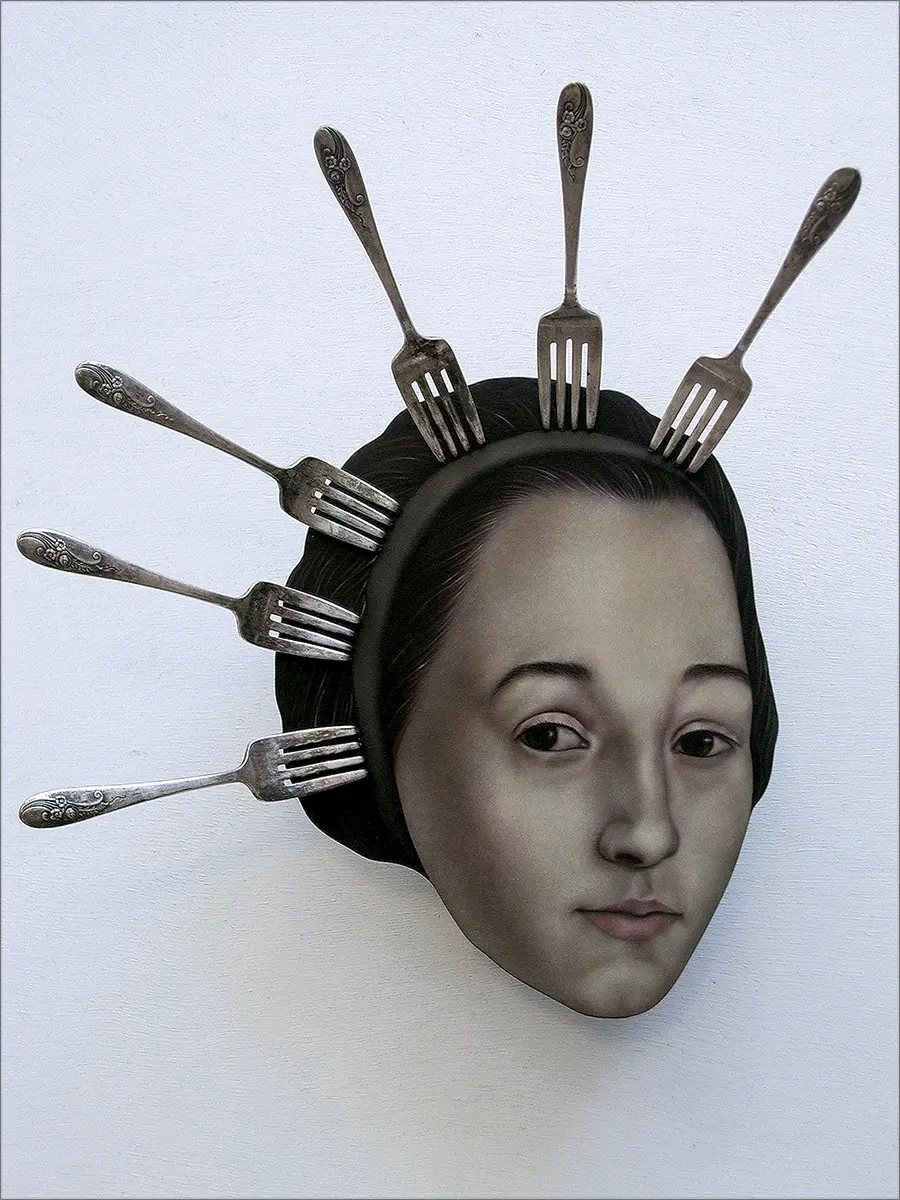
She knows in great detail her own anatomy, to the point of representing it almost obsessively from different points of view; she also has mastered the discipline of pictorial technique. This is why her painting, which foregrounds human figures, is often linked to Renaissance art. Nevertheless, Aimée García seems interested in transcending the framework that the medium of painting offers her. This is where she distances herself from the weight of historical references, in order to inscribe herself within contemporary discourse. Like artists such as Zayda del Río, Consuelo Castañeda, Marta María Pérez Bravo, Sandra Ramos, Tania Brugueras, Belkys Ayón, among many others, Aimée García belongs to a school in Cuban art where the female condition is once again revisited and reformulated, inducing a reflection, one perhaps made problematic, about the artist’s identity.
A self-portrait implies an unveiling of that identity. Several self-portraits comprise, in the words of the critic Perán Erminy, an “iconic self-exploration.” Several situations follow. The person is identified: it is the artist’s own visage. There is no masking there since García often presents a digital image of herself side by side with its painted version. With that, she affects parallelism between reality (seen through the photographic image) and pictorial representation. But there is also a simulacrum precisely at the point of the relationship established between what is real and what is represented. The image begins to hide. The artist is always the Other in the different roles that appear in each new situation created. These situations are also heavily dependent on the formal resources García employs. It is thus important to recognize the meaning of these resources. She incorporates extra-pictorial elements taken from reality (hair, thread, bits of metal, and some embroidered with lace, as well as knives, forks, and dolls), and with them, she forms the image of herself within the work, an image generally of great and painstaking technical excellence. With these contrasts—what is painted and what is real—she creates believable situations and others that are unbelievable, de-contextualized, parodic, or ambiguous and that, as critics have pointed out, are often surreal in appearance. Perán Erminy defines it best: García theatricalizes experience because this contained and austere environment denotes an austerity of affect. This results, paradoxically, in aggressiveness toward her own image: forks surround her or stick into her head, threads bind her, or her face looks at another face that is also hers.
The act of repeated self-portraiture resembles the act of looking at oneself in a mirror day after day. It is said that the mirror reflects the soul. In front of a mirror, we confront our truth. This is what happens with Aimée García’s faces. Their eyes are fixed, open, and they confront our gaze. We can’t elude the frontal dialogue, a subtle, deeply intense dialogue, established between her image and us.
SUSANA BENKO