
“There are many kinds of collectors; besides, inside each of them a operates profusion of impulses.” This is how Walter Benjamin began his 1931 article on collecting. I quote it here because the work of Alberto Baraya has for a while been comprised of collections of artificial flowers. He got his start in this practice, I heard him comment once, by raking fallen leaves, among which he discovered some that were plastic.
I want to describe here the collection Baraya presented this time around at Galería Cuarto Nivel, to ultimately try to find out what impulses operate behind it. It is also my intention to re-read Benjamin’s article in order to explore some of its key secrets, thus attempting to understand this “weird” world we live in.
Baraya’s show, then, was a collection of artificial flowers. We call them that, as is known, because they are created by culture, that second nature. In the gallery we could see flowers of all kinds: the ones in cloth, “made in China,” he arranged carefully in boxes/frames; such was the case of the Mimosas that appeared, truth be told, “identical to nature.” Baraya also selected pieces of branches and stems from the same flower, which, being fragments classified with the name of the person who found them, plus place and date, confirmed once again the collector’s scientific attitude, similar to that of an expeditionary botanist.
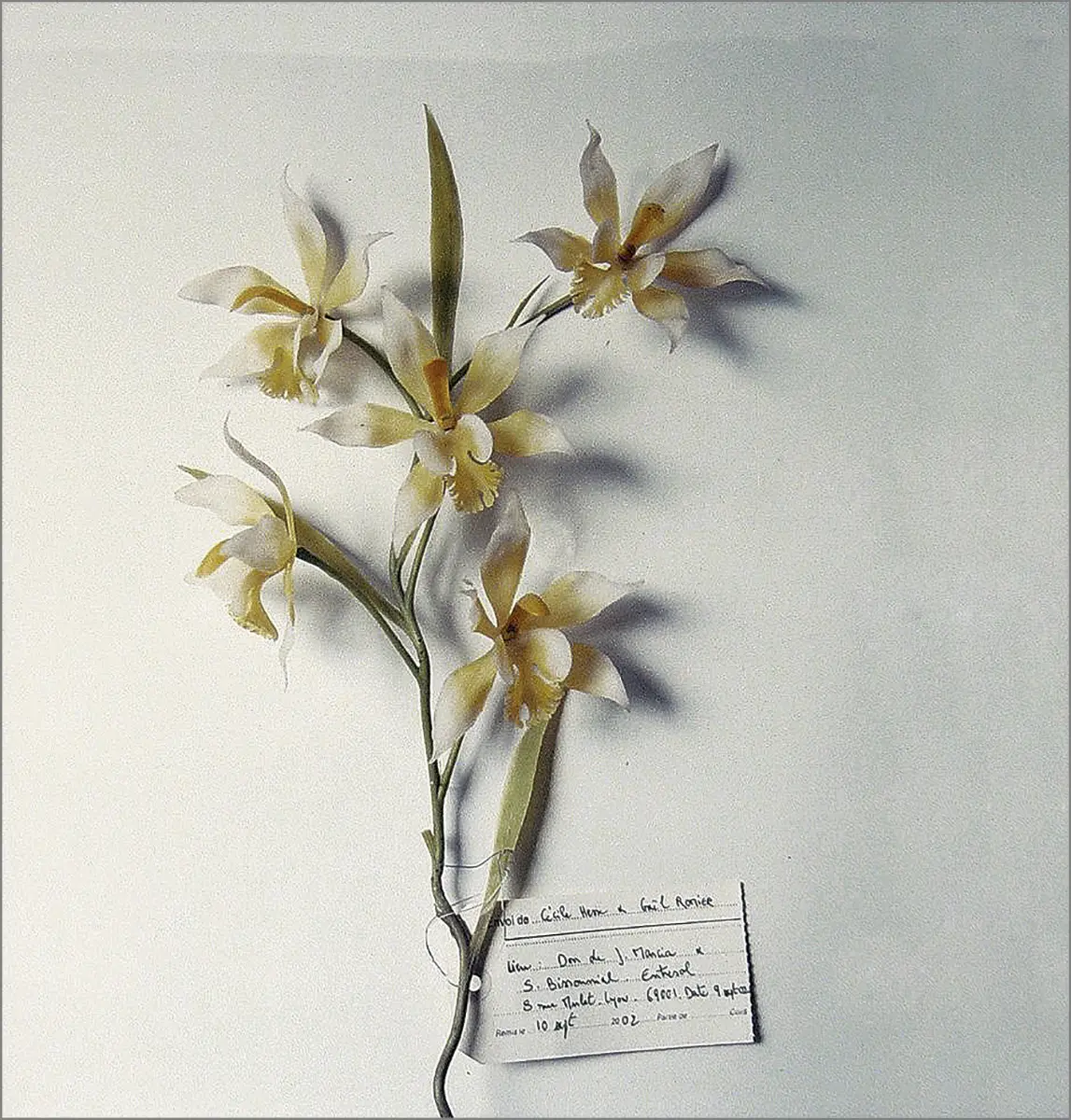
Other flowers were registered in photographs because, like any collector, Baraya is devoted to gathering “found objects.” Some depicted vases with bunches of exuberant cloth flowers. Others were records of vases with plastic or cloth specimens discovered in the most unsuspected places. For example, in small hotels or hair salons in the Amazon region, where one would never have thought that nature-nature could be slowly replaced with the “second one,” the artificial one.
In another gallery wall, arranged like an aleatory inventory, we could find photographs of flowers tattooed on bodies, or as hair arrangements, and tiny cloth ones that are used as pins; in one group photograph that surprised me, an indigenous woman exhibited one of these rather proudly.
Likewise, Baraya displayed a start-up collection of very feminine panties: one in red lace, carefully arranged inside a box/frame, accompanied by photographs of flowers created using the same lace. Also recorded in photographs are white thongs with embroideries representing daisies.
In the case of Baraya, collecting begins, in my view, with the decision of becoming a compulsive traveler, one intent on satisfying a great curiosity for the details of the world and becoming their cartographer. And as to my self-imposed task of tracing back some of the impulses behind this activity, the first thing that needs to be said is that the collector transforms past and present into experience, and, in exhibiting it, makes visible the paradoxes in the construction of culture. The artist, in a recently published article, highlights one: plastic and cloth flowers “are solid proof of the infinite expansion of that strange Chinese vegetation throughout all corners of the world.”
Collecting, more than attempting to reconstruct history, brings to the fore genealogical trees of forms and relationships. This is why in a collection the viewer finds subtle similitudes between what was seemingly classified as different. Thus, it is possible that we see ourselves as geographically separated by a map, which ultimately is an abstract convention; but in a collection, the essential issue is brought to light, as in this case, when a “naïve” exhibition of flowers makes us realize that from the Amazon to Tibet we are all subjected to the same invisible market laws. And also, why not, to the invisible laws of seduction.
We see, then, that collecting plays an important function today: to disorganize established classifications and to promote a line of thinking that allows us to find new relationships; this is to say, to make visible the flows, such as money, influences, and power.
In Benjamin’s article, it is evident that collecting as a practice implies its exhibition. If we speak of flows, then, it would only be possible to fix its paths by showing them, and perhaps with conventional strategies, such as herbariums, museums, albums, etc. In this way, we would gain access to their trajectories, or, on the contrary, they might remain trapped inside official documents or hidden and nameless in individual experience.
Benjamin writes: “The collector appropriates the types offered by his epoch in order to exhibit them.” It is possible to claim after this sentence that by exploring collections we reveal the “weird” and sometimes dramatic patterns of the history that we are bound to live.
NATALIA GUTIÉRREZ