
To arrange something for a specific end, to condition one of life’s basic elements such as air, is a common denominator in the work of Carlos Blanco, who expresses in his inflatable pieces two concerns. The first one is to capture air as if life was ending and we needed an oxygen tank because for Blanco air is a principle of life, of destruction, and of his processes as an artist. Air flows through his works, comes in and out of them. The second concern is to question political and social situations, a time invaded by the mass media, by advertising, by video, and the mediated image.
Sculptures like Alas, Los caracoles, El cultivo intensivo, or Los peregrinos represent the ephemeral condition of humans. The element of playfulness is in turn present in some of his works, where play is an essential component, as in Los chismosos, an audio work presented at the Seventh Havana Biennial, where a rumor broadcast by means of a recording inside a large inflatable ear stated that the Cuban group Los Carpinteros had won first prize, a black humor piece that made everybody laugh and caused discomfort among the event’s jurors.
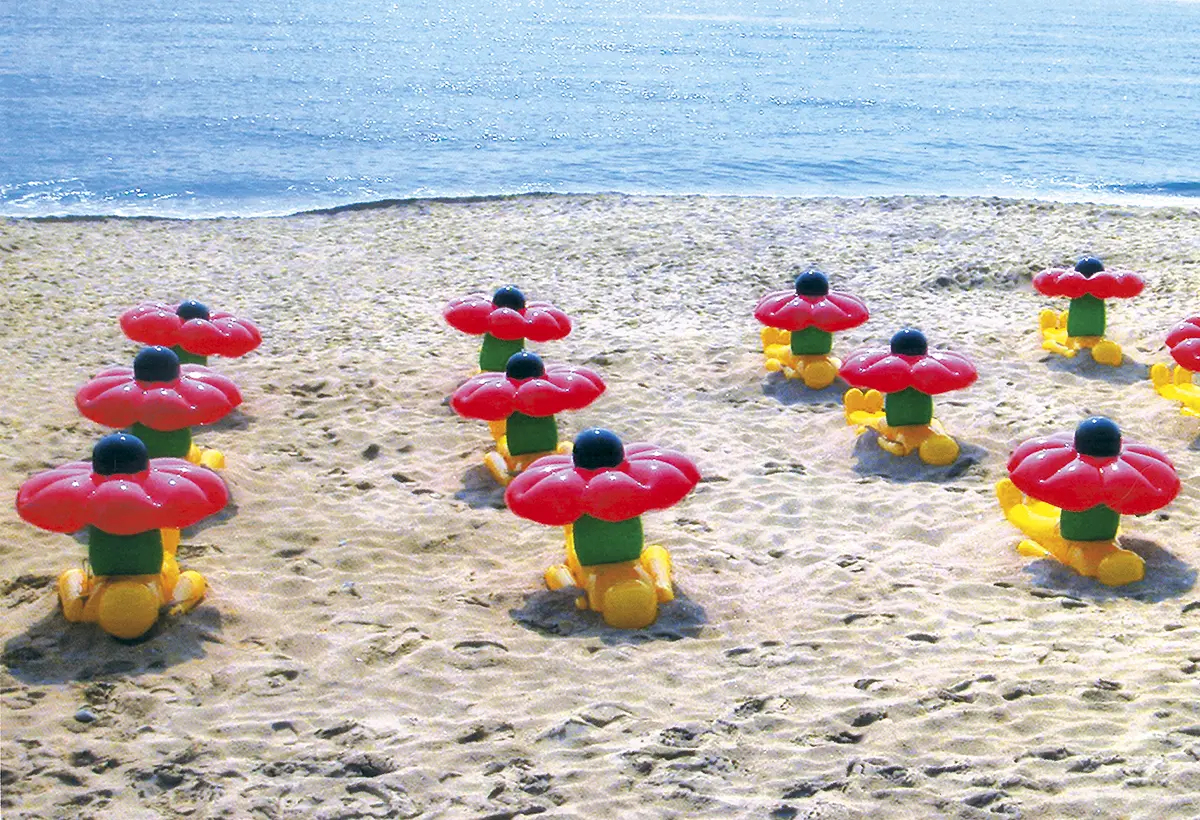
Blanco is also concerned with reaching out to the viewer in a direct way and activating synesthetic perceptions, bringing viewers and works of art closer together. He wants viewers to touch, feel, and remember his works so that the public is able to commit to the piece by activating it, dressing in or using the objects, be they wings, houses, vests, or visiting large plastic suitcases containing photographs and archives of the city. The viewer can traverse this new micro-city since the suitcase contains his or her memory and triggers collective and individual remembrances that provoke a sense of belonging.
The artist perceives the city with all its problems and even pretends, in an altruistic and naïve way, to offer solutions for some of them, as in Alas and Casa a cuestas, for example. In the first piece, executed in a zone of tolerance, he distributed information and condoms and talked with the population about the risk of contracting the HIV virus. In Casa a cuestas, he wanted to solve the problem of housing for people displaced by violence and of people who for any reason are homeless. For him, his work is open to new interpretations, but one of his purposes is to give the viewer moments of imagination in the midst of their daily routines and the chaotic life of the city.
Aire Acondicionado, presented at Galería La Cometa in Bogotá, is a selection of works from various periods in Carlos Blanco’s career, and it includes pieces that are emblematic of Blanco’s oeuvre; it comprises drawings, paintings, and inflatable sculptures that have been unveiled in different places. Blanco first became known at the Ninth Documenta in Kassel, held in 1992, when he appeared in the city’s streets with a traveling performance of a traveler who “sneaks in.” In an act that comprised four suitcases, a tripod at eye level, and a reflection about nomadism—the artist moved every day to a different point in the city—and about participation in these grand art world events. Blanco had not been selected for Documenta, but he was well received by the public, which discomforted the organizers.
His work begins by articulating itself in charcoal drawings, which he requires as a support for his whole process; later, he creates prototypes to scale that will become inflatable sculptures, which need anchoring to the ground, motors, and weather-resistant materials.
For Carlos Blanco, Aire Acondicionado is to live off air and to live of dreams.
MARÍA ELVIRA ARDILA