
Among the interests explored in the work by the artist Erick Beltrán (born 1974, in Mexico City) there has been a reflection about the processes of typographic reproduction and the methods used to determine, value, prioritize, order, and construct specific discourses on the basis of the selection and distribution of images of our time.
In his most recent proposal, titled Enciclopedia and presented at Galería OMR from August 15 through September 17, 2005, Beltrán, in the manner of the old French philosophers of the mid-eighteenth century, has performed the titanic, rigorous task of creating within a given framework his own graphic encyclopedia.
Unlike those precursors, who registered and established in their treatises a linguistic ordering of the world based on the compilation and classification of the various subjects, in Enciclopedia, Beltrán creates a visual product intended to provide an incisive, questioning gaze on concepts such as hierarchization, systematization, classification, editing, value, and order, which are implicit in the images and messages that normally surround us.
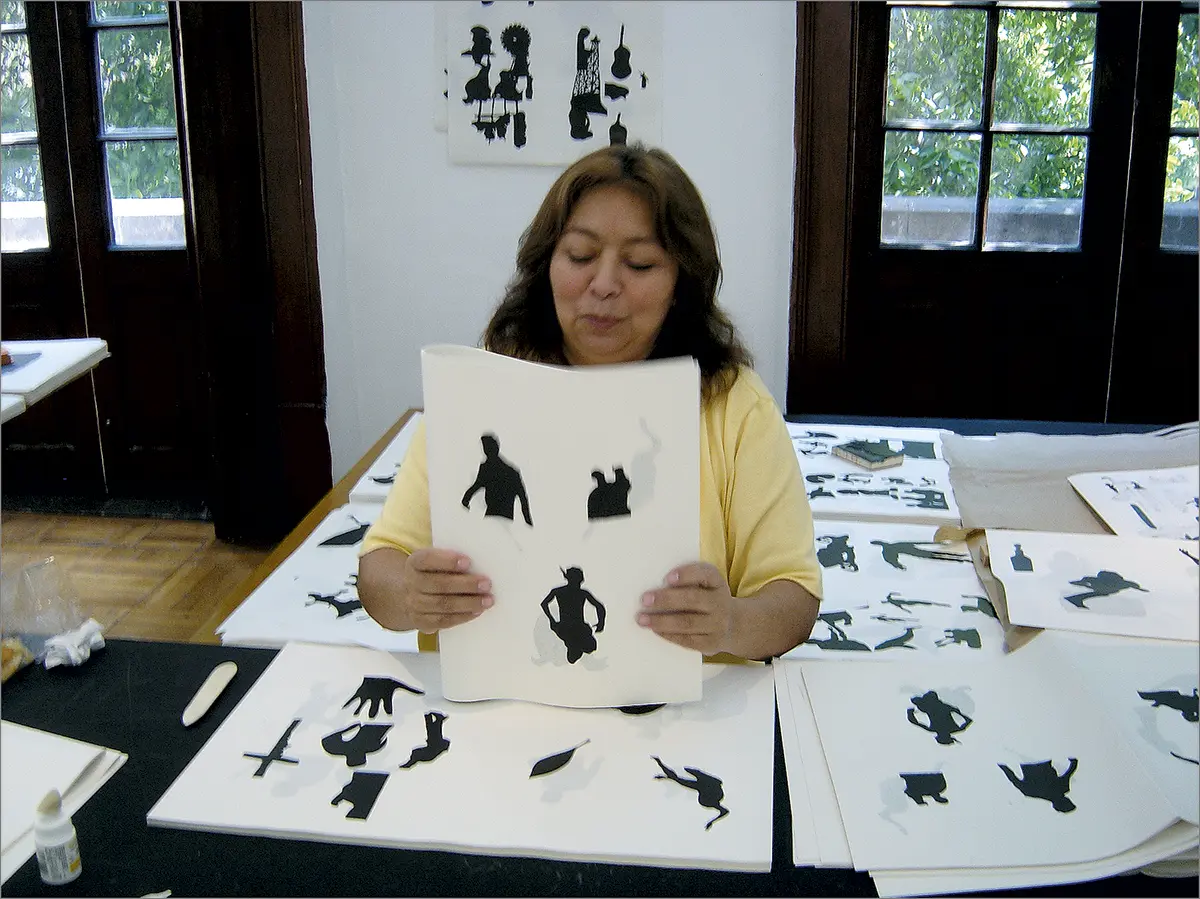
Particularly interested in revealing the mechanisms through which some contemporary discourses are structured, Beltrán presents the viewer with a series of questions and concerns that do not cease insisting and moving in the same conceptual direction: who selects and organizes the images, and how? To what specific ends? Which of the many images should be taken as true? Which ones should be rejected, and which ones should be signified?
In the intent to show the audience the process of creating his personal encyclopedia, the artist transformed each of the gallery spaces into a kind of graphic workshop. At the same time, a different concrete activity took place in each gallery, with the goal of the Enciclopedia, an artist book published in a limited run of 150 copies.
To carry out the various steps in the production of this visual compendium, Beltrán organized a large group of people who, following his guidelines, collaborated in different activities. As a first step, one of the gallery areas became a workshop where, without interruption, the artist and his collaborators gathered and transferred to linoleum a myriad of images taken from the most diverse sources: catalogs, the press, the internet, advertisements, books, booklets, photo albums, and magazines, among others.
A second space remained occupied by all the instruments, materials, acids, glues, and tools required to transform the captured images onto metal printmaking plates. Inside the third space, a power saw was installed where the moveable linoleum blocks were mounted on wooden supports, which the artist trimmed with the saw to prepare them for printing. For this final task, Beltrán brought into the first floor of the gallery a nineteenth-century Chandler press, maneuvered by a worker from Imprenta Payol, who remained in the building until every page for the first copy of the encyclopedia had been produced. The painstaking processes of selecting the printed materials and binding them were also part of the on-site production.
Visitors to the exhibition were able to observe the different phases of the project, as well as the various objects that emerged from its execution. These included the Peinazos, wooden furniture conceived to hold metal plates, printed materials, and moveable type; a diorama slideshow titled Stock, showing an intermitent and vertiginous sequence of images; the Negativos or plaques of cromalit film; the series of linoleum moveable types arranged along the walls; and another group of zinc plaques organized in shelves. Also significant is a group of works titled Universo, comprised of large pieces of cut linoleum that the artist salvaged and transformed into two-dimensional works.
Finally, there was the graphic encyclopedia, on the pages of which were displayed a flood of images tirelessly selected and worked over by the artist.
Confronting the current, merciless avalanche of images transformed into power systems that articulate and sponsor messages of, among others, a political, cultural, institutional, and ideological nature, Enciclopedia reveals that discourses, whatever their character or texture, are the product of a specific deliberation that applies pre-established definitions and criteria in order to provoke constant tensions and reactions in the viewer.
MARTA LIAÑO