
In 1989, two movies were released with the title Black Rain; both were set in Japan. One, directed by Shohei Imamura, showed the slow and devastating decline of the victims of the radioactive “black rain” in Hiroshima, four decades after the United States dropped a nuclear bomb on that city. The other movie told the adventures of two New York cops as they went after the Yakuza, the bloodthirsty Tokyo mob.
It could be viewed that the second film deployed obvious tactics to ensure its dominance in the minds of the public. The renowned filmmaker, Ridley Scott (who had made the films Alien and Blade Runner,) cast two Hollywood sex symbols, Michael Douglas and Andy García. If anybody were to ask about Black Rain, 1989’s “Japan” film, people would not recall Imamura’s work.
The mass-culture industry encourages the forgetting of the transcendent in human experience. This movement is examined by artists who are committed to the reconstruction of our societies’ historical memory. Javier Cambre is a standout among them.
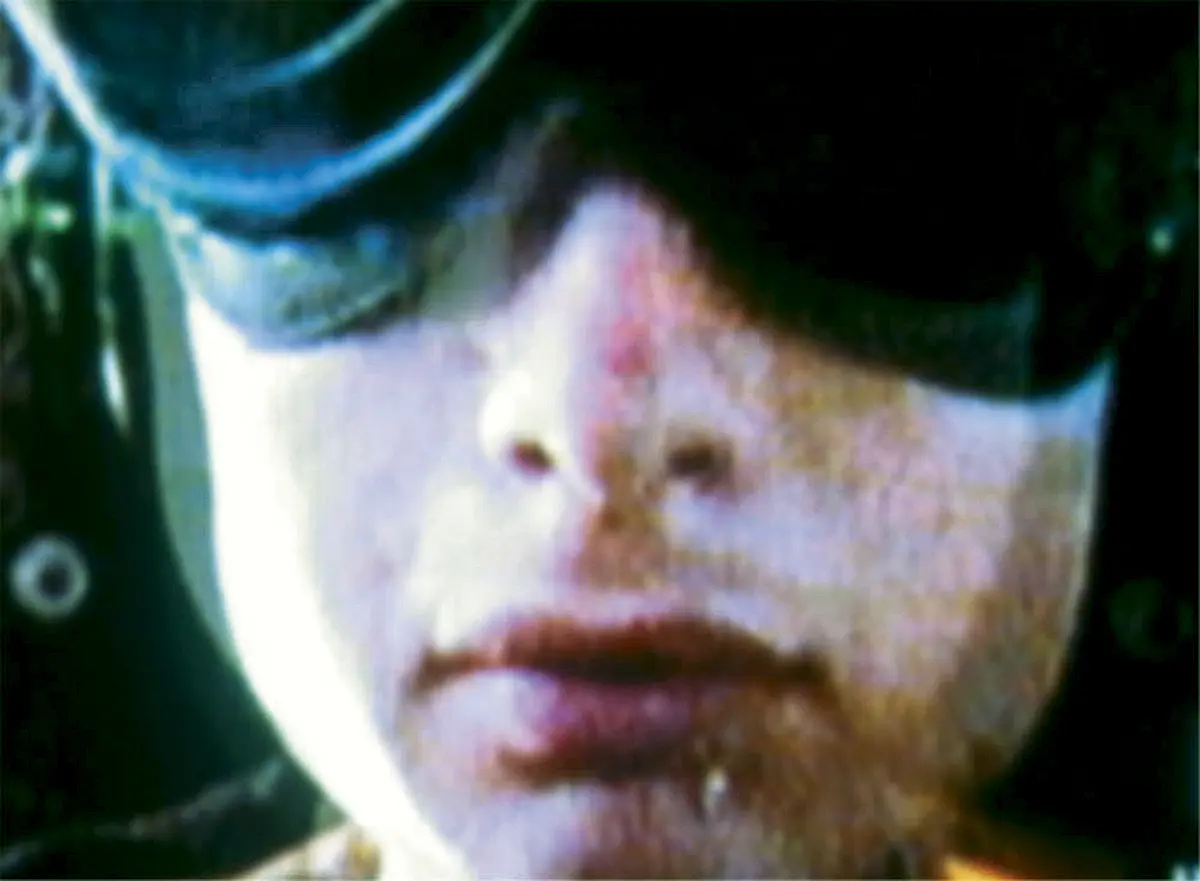
For example, Godzilla, one of the pieces in his first individual show in Puerto Rico, is a video that mixes shots by the author with fragments of Imamura’s Black Rain and sequences from documentaries made for American TV on war and the armed forces. What results from the manipulation and editing of such sources is a dramatic amalgam denouncing the horrors of modern barbarism.
Cambre takes advantage of the fact that the original Japanese film was made with strongly contrasting values in order to saturate the images (metaphorically burning them) and bring the whole into harmony. On this aesthetic basis, he allows himself to introduce scenes from this side of the globe. The piece’s title engages ironically with the tactics used by Hollywood’s publicity machine. It refers to a Japanese “monster” digested by US mass culture—the baseball player Hideki Masuki, of the New York Yankees, was nicknamed “Godzilla” because of his ethnic background—while revealing the true monster.
Two more videos and a sculpture complete this exhibition, Cerca de la Puerta del Sol, at Galería Comercial in San Juan. Paseante is a seemingly idyllic tour with the architect Marta Serena Colón of some emblematic buildings of Heinrich Klumb’s “tropical modernism” at the University of Puerto Rico. Onto this footage, scenes are superimposed, in flashback, as assaults on the memory of these spaces: archival images of protests, police interventions, shootings, and explosions that took place in the idealistic environment of Modern rationalism.
Cambre’s interest in architectural spaces is not random; he studied environmental design at the University of Puerto Rico (1993) and architecture at the Universidad Pontificia Bolivariana in Colombia. In fact, Paseante has been occasionally exhibited as an installation in the form of an acrylic box inside which the video is projected, as seen in the exhibition “None of the Above,” at the Museo de Arte de Puerto Rico (2005). This time around, Cambre presents another paradoxical construction. Modelo (Terragni) is the never-realized project for Il Danteum, a building/monument to the Divine Comedy commissioned by Benito Mussolini to the Italian modernist architect Guissepe Terragni (1904–1943).
The video from which the exhibition takes its title explores the tension between documented and fictitious history. Cambre presents the marginal world that exists in central Madrid, steps from Puerta del Sol. Prostitutes, beggars, gypsies—characters undesirable for representing a society—pose for the camera or are captured in flagrante delicto, as if the artist were a paparazzo and they, his prisoner celebrities.
But Javier Cambre is not Ridley Scott, and neither are poor people the sex symbols of the day. Nothing seems to stop the hardship, their “black rain,” that they endure daily from overcoming them, like those washed into the inundated streets of New Orleans.
ELVIS FUENTES