
For many visitors, the retrospective exhibition of the work of Argentine-Panamanian artist Juan Carlos Marcos, curated by Alexandra Arias and shown at the Museo de Arte Contemporáneo in May of 2005, was a real discovery. On one hand, until now only a limited audience was aware of the long and fruitful career Marcos had developed as a painter, although he is amply recognized for his contribution to advertising in his adoptive country. On the other hand, there have been few opportunities in Panama to review the lifetime artistic production of a particular creator with the benefit of a parallel publication. The book titled The Life and Work of Juan Carlos Marcos by this author offers a detailed view of the artist’s biographical and stylistic development and is part of the editorial project headed by Alexandra Arias, which together with this singular exhibition, makes a lasting contribution to the art history of this nation.
The exhibition begins with a self-portrait from 1946, an image that reveals not only a believable resemblance but also noteworthy handling of chiaroscuro, of light and color, and of the spatula, all proof of the promise shown by the young artist. The retrospective follows a chronological course that allows visitors to become acquainted with the diverse creative stages in Juan Carlos Marcos’s life, which has been richly nourished by his numerous moves around the world. In the first exhibition room covering the period through 1964, there are examples of early works, such as his watercolors of ballerinas painted in Argentina, which are followed by paintings that reveal the influence of Informalism, created by Marcos during the enriching student years he spent in France and Spain. They are impressive semi-abstract compositions with dramatic surface textures and subtle, earthy colors that convey a primitive feeling.
The following section of the exhibition goes as far as 1986 with paintings Marcos created in Chile and also in Panama, where he arrived in 1965 to present a show at the Instituto Panameño de Arte, the parent institution of the Museo de Arte Contemporáneo, making the current retrospective the closure of a historic circle. In this period we find completely abstract works of squares within squares, many of them white and others dominated by strong hues of red or yellow. In spite of the now larger format of the canvases, the artist employs minute brushstrokes that produce textures and combine to create large areas where color is the clear protagonist. There is more abstraction in later works, in which Marcos employs trompe l’oeil to create the impression of cut canvases or geometric forms that protrude and recede within the compositional space.
If the initial part of the exhibition exudes a sense of peace through the spacious arrangement of the painter’s early works, the first hall in the Museum’s upper floor clearly announces changes in the artist’s career with a sampling of square paintings from the series titled Altars of Light to which Marcos dedicated several years. Each composition was developed on the basis of the previous one, passing progressively from geometric abstractions to figurative realism. The initial pieces were covered bit by bit with pages from newspapers, which Marcos reproduced in hyperrealist detail. When the newspapers occupied the whole surface, the artist painted a tie and shirt, and later a piece of yellow cloth, then over the cloth, a traditional still-life, and so on. The series ended up including over twenty paintings, each one generating the following one.
The next room is smaller, set up like a mini-museum of small-format paintings created by Marcos over several years, among them a series of successful and even entertaining self-portraits in which the artist uses his face as a site for self-mockery, with plumbing pipes that emerge from his eyes or mouth, an electrical outlet on his face, or the round, red nose of a clown.
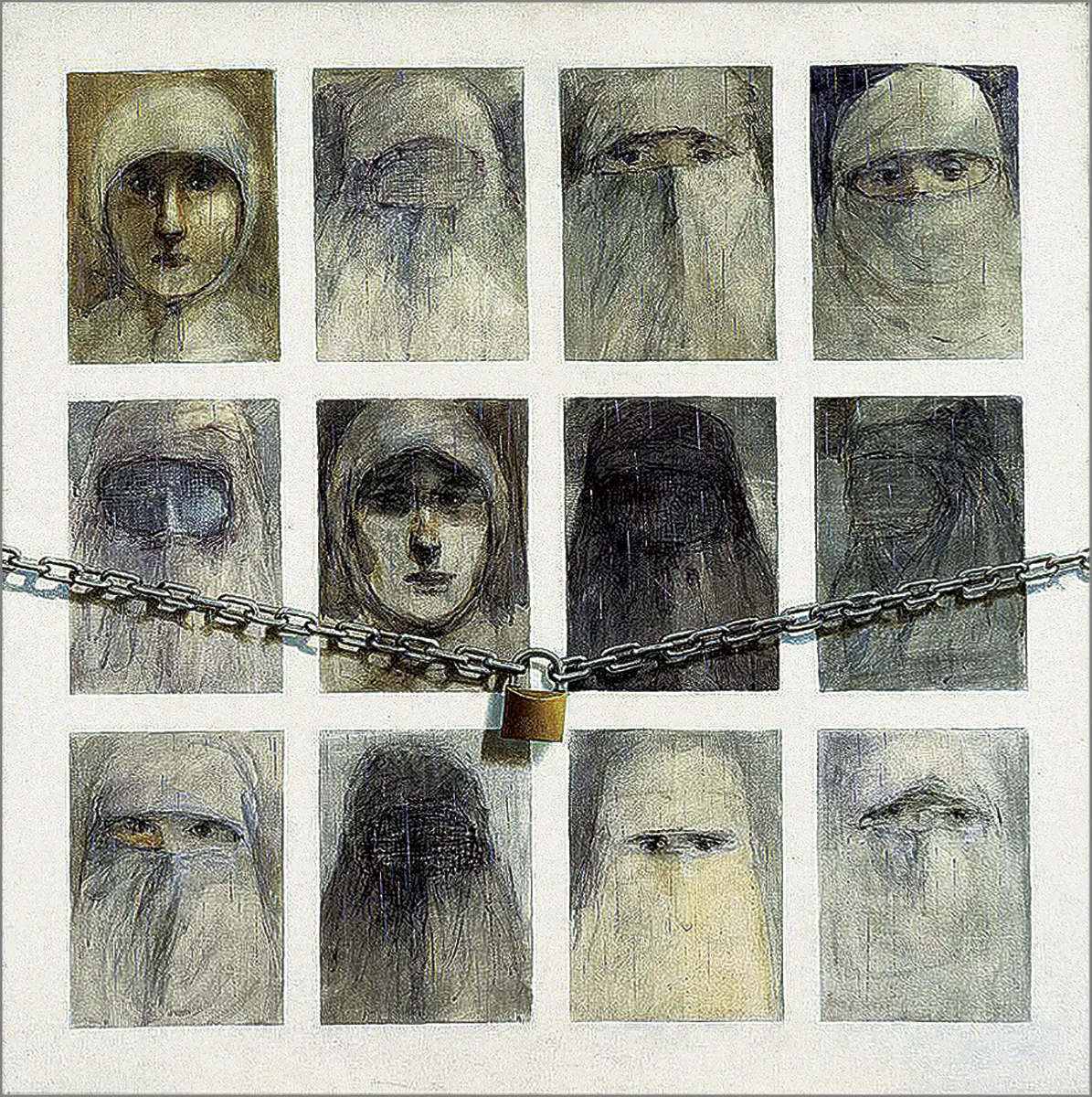
The last great exhibition hall—full of color and human figures—displays a great number of large-format paintings created between 1993 and 2004. It was a period during which Marcos concentrated on the creation of realistic figurative works, with noteworthy craftsmanship, characterized by surrealistic interpretations, sociopolitical commentary, the successful recreation of the human body, and a considerable sense of humor. Among other things, Marcos returned to academic tradition in his studies of nudes and the careful reproduction of still lifes, as the base upon which he has built his own visual language. An admirer of the great masters, he has never felt completely satisfied with his achievements, a condition that has pushed him to continue searching. In the process of this search, he has achieved an oeuvre that is impressive, both for its creativity and its masterful technique.
MÓNICA E. KUPFER