
The Lyle O’Reitzel art gallery has been characterized for a long time for its promotion of Latin American and Caribbean art in Santo Domingo, a direction now confirmed by this exhibition of works by Cuban artist Luis Cruz Azaceta, which reiterates some of the aesthetic and iconographic constants of his work while introducing some variations in terms of, more than concepts of meanings, his images.
What is clear in the first place is that Cruz Azaceta’s show is one more demonstration of the way in which visual signs belonging to the Western artistic tradition or to other cultures, or those belonging to the contemporary period, acquire different functions and meanings in the context of our continent’s art. Elements taken from 1960s Pop Art and Op Art, or even Klimt’s modernism and the Orphism of the Delaunay’s (for example the circles repeatedly present in the background), assume, without losing their decorative ones, connotations related to a reading of planes that sacralizes the figurative element. This element, isolated from all empirical spatio-temporal reference, from the concrete world of perspective, like the saints against a gilded background of the Middle Ages, enters the realm of the mythic and the timeless.
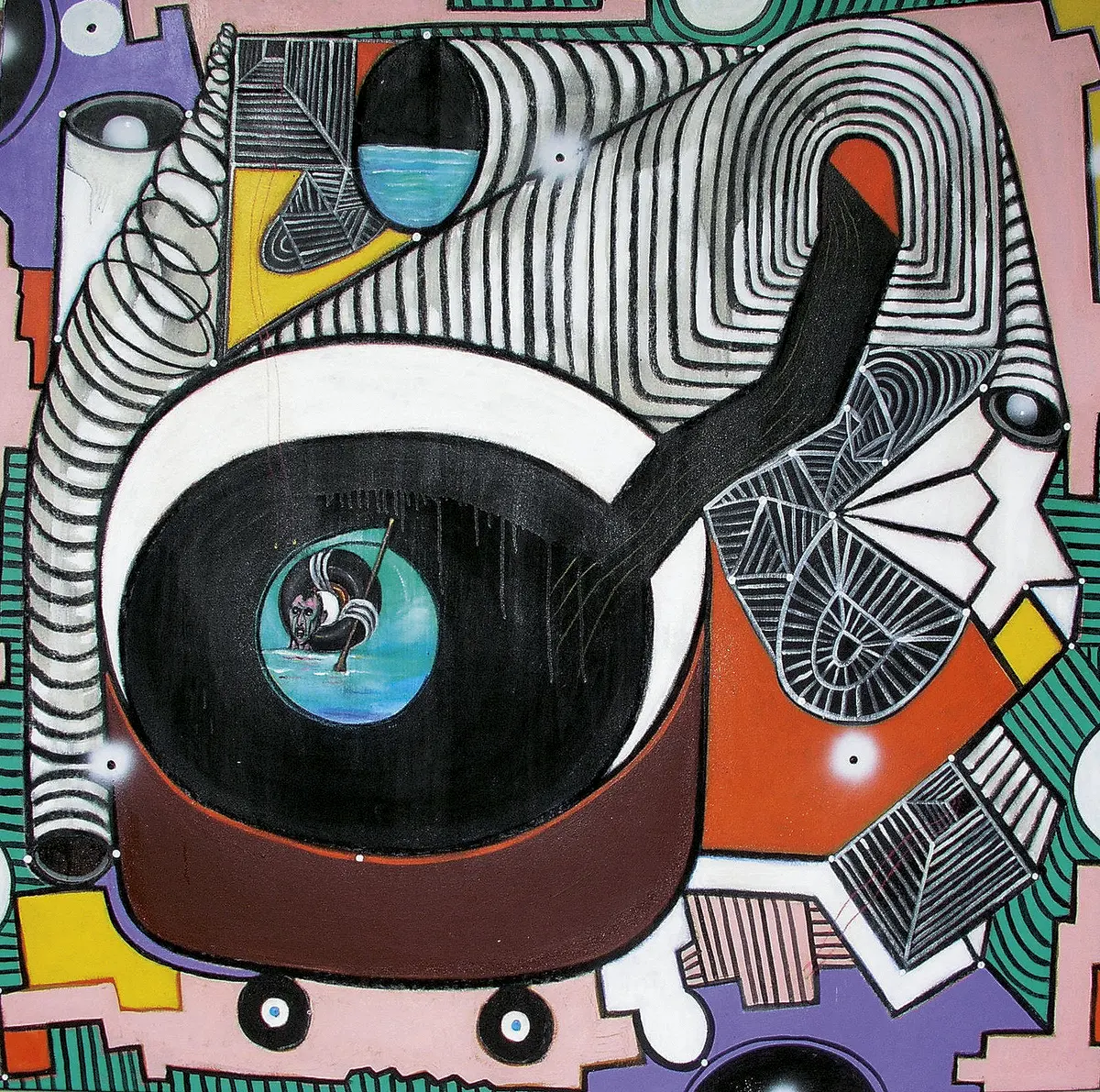
In this way, Cruz Azaceta approaches the contemporaneity that is closest to him, the drama of Cuban balseros, and deciphers it in a mythological key from a point of view that is much more universal than local, the point of view of the mythic voyage as an archetypal plot, with all that deep psychology, anthropology, and the hermeneutic of symbols have to say about it. Images of piracy, symbolic portraits created using objects, and an aesthetics of accumulation that could be seen as a reference to the Baroque and to the industrial context and the mass media, contribute to the definition of a pictorial language of complex references and multiple readings.
On the other hand, this is a body of work rich in color, situated beyond the dichotomous conceptualizations that posit figuration and abstraction as mutually excluding options. At times, in this painting in which talking about form and substance as absolute instances and not as interchangeable terms is equally absurd, the figurative image assumes the function of pictogram, and the symbolic density is so extreme that the character of pictorial icon and writing also become interchangeable.
In almost all instances, composition and graphics, and even chromatic juxtapositions, provide the images with a peculiar dynamic sense, although, paradoxically, the stoppage of the flow of time is also a constant and there is something of stasis in some visions that could also be spoken of in terms of psychedelia. At times, the face of a balsero-pirate rises up and is monumentalized like a sacred image, like the face of Christ in Roualt or the Holy Shroud.
In all cases, the point is to sacralize the concrete, history, to find once again the mythical and the timeless in today’s dramas, almost between journalism and myth, in the in-between, exact place where life is located.
LAURA GIL FIALLO