
Throughout her career, María Cristina Cortés has shown an intense interest in the topic of landscape, and this has allowed her to produce a wide-ranging reflection around light’s changing values. In her recent work, titled Matemonte, she once again explores an atmospheric, dense, and shadowy landscape, now in order to emphasize the possibilities of the outline, of the line, of graphics, and to continue alluding to the relationship between culture and nature.
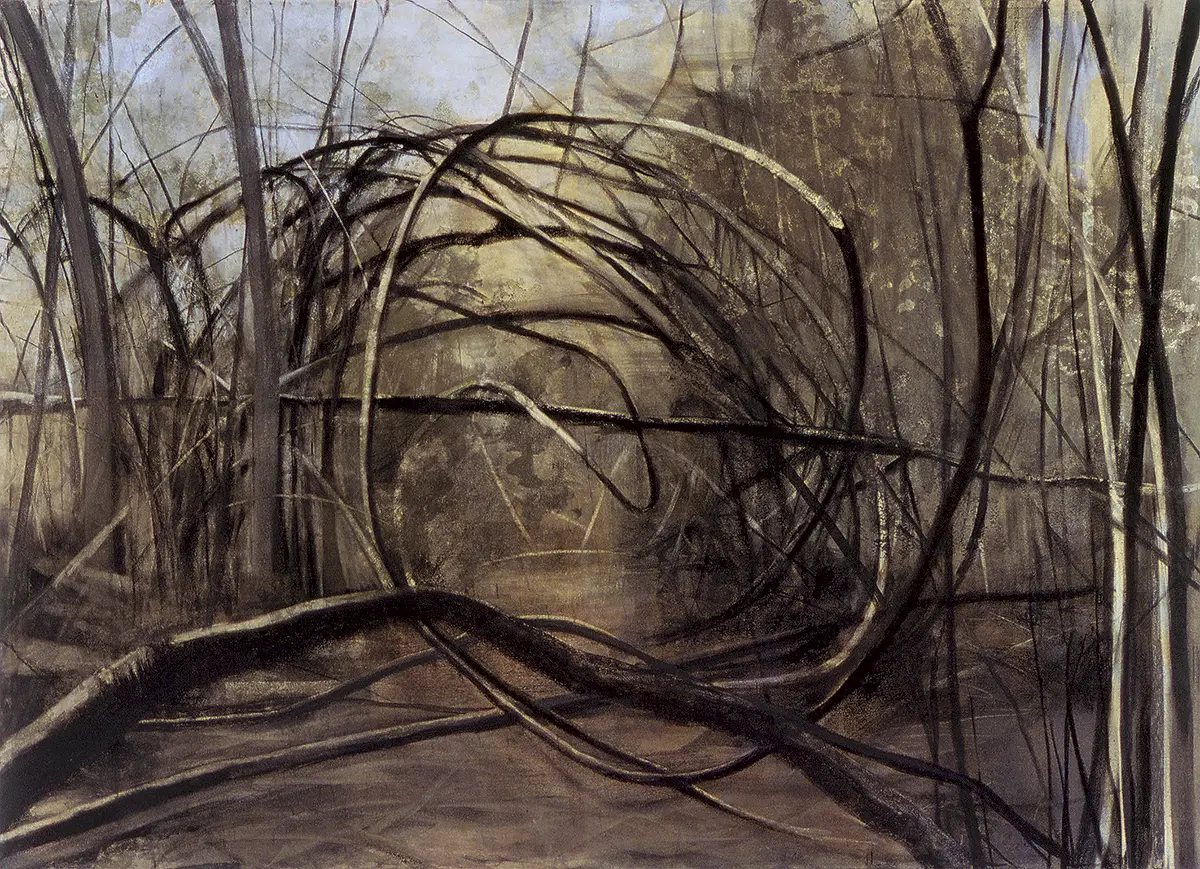
Sometimes in these mixed-technique drawings on canvas, the classical perspective of landscape painting is made explicit; in them, the graphic marks that appear in the foreground refer to entangled tree trunks, behind which there stretches a deep, humid space. In other works, there is also an atmosphere but depth is not explicit, shadows flatten the space, and in those cases, Cortés’ lines lose their connotation of tree trunks and come to us as organic lines intent on generating tensions on a plane. And it is this intention to draw, beyond representing, where her work becomes stronger and more incisive.
Drawing is a human act that has persisted throughout the history of art from the earliest times. There has been talking in art-history circles of “the death of painting,” but never, to my memory, has anybody mentioned “the death of drawing.” Drawing is a millennium-long medium that, through one gesture, expresses thought directly, in a spontaneous or premeditated way, and makes our intentions visible. Artists, be it conceptual, abstract, or figurative, have used drawing to plan work or to create a final work, and whether in the former or the latter case drawing effects upon those who see it a peculiar attraction.
María Cristina Cortés’ work has been closer to the values of representation than to those of “conceptual” art. She belongs to a generation that marked a point of departure in Colombian art: some blazed a trail towards contemporary practices, others adhered to the values of modern art, and she opted for the second path. Faithful to her precepts she is seriously committed to a poetics that remains close to impressionism and to “good modern painting.” Since 1998, however, María Cristina Cortés has been concerned with topics related to ecology, which brings us to that conflicted relationship between nature and culture. As Ivonne Pini points out in the show’s catalog, this conflict is showcased in this period of her work, as an inhospitable nature, an entangled and asphyxiating landscape is presented.
Beyond the issue that motivates her, these canvases are an excellent exercise in draftsmanship. Beyond Man’s conflict with nature, they are suffused in the will to compose using lines a surface that for some strange reason puts me in mind of Santiago Cárdenas checkerboards. Those paintings that deceived us, that made us think we were looking at a green board, badly erased, but were, in reality, nothing but excellent paintings that allowed the expression of a great draftsman to shine through. In the case of Matemonte, as happens with Number 21, Cortés’ lines can be representation, they can be part of a landscape in conflict: dry branches, interwoven trunks; they can also be lines that project shadows, alluding to a more or less precise figurative space, or they can be perceived as abstract compositions in a two-dimensional space. Whether from one perspective or the other, this weaving of lines brings to the fore the pleasure and power f good draftsmanship, a product of a human gesture that wants to leave its trace on any surface in the world.
MARTA RODRÍGUEZ