
Galería de Arte Mexicano first exhibited the work of María José de la Macorra in 2001. The show De las Geografías al Norte Interior already presented an author with very clear ecological concerns, especially related to water and to changes of state between the different elements.
De Nubes y Lluvia / Torres de Agua brings to the public the work of a well-informed author who carries out research that results in particular propositive works in terms of her use of materials and the ways in which she combines the languages of cartography and pottery, wire mesh, and even chaquira beads, materials all that refer to key moments in the life of the nature here evoked.
For the last two years, María José de la Macorra has been especially interested in installations and the way they relate to both the space that contains them and the viewers they confront. These installations include within themselves very clear references to exteriority that, brought into the exhibition space, acquires the character of a compilation of formerly open-air elements such as mountains, water, clouds, and even, when she makes reference to human beings, she does this deconstructing the figure and offering evocations of organs (stomach, intestines, genitals, etc.), in a relationship of vulnerability with weather events.
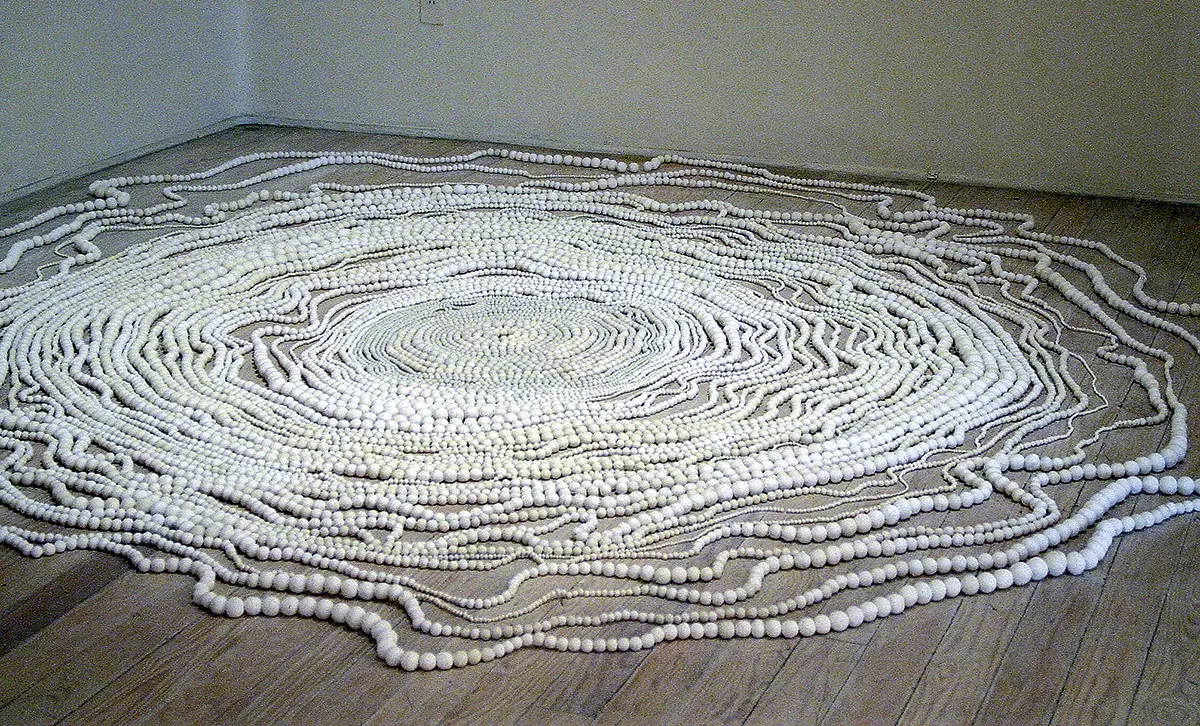
The show greeted visitors with Spheres within spheres, De la Macorra’s reconstruction of an imaginary aerial view of the volcano known as the “Pico de Orizaba,” highly representative of Mexico’s Veracruz region. This work makes a forceful impact thanks to the materials it uses and the way in which De la Macorra expresses her relationship to this mountain. Formed by long, meters-long ceramic-bead necklaces arranged in circles on the floor, the workplaces us, when we stand next to it and see it from above, in front of a mountain from which a kind of x-ray has been taken to reveal with great precision its representation in those maps that, on the basis of graphic codes, give us the different heights, levels, terraces that we now infer on a floor work revelatory of volumes nonexistent within itself.
Regarding this series of works, the artist has said that “the mountains are like centers that protrude in our terrestrial geography; the Citlatépetl or the Pico de Orizaba is for me a geography parallel to (mythical or imaginary) Earth’s geography, corresponding to an imaginary landscape related to structures of our consciousness or a mythical memory.”
Something similar occurs with the clouds De la Macorra placed in one of the gallery’s walls, which are human body parts arranged floor to ceiling. This museography recreates a kind of sky populated by body sections, and it is a sky we can see from our vertical position as we walk through the show. Just like we see the mountain as if we were flying over it, we see this sky as if we had it, like a horizon, in front of us.
Rain marks an important landmark in María José de la Macorra’s work, from the point of view of her handling of time. If with other works we intuit that the course of nature is something in constant movement, with this work we perceive that instant, of which we are now privileged witnesses. The flux is frozen, and, at the same time, it becomes clear that rain falls eternal.
The interconnectedness of all the elements of nature with the components of our contemporary representation helps us find in her oeuvre evocations of emblematic works, such as Kanagawa’s Great Wave, a model of representation that has been entirely assimilated into our cultural references when it comes to pointing out the strength of nature, its constant flow, its simultaneous fragmentation and reconstitution as that which, like us indeed, is always being.
SANTIAGO ESPINOSA DE LOS MONTEROS