
Thanks to her work as a producer, coordinator, and designer of exhibitions and cultural events, Teresa Govea has been sensitive to the art world and close to the creative process for more than a decade. Her quests have taken her to disciplines such as modeling, jewelry-making, photography, and video art. Self-portraiture also has been a recurring theme in her artistic production. In previous pieces, such as Juegos didácticos atemporales #01 (1999), exhibited in the 4th Pirelli Young Artists Salon at the Museo de Arte Contemporáneo de Caracas Sofía Imber, the artist builds a structure of bones as a replica of her own skeleton. Wrapped in gold leaf with added elements like a metal mask, razor blades, pearl beads, and other accessories, this proposal is evidently linked to her practice as a jeweler during the 1990s.
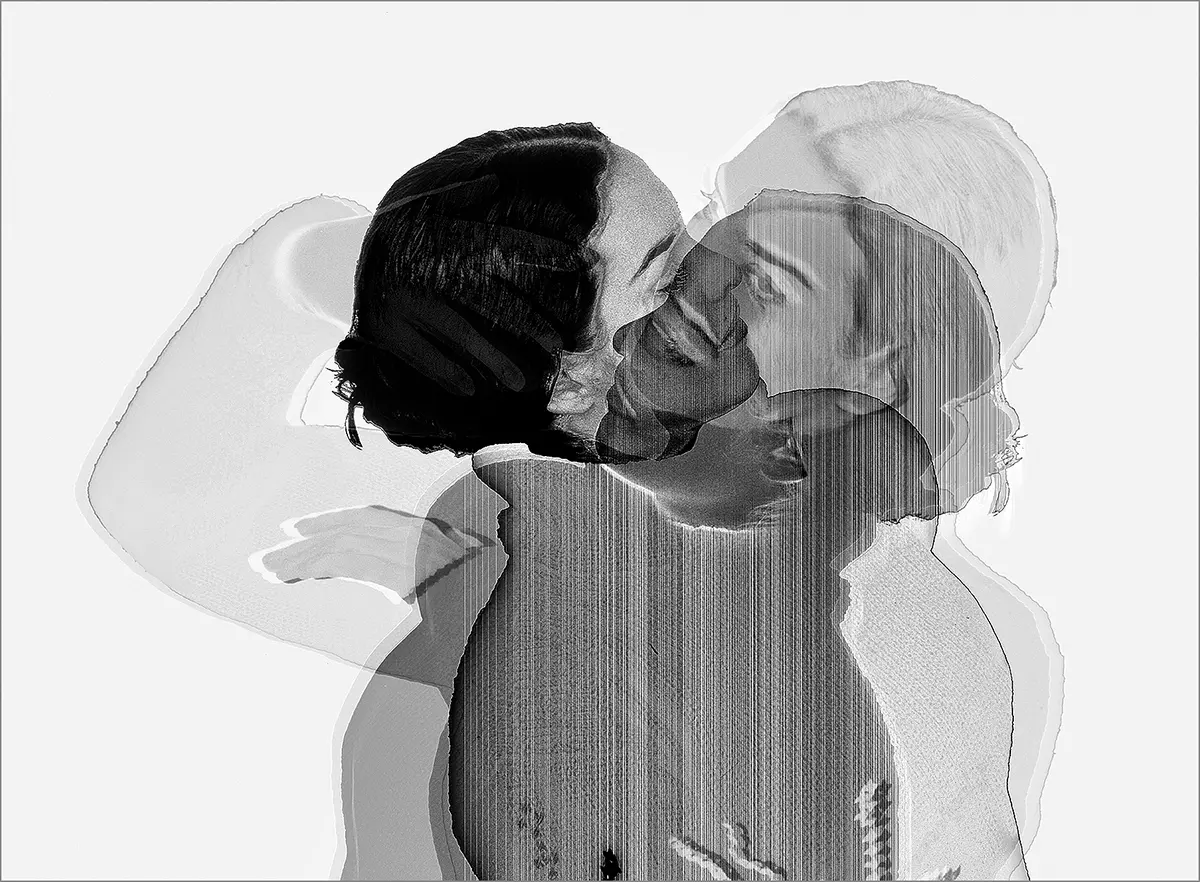
In her recent show at Sala Alternativa in Caracas, titled Blink, the artist presents works created in the early months of 2005. Now with a photographic technique, the artist pictures herself as a half figure in the quiet of her study, as if exorcising herself through the experience of art. Govea tries several poses in front of a conventional camera lens, in a 6 x 6 in, format on black and white film, to register different angles of her own figure. In this way, she obtains images that seem to break down into subtle gradations and are disarticulated from each other by a variety of screens and textures. The clashes of opposed colors, the successive superimpositions, the gradations, and the focusing and unfocusing, propitiate harmonious contrasts between density and transparency, between blurriness and neatness, through which she achieves an interplay of visual forms. In works like 20/3 G-M, the figure unfolds to form a maze of intricate outlines that transform the compositional nucleus into a rich scale. In other pieces like 3/3 G-M, 5/3 G-M, and 6/3 G-M the positive-negative relationship creates a duality that breaks with the traditional meaning of the self-portrait as a genre that defines an individual’s characteristic expressive features. In contrast, Govea creates a representation of translucent consistency where the image emerges in different aspects, trying to impose itself on the plane.
Govea’s language reduces compositional elements like line, shape, and color to their minimal expression; this allows her to amplify her plastic resources and transform them into eloquent visual and conceptual meanings. Her celluloid prints, framed between transparent acrylic sheets, become incursions with surprising results, giving photography a new plastic dimension. The show’s design is in itself a part of the whole proposal because the works are arranged on white walls separated by a distance of a few centimeters, and in this way achieve an effect that greatly enriches their content.
Her twenty-eight small- and medium-format pieces distributed around the gallery space highlight the protagonist figure of these compositions, due to the fact that the whole set—work, frame, and arrangement—is able to incorporate, in a dynamic sense, the museographic environment. The images, which simulate their materialization and dematerialization in a register of static vibrations, suggest the projection of a film strip that appears to have stopped its run for an instant or two.
The force of her discourse resides precisely in the simplicity of the composition because Govea liberates the figure from any visual background or landscape that could interfere with the representation she wants to make of the character. That figure transforming itself in a process of decomposition and re-composition is in essence an allusion to the passage of time, which ultimately always points towards the present moment as a sole palpable reality. Luis Ángel Duque, the curator of this show, says this: “Blink acquires great resonance because this enigmatic artist reconciles the concept of the fragment of time and the decantation of artistic means used throughout the history of art—from oil paint to video art, from film to photography—with the final resolution of her work in stroboscopic black and white images in which she exposes herself in self-portraits as a contemporary beauty in whose eyes we remain trapped for a fraction of a second...”
GLADYS YUNES YUNES